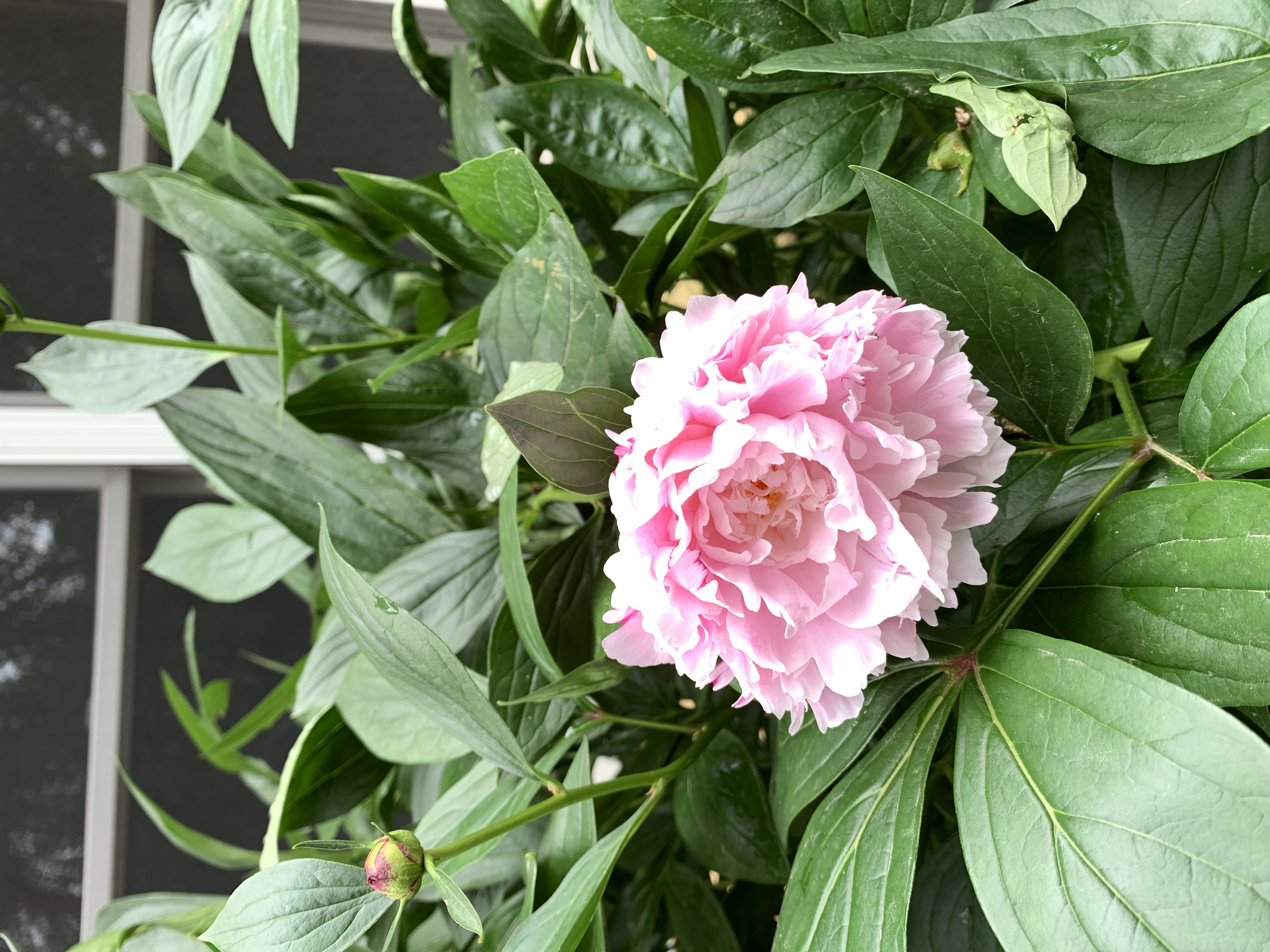
Once when I was about eleven, my friend and I were walking to Mass at St. Mary’s Catholic Church when we realized we had forgotten our chapel veils. These circles of lace were mandatory as head coverings for girls at Mass. What to do? We spied some flowers growing next to the sidewalk and picked a couple. We fixed them in our hair and went along to Mass. Almost immediately, something was crawling on my neck, down my shirt and all over me. Ants! We had picked some peonies and the flowers, as peonies are wont to do, were filled with ants. And the ants weren’t happy about being in our hair. We left as soon as we could, but the damage had already been done.
I used to think that those big tight buds needed the ants to open the flowers. It turns out that although the peonies have a mutualistic relationship with the ants, it’s not to open the flowers. The ants are running a protection racket. The currency is nectar. At the base of the bud are structures called nectaries where the plant produces a kind of nectar that the ant particularly likes. This nectar has a different formula than the nectar that will be produced inside the flowers for the bees to enjoy. Its sole purpose is to feed the ants, so it’s made with the sugars, oils, amino acids and proteins that the ants want. When the ants discover this sticky nectar on the peony plant beneath the buds, they put out a call via pheromone trails to bring their friends and relations to the party. If other insects encroach on the ants’ territory, though, they will fight them off. In exchange for protecting the plant, the ants harvest the nectar.

A black ant stands guard on a ball-shaped peony bud. Author photo.
The common peony, (Paeonia lactiflora), also known as Chinese peony, is a perennial native to Central and East Asia. It’s one of a member of the peony family (Paeoniaceae) and its species name is Latin for milk-white flower. It is herbaceous, producing new foliage in the spring, and dying back in the fall to its roots to overwinter. Its leaves are six to eight inches long and about two inches broad, and it grows to about three feet tall. Its flower buds begin forming in early May at the tops of the stems. On Owl Acres, they bloom extravagantly around Memorial Day.
Chinese have been cultivating peonies for over 3,000 years and celebrating them in paintings and poetry. They raised both herbaceous peonies like the common peonies on Owl Acres, and tree peonies. The common peony made its way to Europe in the Middle Ages and was introduced to England in the 1800s. P. Lactiflora got a foothold in the United States in about 1885 when its popularity crowded out P. officinalis, a European species.
Two species of peonies are native to the United States. Their flowers are not as showy as the imported versions, and these native plants aren’t generally used in our gardens.
Peonies have a long history as medicinal plants in Asia and southern Europe. The roots were harvested in China and are still used in both Chinese and western herbal medicine. The Greeks and Romans also cultivated peonies for medicinal purposes. The roots of the peony are used for everything from menstrual cramps, rheumatoid arthritis and psoriasis to coughs, epilepsy and aging skin.
When I built my house on Owl Acres, my friends Lisa and Louise came with plants from their gardens to help me start mine. We planted irises, and day lilies, hostas and ferns, and two peony bushes harvested from Louise’s yard. Louise is gone now, but each spring I am reminded of her in these beautiful flowers. So just before the flowers open, when the buds are about as squishy as a marshmallow, I will pick a bouquet, rinse off the ants, and watch them open in splendor.
Feature photo by Author. Alt text: Large pink flower stands out from dark green foliage. Peony blossom has dense, crepe-paper-like petals that form a soft ball atop a short stalk.
4 comments
Beautiful flowers, great info, and a nice remembrance of your friend Louise, Karen. Thanks. – Joe
I don’t usually bring bouquets into the house, but I made an exception for these.
I really enjoyed the church story. Peonies are my favorite flower. Unfortunately, my peonies have started to decline a great deal the past few years. They are very old. We bought our home in 1975 and they were here then. There were probably 8 of them when we bought the house and we’re down to 3 now. Only got a couple of bouquets this spring. I fear in a year or two they will all be gone.
They are beautiful flowers. Maybe you have a friend who would share?