May is the busiest month for spring migration. Here on Owl Acres, we’ve been keeping track of our visitors using the Cornell Lab’s Merlin ID. Each morning I stand on the deck overlooking the back yard and woods and let Merlin capture the soundscape and name the birds. A second session from the front porch yields the birds in the less dense trees in the front yard. The Merlin app hears better than I do, and helps me recognize transients as well
At the beginning of May, an intriguing little bird joined the sing-along with a cheery tune that varied quite a bit. Merlin identified it as an American redstart.
Classified as a wood warbler, the American redstart joins some 50 other members of the New World warbler family officially called Parulidae. These little songbirds are generally bright-colored with patches of brilliant yellow, orange, green, blue, or chestnut. Most of them are named based on one of three criteria: their coloring (yellow-rumped warbler); their association with a place (Nashville warbler); or their association with or honoring of a particular person (Wilson’s warbler). A few of them have names all their own. The oven bird, for example, is a warbler. In fact, the oven bird is the oldest line of warblers. Our little redstart is another example.
The American redstart, like the American robin, was named by someone who thought it reminded them of a bird they’d left behind in England. Back there, its name came from Middle English with red being a catchall color term encompassing reds, oranges and related colors. The start part started out as “steort” meaning tail. So the old English name was basically redtail. At the same time, little songbirds of varying lineages were lumped into the category warbler, which comes from Middle English ”werble” meaning tune.
Eventually as classification got more precise, scientists realized that the New World warblers were not related to the Old World warblers genetically. That’s when the New World bunch got a family of their own with over 50 member species.
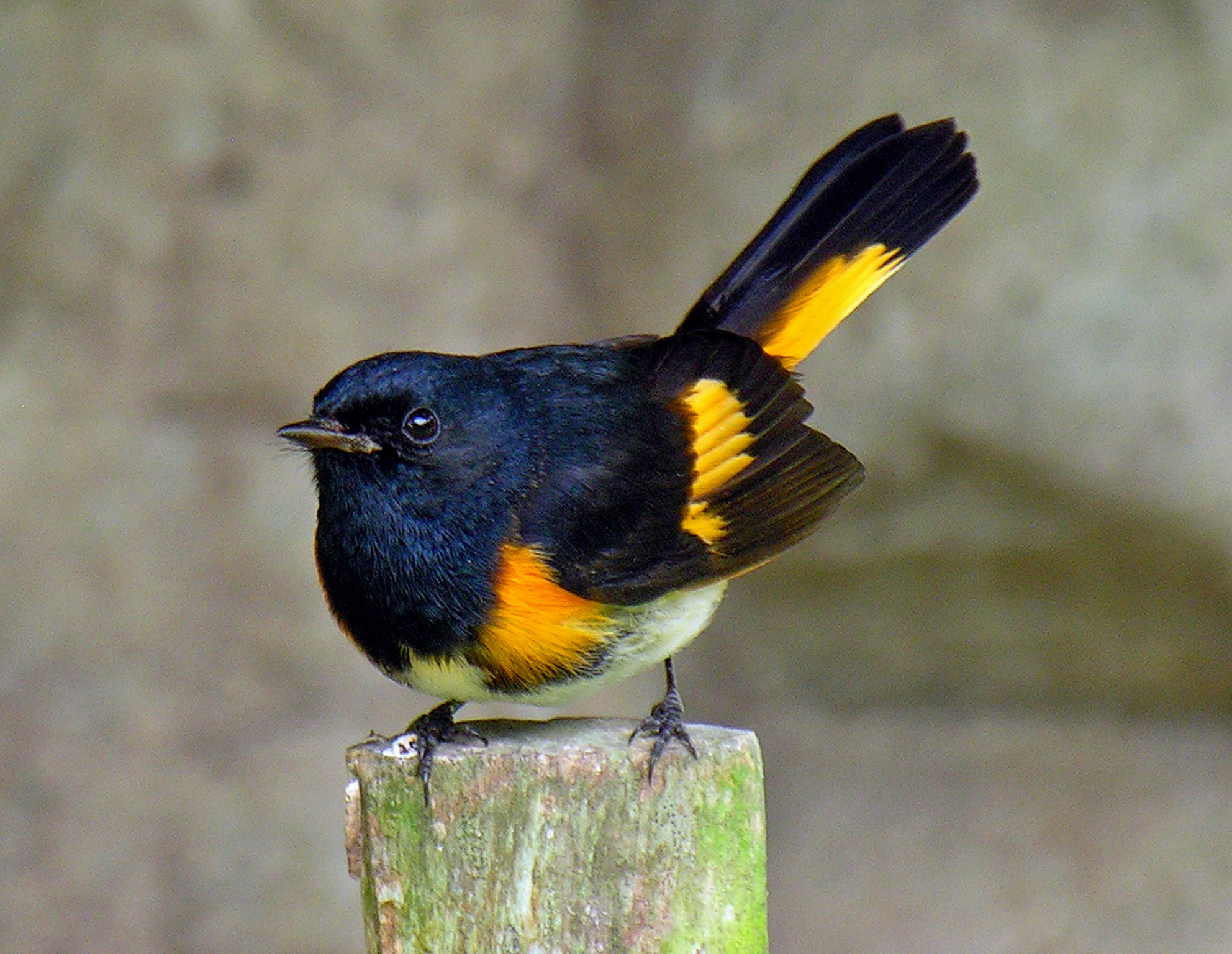
The male American redstart is about five inches long and weighs about a quarter of an ounce. He is shiny black with orange patches on his sides, wings and tail, and he’s white underneath. He arrived in early May after a ten-thousand-mile journey from as far south as Brazil where he spent the winter in a mangrove forest. Here up north, he’s looking for a wooded area where he can claim some territory and invite a lady to join him. He may continue on to Canada, or perhaps he’ll stay around Owl Acres to breed. The females will come a little later dressed in less flamboyant gray with yellow accents instead of orange. Young males look a lot like their mothers so usually have to wait a year to breed. By then they’ll have the appropriate black and orange outfit.
Once a female has chosen a male partner, he shows her possible nesting sites in his territory. She selects one and builds the nest. When the eggs hatch, he helps with household chores such as removing waste packets from the nest and finding food. The pair will divide up the family so that each parent focuses its attention on half of the nestlings.
Redstarts are busy little birds, never seeming to stay still. They are constantly looking for insects in the trees that they can flush out and catch on the wing. The bird cocks his tail and then rapidly spreads the tail feathers to flash the orange feathers in the tail. This is thought to startle the insects nearby into taking flight. At that point the redstart chases them and catches them on the wing.
So far this spring we have identified seven of the American Redstart’s warbler cousins. We’ve heard black and white warblers, yellow warblers, Nashville warblers, Tennessee warblers, yellow-rumped warblers, orange-crowned warblers, and chestnut-sided warblers along with the redstarts, who were still singing here at the end of May.
We’ll keep listening for their songs and see how many more species we can capture before they head back to Brazil for the winter.
Photo from Wikimedia.org by Dennis G. Jarvis