Have you ever watched a bird crash into your window? It’s heartbreaking to see it happen. There’s that thunk against the glass, and then the bird falls to the ground. Maybe it gets up again and flies away, and maybe it doesn’t. 60% of the birds that survive the collision die from it sooner or later.
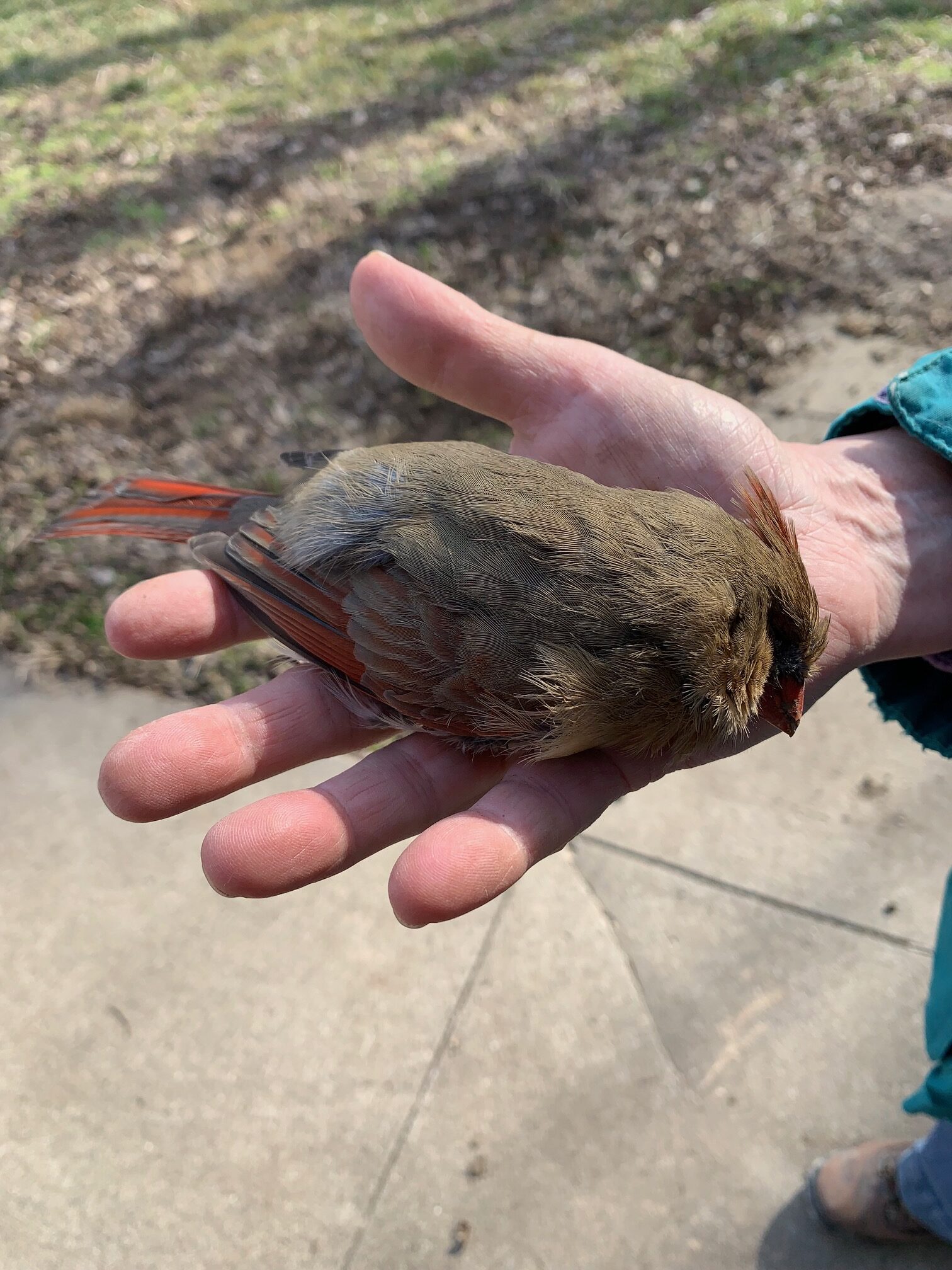
One day last winter, Bryan was trying to get a picture of some birds through the window in my study. The window screen was messing up the picture, so he took it off—just for a minute. Before he could get in place to take the picture, a female cardinal crashed into the glass. She did not survive.
Every spring some 3.5 billion birds migrate from their wintering grounds in Mexico, central and south America to their breeding grounds in northern United States and Canada. And every fall, those birds plus this year’s offspring, some 5 billion birds, fly back south. When you think of it, it’s an amazing feat for these little songbirds that weigh less than half an ounce and fly for thousands of miles twice a year. Those migrating birds play a significant role in the environment. They keep insect populations under control; they help spread seeds, and they entertain us with their song and their antics. Birdwatchers alone spend over $100 billion on their birdwatching activities each year.
Unfortunately, over the past 50 years, the number of birds in North America has steadily declined. We have three billion fewer breeding birds today than we had 50 years ago. Three billion. That’s a lot of birds. The reasons for the decline are complex. Habitat fragmentation and loss account for a lot of the decline. And the more buildings we build, the more green space and forests we convert to cities, the more impact this will have on the birds.
A second, often cited reason for bird decline is our fondness for cats—both domestic and feral, who prey on birds.
Another major factor is glass. A new study from the American Bird Conservancy estimates that over one billion birds die each year from avoidable man-made causes including collisions with glass. Glass poses several types of hazards for birds.
First, there’s light pollution. Lighted windows, lighted signs and beacons, street lights and all the other ways that we light up our environment cause light pollution. Migrating birds are attracted to light and will fly toward it, colliding with window glass that they didn’t know was there. The light pollution in our cities also washes out the stars, leaving the birds disoriented. Birds have evolved a complex of cues to navigate by, and one of those cues is the stars. Studies show that birds learn the night sky and use the star maps to navigate. They get disoriented if they can’t see the stars.
And then there’s the glass itself. Window glass tends to be either transparent or reflective. If the glass is reflective, the bird sees habitat like trees reflected in the glass and thinks it can fly to that reflected tree. If the glass is transparent, the bird doesn’t see it at all and flies right into it. The net result is the same—the bird collides with the glass.
In October 2023, on a single night during the fall migration, a thousand birds collided with the windows of the McCormick Place Lakeside Center in Chicago. This was an extreme event, but brought attention to the fact that on nights during peak migration times, over 700 million birds will be filling the night skies, and lighted-up buildings like McCormick Place are lethal hazards.
Low rise and mid-rise buildings account for 95% of these collisions. Birds are less likely to collide with the tall skyscraper than with a low-rise facility because when they’re coming in for a landing or taking off, it’s the low-rise buildings and their windows that are in the birds’ immediate vicinity. And that includes our homes. 50% of bird-glass collisions occur on residences. And it’s not just the migrating birds that are affected. Our stay-at-home birds run the same risks.
After that terrible night at McCormick Place, the management decided to do something about it. They shaded the interior lights to minimize the light they were putting out. And they installed a prevention system on all of the windows, consisting of a simple grid of little white dots. The dots are spaced two inches apart. Birds see that pattern and think the window is a solid obstacle so they avoid it. They reduced the bird collisions 99 percent using this grid of dots.
So, what can an individual do to help solve this problem and protect our birds? Here are three suggestions:
First, cut down on light pollution. Instead of flood-lighting the back yard, for instance, install motion-sensor carriage lights at the back door. Further minimize your contribution to light pollution by using only the light you need, turning off lights when they’re not needed and shading lights where possible.
Second, if you have a bird feeder, place it either three feet or less from a window, or 30 feet or more from the window. If it’s very close to the window, the bird won’t be flying fast from the feeder and is less likely to run into it. If it’s 30 feet or more away from the window, it keeps the birds far enough away to avoid the window altogether.
And third, treat your windows. I have window screens on the outside of all my windows, and they are a proven deterrent to collisions. The little white dots in a two-inch grid is also a proven deterrent.
For more information on what you can do, go to birdsmartglass.org
Photo by Author. Alt text: A female cardinal rests in Karen’s hand, victim of a lethal encounter with a window.
2 comments
This a great post! Thanks for bringing attention to this issue and providing some actionable steps!
Yes, sometimes it’s actually not that hard to make a difference.