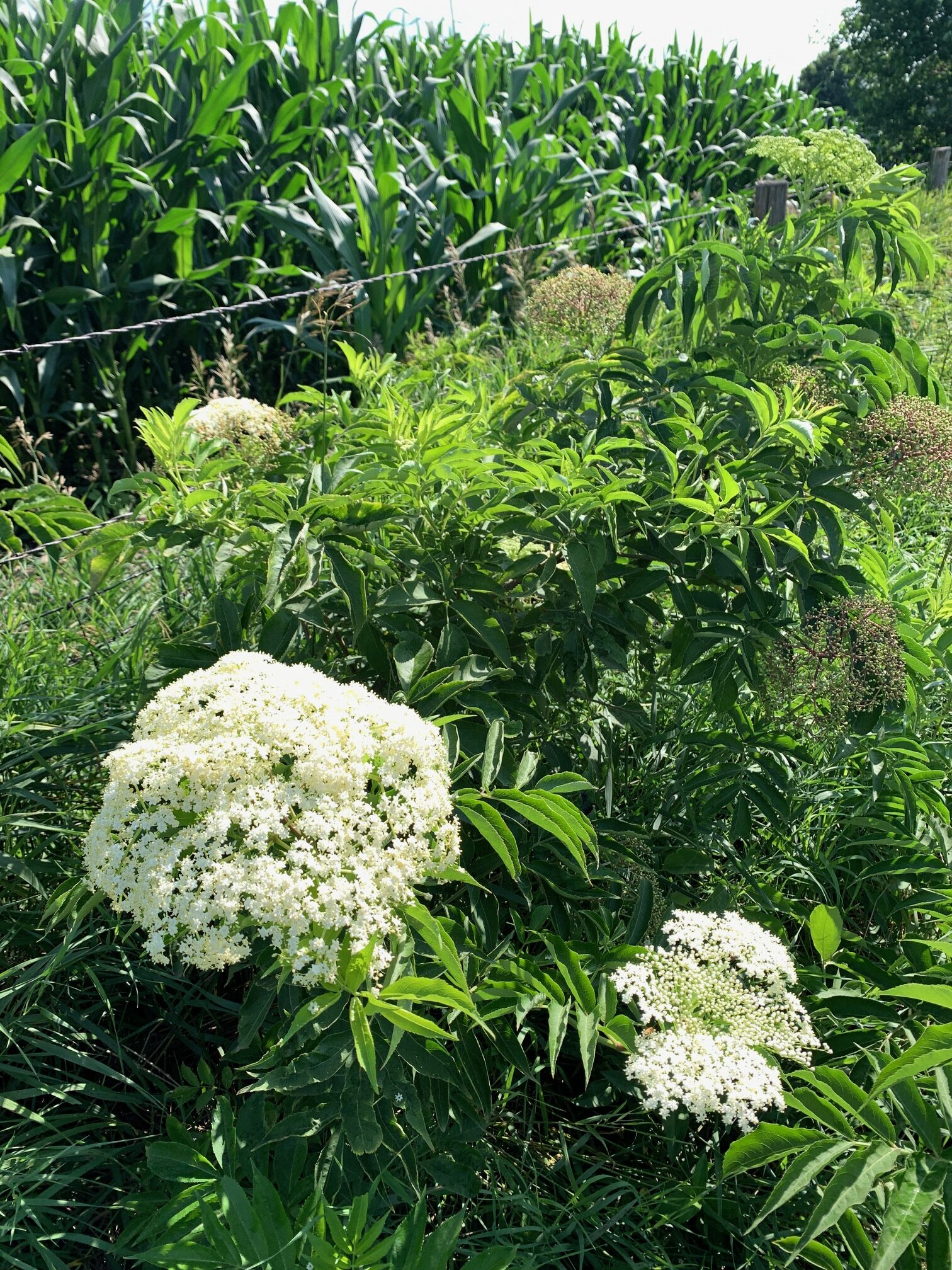
On a bright, cool morning in early July, the landscape is a vibrant, nearly uniform green. We’ve had lots of rain this year, and everything is lush and growing. Against this backdrop of vibrant green, plate-sized clusters of tiny white flowers buzz with happy pollinators. The flowers are arranged in flat-topped umbrella-shaped clusters ten to 12 inches in diameter. They stand out in contrast to the surrounding green. Each of these flowers, if adequately pollinated, will turn into a dark purple to black, pea-sized berry in September. These berries will retain the umbrella-shaped umbel when they ripen into American elderberries (Sambucus canadensis).
Native to the U.S. and Canada, American elderberry is a woody shrub. It grows in multi-stemmed thickets up to 12 feet high. The thickets spread to six feet or more in diameter and flourish on well-drained soil in full sunlight. Roadside ditches and the edges of woods in gardening zones 3 to 9 meet their criteria. The plant establishes a fairly shallow, dense, matlike root system that holds it and its soil in place. Along the lateral roots, nodes send up new shoots, spreading the thicket both above and below ground.
The canes are smooth and pencil-thin, with an outer sheath surrounding a soft, white, pithy core. Long, slender leaves grow in pairs along the cane. Each fall the old canes die back, and each spring new canes develop these lavish flowerheads.
An elderberry thicket does more than just produce fragrant flowers and purple berries. It creates a community of its own, supporting a wide variety of inhabitants ranging from the tiniest of mites to the deer that roam Owl Acres. Let’s take a look at some of the residents.
The mites are one of the 1,859 documented species of eriophyid mites. They are arthropods that live on the leaves of the elderberry plant. They are too small to be seen without 20X magnification or a microscope. The adults are translucent yellow or white and have cylindrical bodies that taper at both ends. They have two pairs of legs near the head. The mites cause the plant to create galls on the leaves which the mites then use for shelter. The galls look like little brown, conical eruptions on the otherwise healthy leaf.
Co-evolved with the elderberry plant is another resident–a type of moth called an elder shoot borer (Achatodes zeae). It lays its eggs on the elderberry leaves. When they hatch, the larvae, called spindleworms, start by eating the leaves and then move into the pithy center of the canes. The adult moths are a rich brown with rust/orange fringes.
Another colorful neighbor is the elderberry borer beetle (Desmocerus palliatus). They, too, lay eggs on the stems and leaves, and when they hatch, the larvae bore into the stems of the plant and eat the pithy centers. The beetle larvae will bore down to the roots where they will pupate and become bright, metallic blue beetles with a yellow band on the elytra (forewings).

In Line photo from Wikimedia.org by Kim H. A vivid blue and yellow beetle with large, stoutly-segmented antennae grips a leaf stem in a dramatic closeup image. Elderberry Borer Beetle.
Along with these specialists, the elderberry thicket supports insects with a more generalist approach. Aphids and ants and a variety of other moths and beetles make their homes here. Larvae of brown-tail, buff ermine, swallow-tail, engrailed, and emperor moths join their elder cousins. The dreaded Japanese beetle is happy to barge into the neighborhood and skeletonize its leaves.
Visitors to the neighborhood come and go with the seasons. The bees buzz in to harvest the pollen from the myriad tiny flowers. Mosquitoes, flies and ants also come to share the nectar. Throughout the summer, deer visit at dusk and dawn to sample the leaves and flowers. And, of course, come fall, everybody from the mice to the racoons and nearly all the birds on Owl Acres munch on the berries. It’s a veritable smorgasbord. Even the humans get in on the action.
This little list of a few of the lives that inhabit this elderberry neighborhood doesn’t scratch the surface of the complexity, interdependence, and organic harmony that flourishes all around us. It’s sobering to think of all the living that goes on in just one little patch of earth. Hundreds of species, thousands of individuals all going about their lives–living that we generally only pay attention to at a macro level. It’s fascinating.
Feature photo by Author. Alt text: Plate-size umbels of tiny white flowers stand atop canes of Elderberry growing next to an Iowa cornfield. More flowerheads have yet to erupt.
1 comment
A great reminder that there is so much life happening just under our noses!