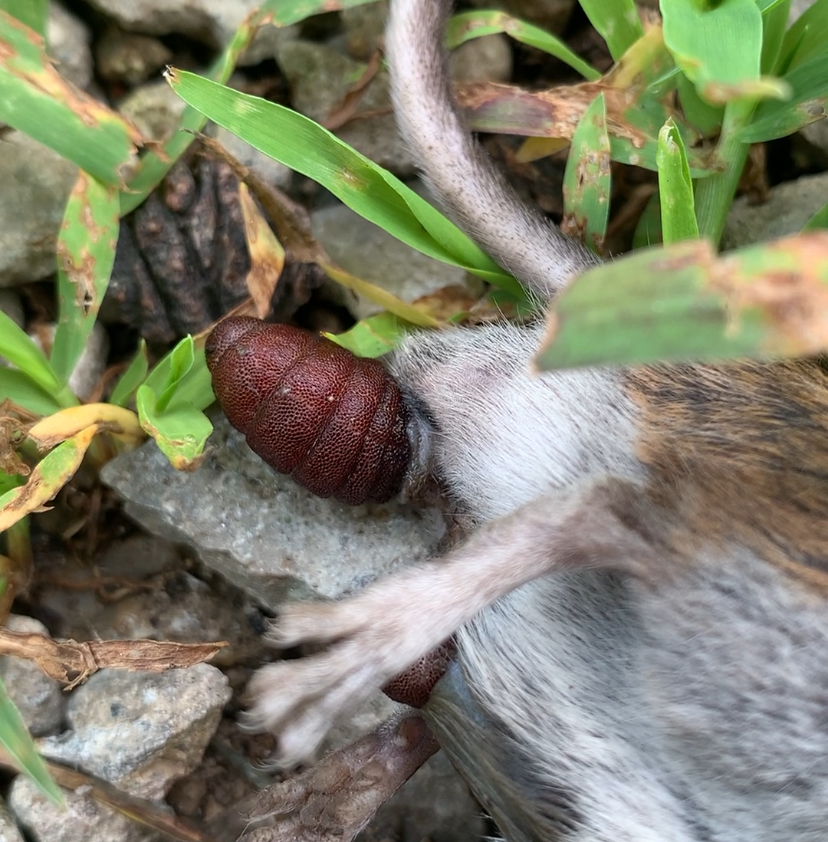
The other day Bryan was out in the shop patrolling for mice. He discovered that one of the traps he had set contained a white-footed mouse. As he watched, a deep red creature wriggled its way out of the mouse. The mouse’s abdominal wall was also pulsating as something tried to escape. It was the stuff of science fiction and horror movies played out on the shop floor. These wriggling things were parasites abandoning their host now that the mouse was dead.
These wriggling things were actually mouse bot fly larvae (Cuterebra fontinella). The victim was a white-footed mouse, (Peromyscus leucopus). The white-footed mouse is the preferred host of the mouse bot fly. Bot flies infest from 19% to 33% of white-footed mice in their first year of life. The bot fly will infest other mouse species and cottontail rabbits as well.
The bot fly lays her eggs on vegetation where mice pass by. The eggs have a groove on the underside to help them stay on the vegetation. The heat from a mouse’s body triggers the egg to hatch and the larva falls onto the mouse. It seeks out an entry point, and finds its way to a space near the mouse’s genitals. There the larva causes the mouse’s body to create a defensive structure called a warble. The warble incases the larva, getting bigger as the larva grows. The mouse has walled the larva off, but the larva continues to feed on the mouse’s tissue. The larva has also created a breathing hole at the top of the warble. The larva has breathing tubes (spiracles) at its back end. It backs up to the breathing hole, poking the spiracles out to breathe.
The mature larva is nearly an inch long and half an inch wide. It is oval-shaped and divided into 12 segments with backward-facing spines on most of the segments. These spines make it nearly impossible to drag the larva out of the warble until it’s ready to go.
When the larva is mature and ready to pupate, it exits the mouse and drops to the ground. It burrows into the soil and may wait for several months to emerge as an adult depending on the weather.
The bot fly larvae that infested our little white-footed mouse would probably not have killed it, but once it was dead, the larvae needed to get out. If the mouse stays healthy, it can usually withstand some bot fly infestation. It is likely to have smaller litters, though.
Adult male mouse bot flies are very territorial and will patrol a chosen space by flying over it in ovals or figure eights. It chases off any intruders whether they’re bot flies or not. Females only fly when they’re looking for a mate.
Mouse bot flies are very sensitive to temperature. Adults congregate over warm places like sun-soaked pavement along the road or near streams and only mate when it’s warm enough. Once the eggs are laid, they need warm, humid conditions to mature. Adult bot flies look very much like bees. Their lives are short, measured in days, and they don’t eat as adults.
I am not a fan of white-footed mice. They live on Owl Acres and get into things which they ruin. I am not fond of bot flies, either. But I am intrigued by the survival strategies they have all developed to keep life thriving in its diversity on Owl Acres.
Photo by Author. Alt text: A deep red, fat larva (Mouse Bot Fly) wriggles free from near the anus of a dead mouse, which has been the bot’s host until today. The larva is not ready to pupate and will die also. This bot is one of at least three that were inside the mouse’s body. A second bot can be seen exiting beneath the mouse’s hind foot.
2 comments
Fascinating—and totally disgusting! 🤮Thank you all the same!!
Bot flies are horrifying but also amazing! I’ve live trapped quite a few mice that have them, and the mice seem quite happy and healthy even dragging around something about a third of their body size!