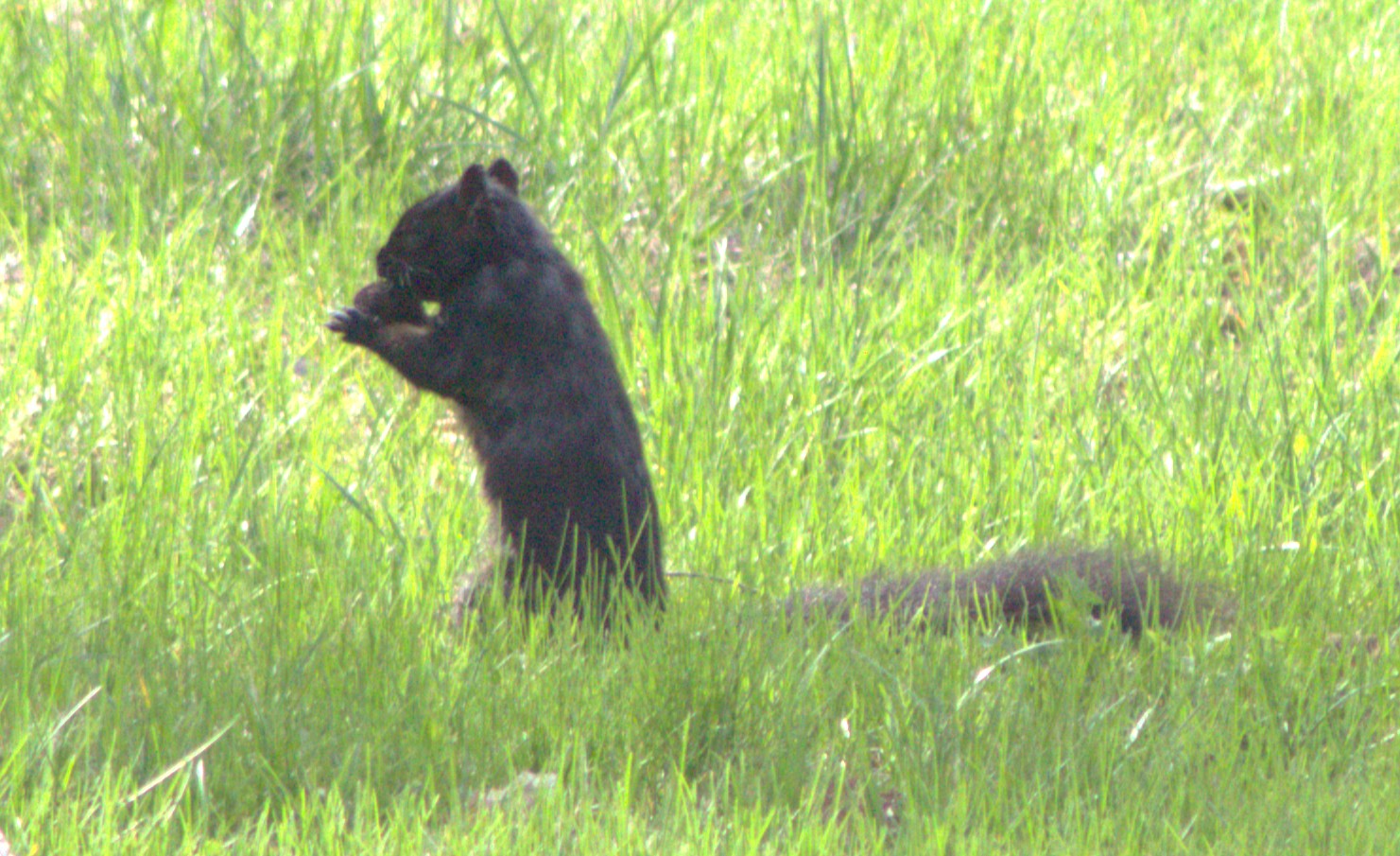
We have a number of fox squirrels (Sciurus niger) on Owl Acres. Clancy loves to bark at them, and I suspect they like to tease him as they run across the yard and shoot up the trees where they sit and chatter incessantly.
Our fox squirrels are reddish-brown in color. Except, what’s this? A black fox squirrel. This is the first and only black one we’ve seen so far.
Coloring, as we all know, is dictated by genetics. Mutations in a single gene can cause a change in color. Interestingly enough, in the case of our black fox squirrel, two separate paths to blackness have occurred in the fox squirrel population. Either change will result in a black squirrel.
Usually, over time, mutations that are beneficial to the species take hold and members of the species that have that trait tend to fare better than those that don’t. So what benefit might blackness have for a squirrel whose relatives are all reddish-brown?
One theory posits that black squirrels have a heat advantage in colder climates. Their black fur absorbs more heat from the sun than their reddish-brown brothers, keeping them warmer throughout the day.
Another idea suggests that it’s a matter of camouflage and hiding from predators. Black squirrels are harder to see in a deep forest. Lighter squirrels blend in better in a more open forest.
Or maybe it’s just a genetic mutation that doesn’t make any difference, similar to the genes that make my eyes blue and my brother’s eyes brown.
This black squirrel issue got me thinking about another population—Labrador Retrievers, like Dave. Why is Dave yellow? And more to the point, how can he be yellow, and have littermates that are black or chocolate? How does that work?

Dave and Clancy tussle in the yard. Clancy is golden, typical of his breed (Golden Retriever). Dave is very light yellow, almost white, due to interaction of several genes that control a variety of colors in Labs. Author photo.
It turns out that in the case of pure-bred breed-standard Labrador Retrievers, like Dave, two different genes are at play determining yellow, black or chocolate. Another pair determine how strongly those colors are expressed.
In our basic genetics in science class, we learned that all mammal genes come in pairs—one from the mother and one from the father. We also know that genes can be dominant or recessive. A dominant gene will mask or override a recessive gene. So, in the case of Labs, the gene we’ll call “B” can be dominant or recessive. A Lab can have one of three combinations of the “B” gene. It can have two dominant genes, two recessive genes, or a dominant and a recessive. The Lab’s “B” gene dictates whether the pup will be chocolate or black. Black is dominant over chocolate, so if the pup has either two dominant “B” genes or one dominant “B” and one recessive “b”, black rules. Only if both of the pair of “b” genes are recessive will chocolate show up.
But that’s not all. Some pairs of genes can mask the effects of other pairs. In this case, there’s another pair of genes we’ll call the “E” genes. Like the others, they can also be dominant or recessive. If both of the “e” genes are recessive, they will switch off the “B” genes altogether, and the pup will be yellow. If one or both of the “E” genes is dominant, then the “B” genes will rule, and the pup will be black or brown, depending on the “B” gene configuration.
There’s one more option that will give another set of colors in Labs. This pair of genes we’ll call the “D” genes. They interact with the “E” and “B” genes to determine how strongly the color will be expressed. If a pup has two recessive “d” genes, the color of its coat will be subdued, creating a charcoal gray instead of black, a silver instead of chocolate, or champagne instead of yellow.
So Dave, who is an almost white yellow Lab, has black and brown genes that have been masked by the recessive “e” gene, making him yellow. And he is such a light yellow that he may have two recessive “d” genes as well.
I’m sure it’s not this simple. The complex interactions of genes make for rich scientific studies. But it gives us an idea of how it works at a very high level.
In Dave’s case, none of this matters. What matters for him is that he makes an outstanding Seeing Eye dog.
Feature Photo by Author. Alt text: A black morph fox squirrel sits up in the yard, clutching a nut.
2 comments
I first saw black squirrels in Newton decades ago, in the area around Sacred Heart church. Over the years, they have spread to other parts of town, including Maytag Park and our neighborhood near Berg school. I suspect they are everywhere by now, if they have even made it to Owl Acres!
Great article! Really accessible and engaging!