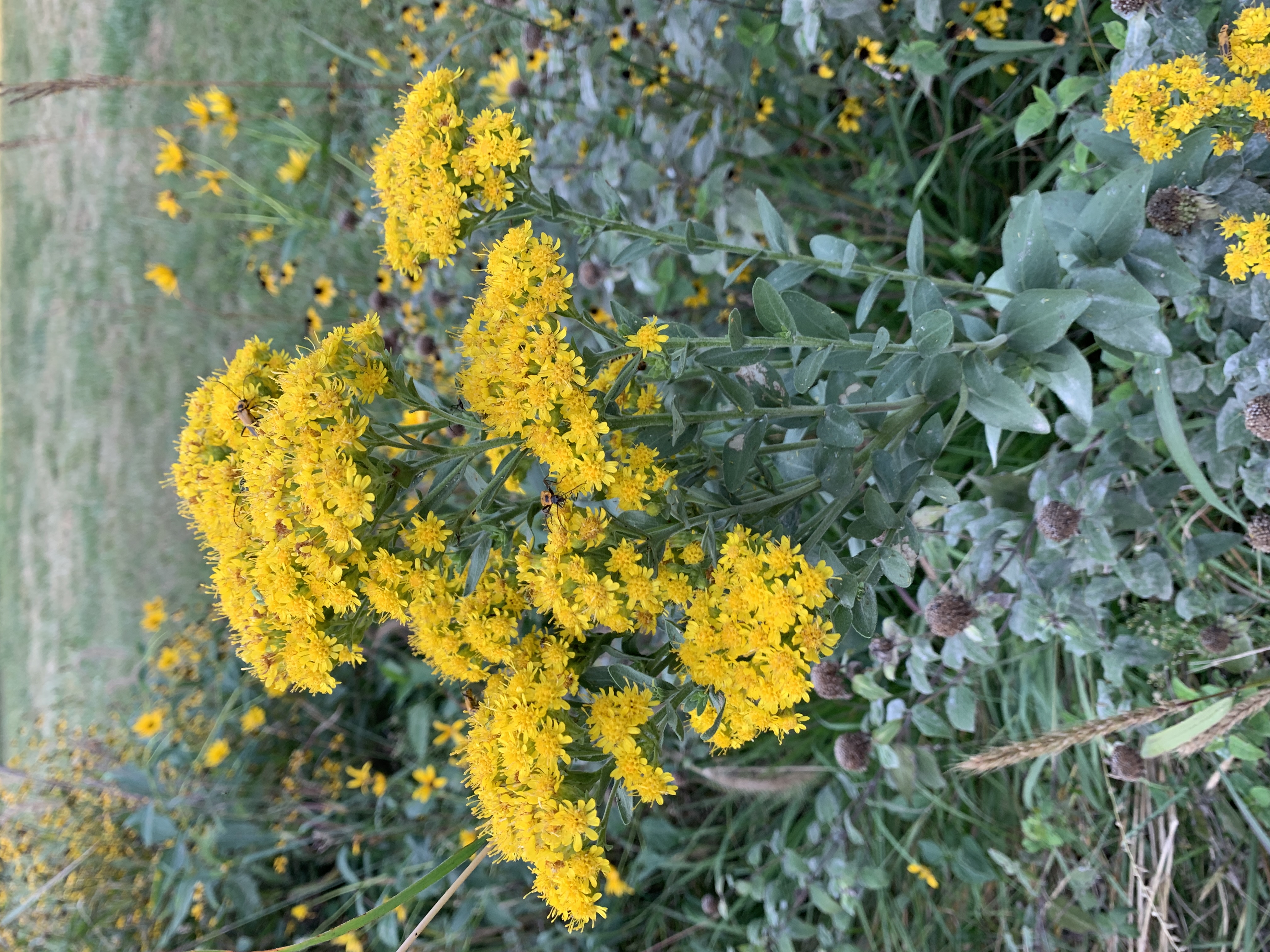
As summer slides into fall, the array of flowers in our prairie garden and along the ditch shifts to yellows. One notable species is the stiff goldenrod (Oligoneuron rigidum). This late bloomer is native to North America and holds a versatile and important place in our landscape.
First of all, because it blooms in late summer and early fall, when many other blooming plants are focused on making seeds, the goldenrod offers a rich source of pollen and nectar to support those bees, wasps, beetles, flies, moths and butterflies getting ready for fall migration or for winter. Monarch butterflies are particularly attracted to goldenrod on their migratory routes.
It’s been getting ready all summer though. In its early stages, goldenrod provides a bit of salad to the white-tail deer and cottontail rabbits. Throughout the spring and summer, it serves as a host plant for the larvae of a long list of moths, (such as the goldenrod borer plume moth, the tufted apple bud moth, and the ruby tiger moth), butterflies and other insects. And later in the fall, when it has produced a copious crop of seeds, it provides food for birds like the eastern goldfinch, who likes to perch on the goldenrod to enjoy its meal.
The plant grows on a sturdy central stalk up to five feet tall. Its stem and gray-green leaves are rough and hairy to the touch, with a rosette of leaves at the bottom and more leaves alternating up the stem. At the top of the central stem, a flat-topped cluster of bright yellow flowers entices the pollinators. Each flower is about a quarter of an inch across with six to 13 short petals around a yellow center. Up to 35 flowers make up the flower head. A mild floral fragrance promises a feast for a pollinator. Each flower will produce a seed with a tuft of white hairs to help it fly on the wind.
A beetle associated with goldenrod is in fact named for it—the goldenrod soldier beetle (Chauliognathus pensylvanicus). About half an inch long, the adult beetles eat soft-bodied insects such as aphids along with nectar and pollen from the flowers. They are thriving in our prairie garden, and we’re happy to let them. They don’t damage anything and chow down on aphids.

A yellow beetle with leathery elytra and two large oval spots, patrols the stiff Goldenrod in a closeup view of the featured plant. Author photo.
This beetle is similar in appearance to the lightning bug. It’s known as the Pennsylvania leatherwing because it has leathery wings instead of the usual beetle elytra (hardened forewings covering the insect.) It doesn’t have a way to produce light like the lightning bug though. It’s called a soldier beetle because an early classifier thought that the colors of the beetles in this family reminded him of soldiers’ uniforms.
You know the adage that life imitates art. Well, if you can call a zombie movie art, then you might consider that the goldenrod soldier beetle is an example of life imitating art. Or you might conclude that the zombie movie makers took their inspiration from the garden. Zombies are real after all. Here’s what happens when a goldenrod soldier beetle gets infected with a particular fungus. This fungus, (Entomophthora lampyridarum), can take over a beetle’s body and turn it into a zombie. The fungus actually controls the beetle, making it climb to the top of the flower and clamp on with its jaws. After the beetle dies, the fungus also makes the beetle spread its wings. Meanwhile the fungus is producing spores inside the beetle and on its surface. Unsuspecting live beetles cozy up to the zombies (now dead) thinking they can mate with them but only manage to get infected in the process.
Goldenrod soldier beetles are only one of many species with fungus controllers. Exactly how the fungus controls the beetle is one of nature’s many mysteries.
Feature photo by Author. Alt text: Late summer extravagance in the prairie garden. Stiff goldenrod stands tall, its dense cluster of tiny yellow flowers promises (and delivers) feast for all.
1 comment
Fascinating, Karen. Goldenrod guided our way up I-35 all the way to Clear Lake. With a puffed-up chest, I told my wife and mother, “that’s goldenrod.” They looked at me with the expression, “well I’ll be… I think he’s right.” Thanks, Karen. – Joe