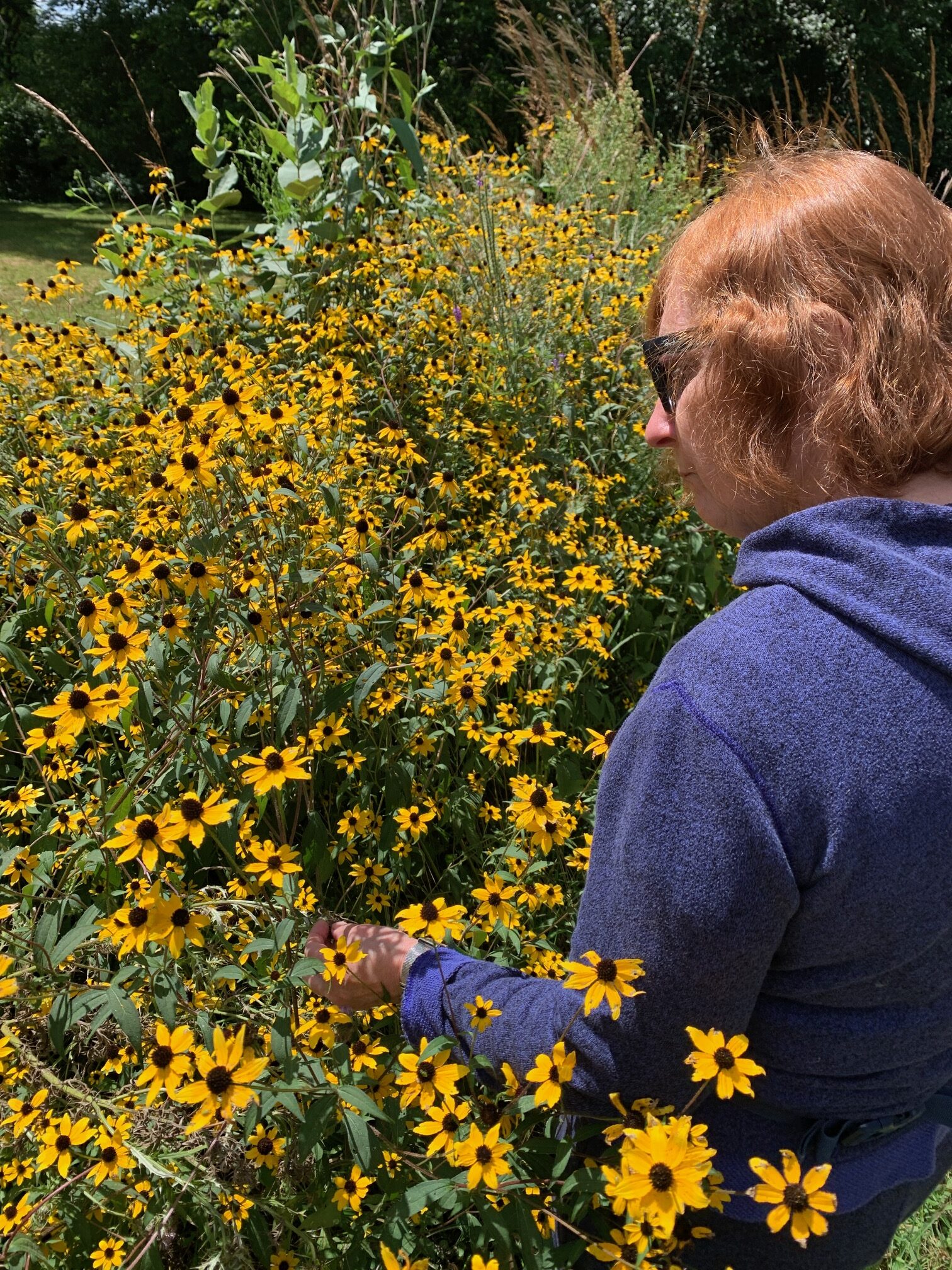
On a sunny fall day, our prairie garden is calling all bees, flies, butterflies, wasps, beetles, and anybody else who wants some nectar and pollen for dinner. A bunch of brown-eyed susans (Rudbeckia triloba) vie for their share of pollinators by waving their flowers above the fray. They have come into their own now that summer is morphing into fall. They are native to our tall-grass prairies, and since the era of the dinosaurs, they have evolved alongside the grasses, learning how to fit into the prairie ecosystem.
Brown-eyed susans are considered to be annuals or short-lived perennials. They have spent the spring and summer building a scaffolding of rather hairy, herbaceous stems. The goal was to get up to five feet tall with an open framework. The stems grew and divided wherever a leaf occurred. Now a whole cloud of flowers rises above the grasses, each at the tip of its own branch.
Brown-eyed susans are members of the aster family, so their flowers have the general shape of a sunflower. Brown-eyed susan’s blooms are small, only an inch or so across, and are composed, like a sun flower’s, of two types of actual flowers—ray flowers and disk flowers.
Bright yellow, elongated and tapering to a point, the ray flowers surround the center of the bloom. Six to twelve ray flowers shout to the bees “come, come”. Their primary purpose in fact seems to be to show the pollinators where to go.
The disk flowers make up the eye of the brown-eyed susans. Dozens of tiny tubular flowers pack together in a tight dome, waiting to be pollinated. When a bee or wasp comes along, it will bring the pollen that ignites the development of a tiny seed. Each seed will be about an eighth of an inch long. The seeds provide food for birds and other small creatures, and also lay down the seeds for next year’s crop.
This time of year, the calling cards in the garden and along the ditches are mostly yellow. The blues and whites, reds and purples of early summer have given way to the yellows of the goldenrod, the prairie sunflowers, and the susans. Brown-eyed susans wave their little flowers above most of the grasses, reaching over five feet tall to shine above the general tans and greens of fall. Why so much yellow? At least it all looks yellow to human eyes. Insect pollinators, though, see the world in a different color spectrum. Bees, for instance, don’t see red, but they’re very tuned in to greens, blues, and ultraviolet. Adding ultraviolet hues to the palette, flowers create specific patterns that guide bees to landing zones where they can quickly find the nectar and pollen they’re looking for. Bees, for instance, may see the yellow ray flowers of the brown-eyed susan as white, with an ultraviolet bull’s eye at the base of the ray flowers, guiding the bees to the nectar and pollen in the middle.
One theory for all that yellow might be that yellow pigment requires less water to produce than other pigments. By the time the brown-eyed susan is making ray flowers, it’s late summer. Generally, there’s less rain and things are drier in the late summer. Or maybe they just look pretty? Whatever the reason, all that yellow is working for the pollinators who need to stock up for winter. It’s working for the humans too when they take the time to enjoy the autumn landscape.
Photo by Author. Alt text: Brown Eyed Susans are in profusion in the prairie garden. Karen is surrounded by the riotous horde of yellow inflorescences with dark brown centers. Each flower-unit is actually a mass of dozens of separate flowers. Ringing the edge are ray flowers, each bearing exactly one of the long yellow petals. At a distance, it resembles a single, daisy-like flower about an inch and a half across.