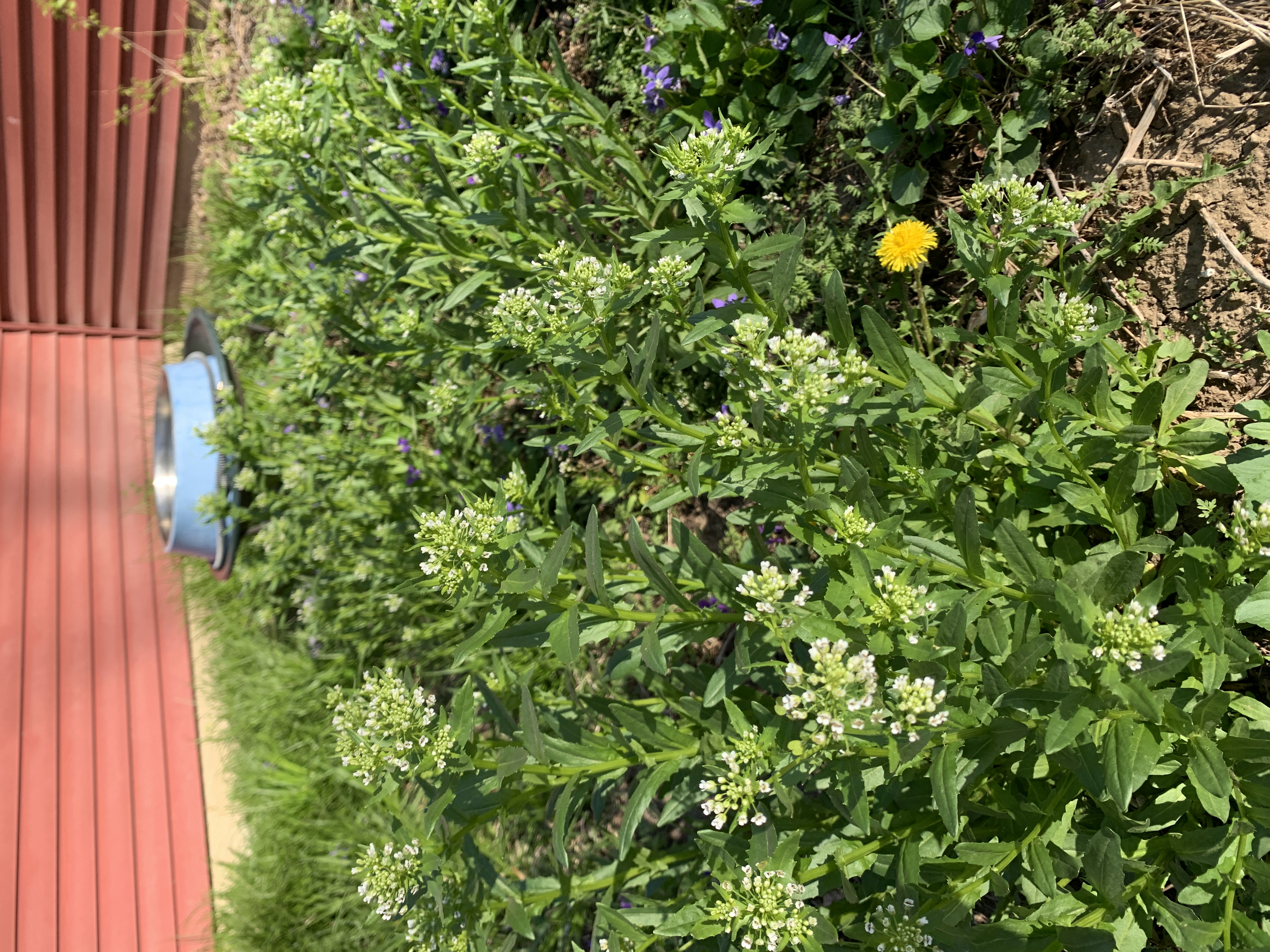
In mid-April, I noticed an unfamiliar plant growing in the garden outside my study window. Its name, I discovered, was field pennycress (Thlaspi arvense). It is a member of the mustard family and is generally considered a weed, but, who knew, it is getting a new reputation in some places. It may become a crop instead of a weed.
Field pennycress gets its name from its seed pods. Each plant produces dozens of flat, round, papery pods up and down its stalks. The pods start out bright green, but turn to a reddish-orange color at maturity. each seed pod is full of little black seeds. The pods reminded people of coins—thus its name pennycress. Right now, in early spring, it was just flowering with tiny four-petaled white flowers at the tips of its stalks. The flowers are typical of plants in the mustard family. Another of its names is stinkweed, because it has a sulfurous smell when it’s crushed. That brimstone odor will also permeate the milk of dairy cattle that eat the plant, and too much of it will make them sick.
It has other names, too, which speak to its reputation as an unwanted weed. Bastardcress, fanweed, Frenchweed, and other permutations. It is also known as mithridate mustard.
Mithridates VI was the ruler of the ancient kingdom of Pontus from 120 B.C. to 63 B.C. He is remembered for taking small amounts of various poisons to build immunity to them. Today, mithridate means a cure-all basically. Mithridate mustard, then, was a term for a medicinal plant used in medicine to cure just about everything you can think of.
Pennycress is native to Asia, and was probably introduced to North America by accident in goods shipped to the new world in the 1700s and 1800s. Today it flourishes throughout North America wherever the land is disturbed. It does not spread into established grasses like smooth brome grass and crested wheatgrass. Its seeds will remain viable in the soil though for 20 or more years, waiting for the right conditions.
Field pennycress has been getting noticed in the last couple decades as a crop in its own right. As a winter annual, its lifecycle allows it to germinate in the fall and begin growing a rosette of leaves at ground level. When temps drop below freezing, the little plant may freeze. It’s prepared for that, though and goes dormant until the soil temperatures warm up in the spring. Then it starts growing and rapidly covers the ground. As a weed, this is not good news, but promoters and scientists say that as a cover crop to flourish between corn and soybean plantings, it has real potential. It covers the ground, reducing erosion, between fall harvest and spring planting. Like winter wheat, it thrives during the winter and early spring. A second advantage to this scheme is that field pennycress can be economically viable.

Stalk of maturing field pennycress. Flat, round, seed pods stand away on individual stems. As a winter annual, the plant sets and matures its seeds very early. This is how it looked as of publication date in late May. Feature photo is from early April. Author photo
A single plant can produce up to 15,000 seeds, and the seeds are rich in oil. The oil is not suitable for human or livestock consumption, but promoters say that the oil can be made into biodiesel, or processed into jet fuel as a renewable source of energy. It will take a lot of new infrastructure to process it, and some genetic engineering so it can be processed at scale.
Perhaps with its potential for renewable fuels and a little genetic tweaking to get rid of some undesirable characteristics, field pennycress can indeed be a cure-all on the prairie.
Photo by Author. Alt text: Just out the window is Karen’s Study Garden. It sports a chaotic mess of species (might call them weeds). The charm of this little plot is that each spring, a different plant finds its ideal conditions and becomes profuse. This year, the star of this unscripted show is Field Pennycress. Next year it will be something else and we don’t have any idea what it will be.