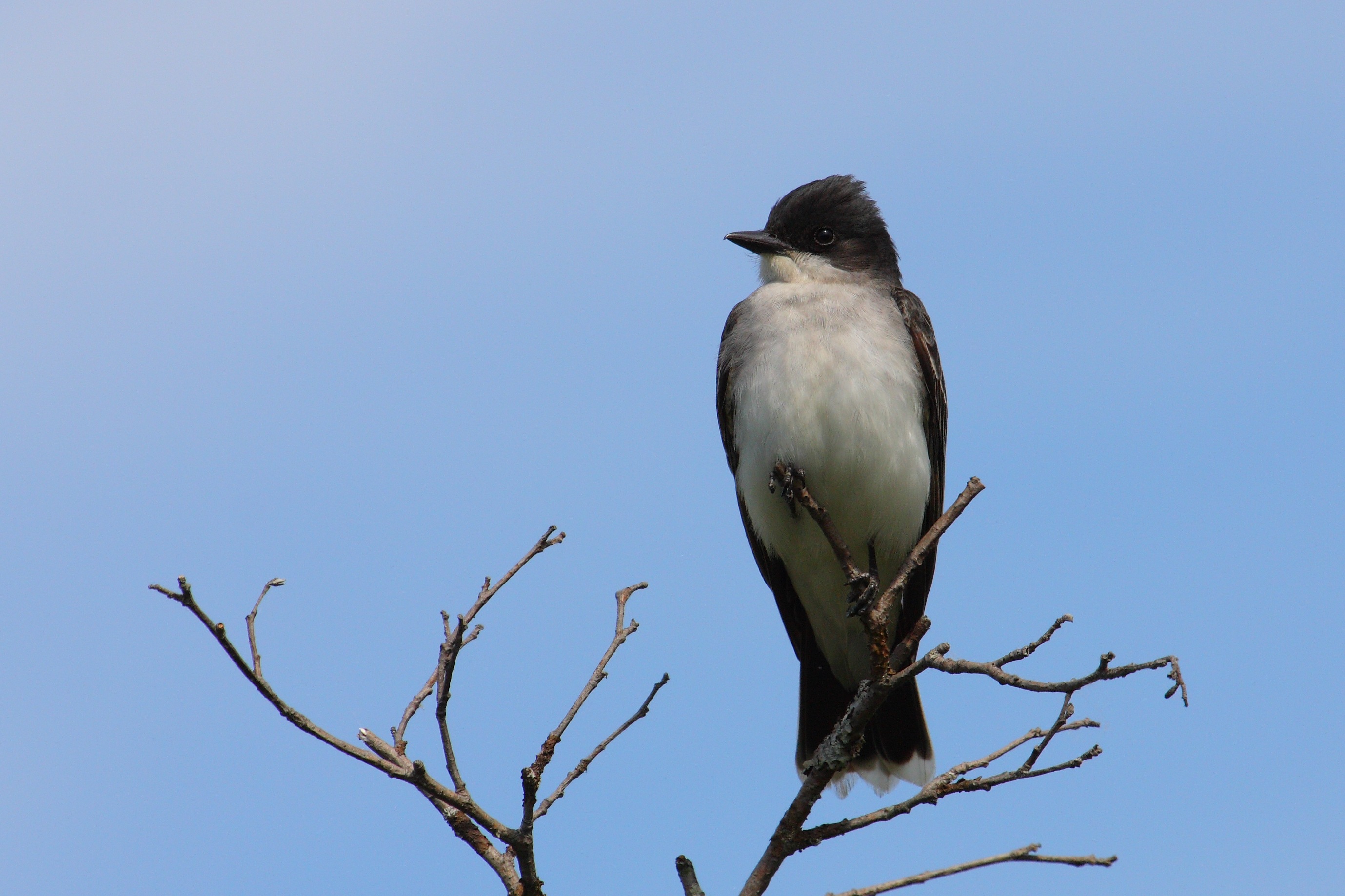
An eastern kingbird (Tyrannus Tyrannus) arrived on Owl Acres in late April and he, or another just like him, is still here, singing his complex, buzzy song in the dawn chorus. He spent the winter in the treetops of the Amazon, gorging on fruit and a few insects. When it comes time to mate, though, Mr. Kingbird struts his royal stuff in the fields and grasslands and woodlands of the north.
Kingbirds are about the size of a robin. They’re gray to black on their backs, wings and heads. Their underside is bright white, and a band of bright white stretches across the tips of the tail. On their heads, usually hidden. except when riled up, they sport crowns of red, orange or yellow feathers. They have a thick black bill and large head. They show off their kingly status during mating rituals, or when they’re venting their royal wrath on other birds and nest robbers.
Kingbirds are social and docile during the winter in the tropics. They flock together in the canopies of the Amazon rainforests, sharing space with other kingbirds including some of their cousins like the tropical kingbird.
When it’s time to migrate, though, they get down to business. It’s a long ways from the Amazon to Owl Acres. They will break up into small flocks for the marathon journey and head north. They fly by day during migration, leaving the night flying to other migrators.
When they reach their nesting grounds on Owl Acres and across the northern U.S. and Canada, they will start looking for last year’s mate. If she’s here, and she usually is if she can be, they’ll hook up again and he’ll wow her with his latest acrobatics. He’ll show off his backward somersaults, zigzags and up and down flights to impress her with his skill. Once she agrees, they find a place to build a nest. It’s usually in open, shrubby places or deciduous trees.
The female takes care of actually building the nest while her partner sits and watches her. Perhaps he’s guarding her from perils, or perhaps he’s making sure no interlopers woo her away from him.
The male can be very aggressive during the mating season. He will attack large hawks, crows, blue jays, squirrels, and snakes, dive-bombing them with his mouth wide open exposing the red interior, and his crest deployed to make him look bigger. He will attack repeatedly with his beak until the intruder leaves. He will sometimes choose a nest site that is near the nests of hawks because the hawks will prey on the blue jays that prey on his nest. Cowbirds often lay their eggs in the kingbird’s nest, and other kingbirds aren’t bashful about leaving their eggs where a kindly neighbor will tend them.
Kingbirds do not deign to walk or hop about on the ground. They are facile flyers, and conduct their royal business in the air and on tree branches. During the nesting season, 85% of their diet is insects.
They catch flying insects by ambushing them, then reaching out to grab them as they fly by. When they catch a larger insect, they will take it back to their perch and bash it repeatedly against the tree until it is subdued. Then they’ll eat it. They have been known to treat little frogs with the same disrespect.
The population of eastern kingbirds is declining. Failed nests, potentially due to herbicides, fewer insects due to pesticides, and loss of habitat play major roles in the decline.
The kingbirds are welcome to all of my insects. I only hope that, with the significant decline in insect populations around the world, there will be enough of them to sustain our bird populations long-term.
Photo from Wikimedia.org by Cephas Alt text: White-breasted songbird perches on a twig in a tree high overhead, against a backdrop of clear blue sky. A tuft of crown feathers shapes the bird’s head profile into a blunt peak.