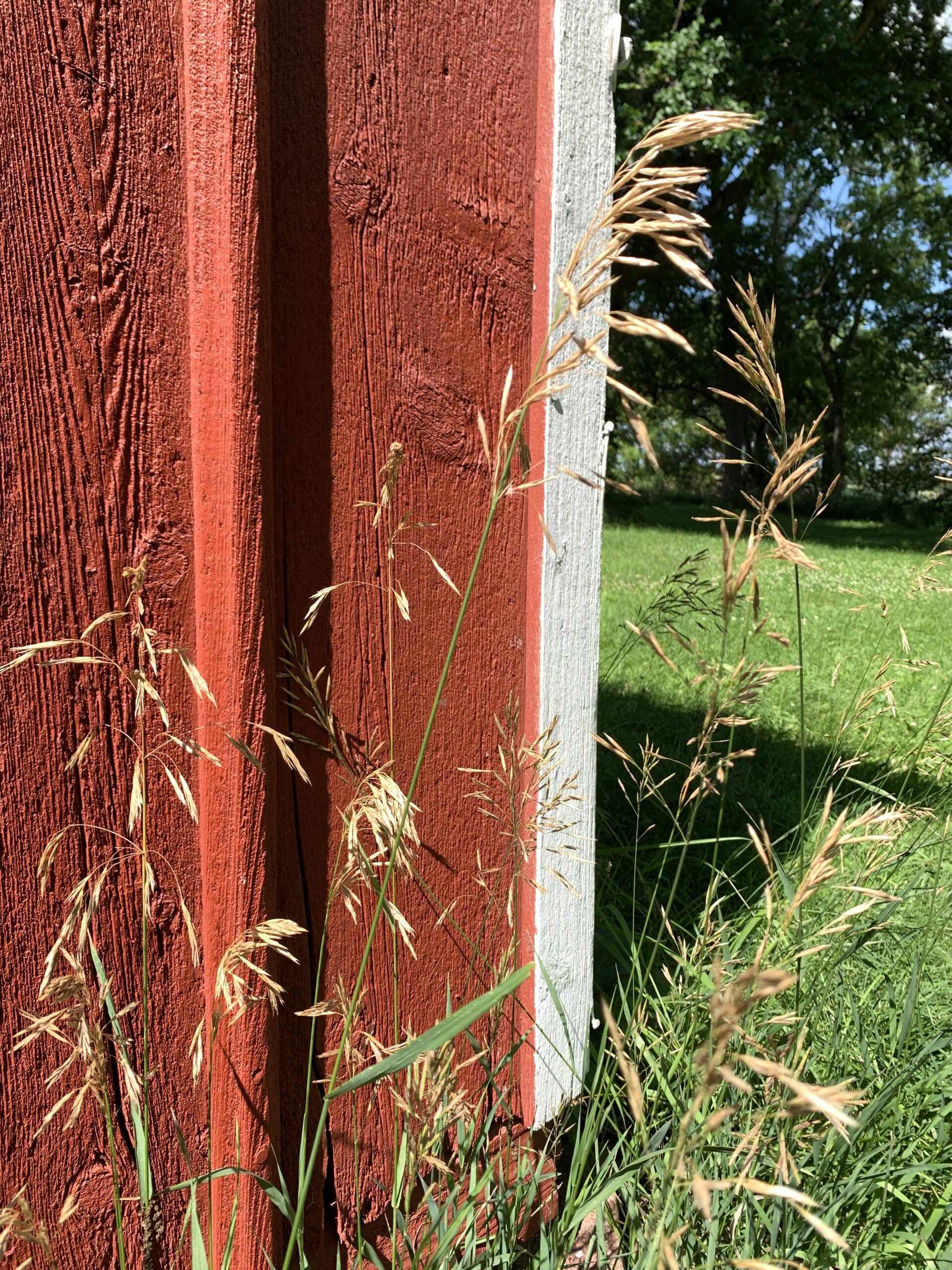
Grass. How ordinary, unremarkable, and everywhere! Owl Acres has about four acres of grass. Now that the mower is fixed, it gets mowed every week or two. Bryan sets the mower high in an effort to avoid mowing the snakes that live deep in the grass. But the grass itself—what do we know about it? During No-Mow-May we identified at least three species of grasses that had a fleeting chance to bloom and set seed before the mower lopped them off. Let’s take a look at what, or who, lives here underfoot.
The first species we’ll look at is smooth brome grass (Bromus inermis).
You probably don’t want smooth brome grass in your suburban yard. It’s okay in the pasture, though, if you are feeding livestock. It comes up early in the spring, so your cows would be happy to eat it after a winter of hay. Your neighbors might look askance though, especially if you are following the no-mow-May plan in the yard. The smooth brome grass will have grown to four feet tall and gone to seed by the first of June.
Smooth brome grass is not native to Iowa. It is native to Europe and Asia and was introduced from Hungary in 1884. It was planted experimentally in California and got rave reviews as a forage crop. Since then, smooth brome grass has spread across most of the northern United States and Canada.
Smooth brome grass is a cool-season perennial. It is happy to lie quietly in its dense root system deep in the ground throughout the northern winter. Its deep roots also help to make it drought-tolerant. When the weather is right, it is one of the first grasses to emerge in late winter or early spring. It prefers temperatures below 75 degrees for its best growth.
It is high in protein, and cattle like it. That makes it a good crop for forage, hay and sileage for livestock.
Along with its deep root system, smooth brome grass sends out underground runners called rhizomes all around the parent plant. These rhizomes have nodes along their length where new sprouts can grow. The result is an expanding clump of grass that increases in size and creates a dense layer of sod. This makes it good for erosion control along roadsides and stream banks, but it also gives the grass the wherewithal to take over large areas and crowd out native plants.
However, in the 1930s, this characteristic was actually beneficial since the smooth brome grasses could establish in the conditions of the Dust Bowl, surviving drought and periodic flooding. Farmers planted it to repopulate the ravaged land and provide both forage and erosion control. Today efforts to control its colonization habits are aimed at preserving native grasses especially in prairie restoration projects.
Smooth brome grass grows from two to four feet tall on long smooth stems. Long, narrow leaves appear every eight to ten inches along the stems, and each leaf has a W-shaped constriction about halfway along its length. The leaves are about half an inch wide and up to 10 inches long. At the top of the stems, it divides into several branches where loose collections of nondescript flowers, and later seeds, develop. After they are wind-pollinated, they go to seed in May and June.

In this close up image of a single blade of Smooth Brome Grass, a prominent W-shaped constriction going across the leaf can be both seen and felt. Every leaf has this feature, which can be used to identify the plant when the seed stalk isn’t present. Author photo.
Left to its own devices, a stand of smooth brome grass will feed the birds, the deer, the rabbits and mice and will provide substantial cover for ground-nesting birds and wildlife. You can manage the grass by mowing regularly. If you’re determined to get rid of it, though, you have your work cut out for you. You either have to dig out its matted roots and rhizomes, or you have to poison it. On Owl Acres, we’ll just manage it by mowing.
Photo by Author. Alt text: Loose collections of seeds lean out from the top of a long stem of grass. Smooth Brome Grass stands in front of a barn-red outbuilding on Owl Acres. This is one of the main forage grasses on the place.