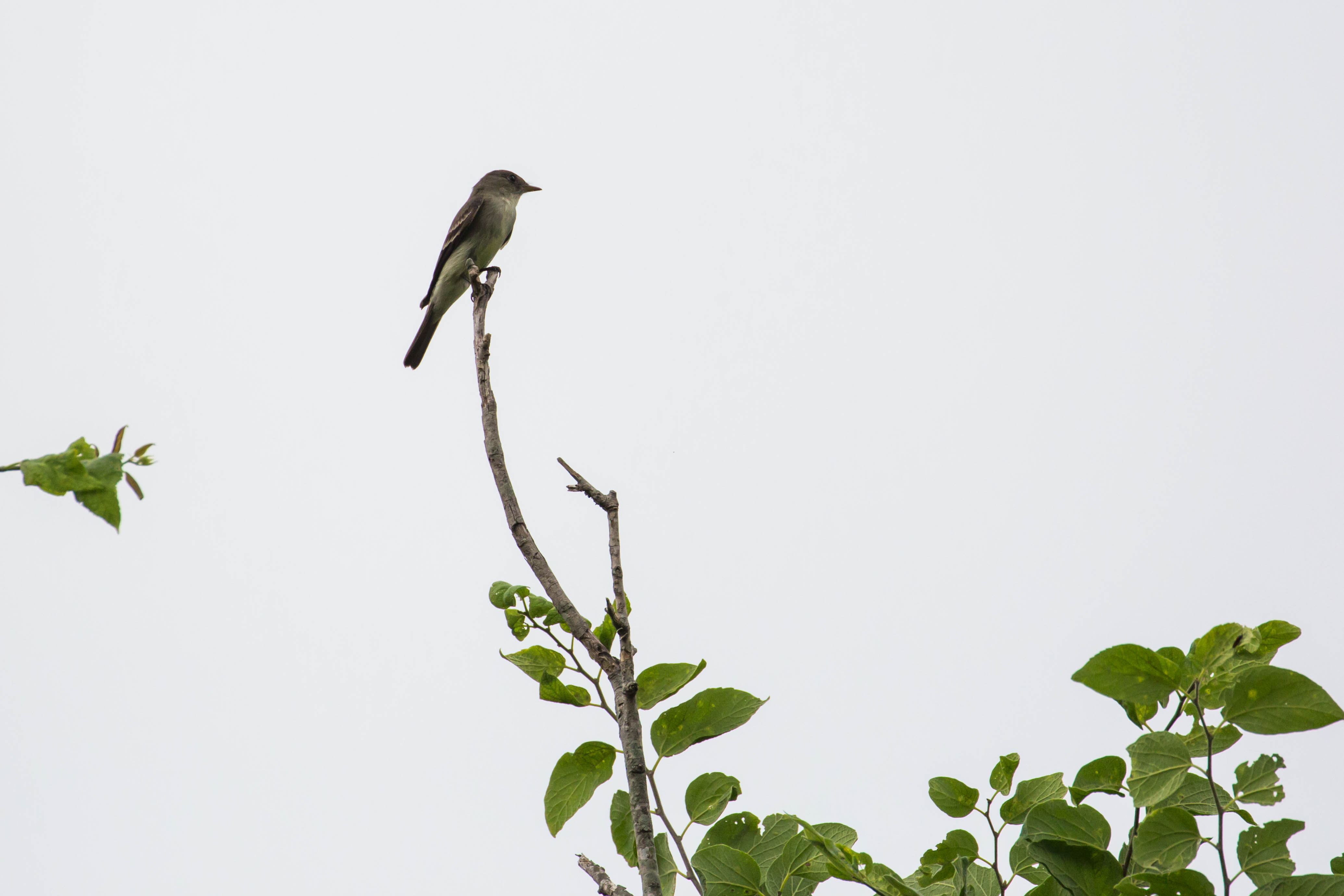
On May 14, 2025, a little olive-gray bird with a big voice joined the chorus on Owl Acres. It’s a voice that’s relatively easy to identify. It features a clear, bright, sliding whistle. It slides down and then up sounding like “pee’a’wee.” He’ll sing to us all summer while he guards his territory, and courts his mate.
Like some 350 other species of small songbirds, the Eastern wood pewee (Contopus virens) has returned from his annual migration. Flying at night, he left the scrubby forests of Brazil to fly thousands of miles and join us here on Owl Acres.
The Eastern wood pewee is about six inches long with a wingspan of about 10 inches and a weight of half an ounce. He is olive gray on his back and wings and lighter underneath with two pale wing bars on each wing. His wings taper to a slender point, and his tail is squared-off and notched.
The Eastern wood pewee is in the flycatcher family. He has a slender, straight bill which is well-suited for catching insects in flight. He will sit on a dead branch about halfway up the the forest canopy. When he spots an insect flying by, he will spread his wings and “sally” out, that is pounce in the direction of the insect. His pounce carries him eight to 15 inches outward. He will capture the insect in his beak and then retreat to the vicinity of his perch. One study counted an average of 36 sallies per hour in the nonbreeding season and twice that during the breeding season.
Populations of the Eastern wood pewee have declined steadily, about 1% per year, over the past five decades. One perplexing reason cited for this decline is the over-abundance of white-tailed deer. The connection, it turns out, is that the white-tailed deer eat the leaves of the understory where the pewees nest and forage. The habitat degradation caused by the deer impacts the success of the nesting birds.
The paucity of insects is another factor that adds to the decline. Eastern wood pewees are flycatchers, eating almost exclusively insects. Unfortunately for the pewees, those insects have been reduced by as much as75% by pesticides and habitat changes over the past several decades. That means fewer insects to eat.
Another cause of the pewees’ decline is the various hazards on the migratory route. In general, about 10% of birds that set out on migration are lost due to man-made hazards including collision with windows. Pewees are among those travelers.
Other perils include cowbirds, who lay their eggs in the Pewee’s nest and monopolize the nest resources. I hear both cowbirds and pewees most mornings, so imagine some nest parasitism is going on out there.
In spite of all these hazards, we have at least one pair of pewees singing all summer long in the trees on Owl Acres.
Photo from Wikimedia.org by Melissa McMasters Alt text: A little grey songbird perches atop a bare twig. Eastern Wood Pewee waits to sally forth on its next mission to snag dinner-on-the-wing.
1 comment
Just last night we heard and saw a Pewee singing his little heart out from my mom’s back deck. I’m happing to have a name for him. Thanks, Karen. – Joe