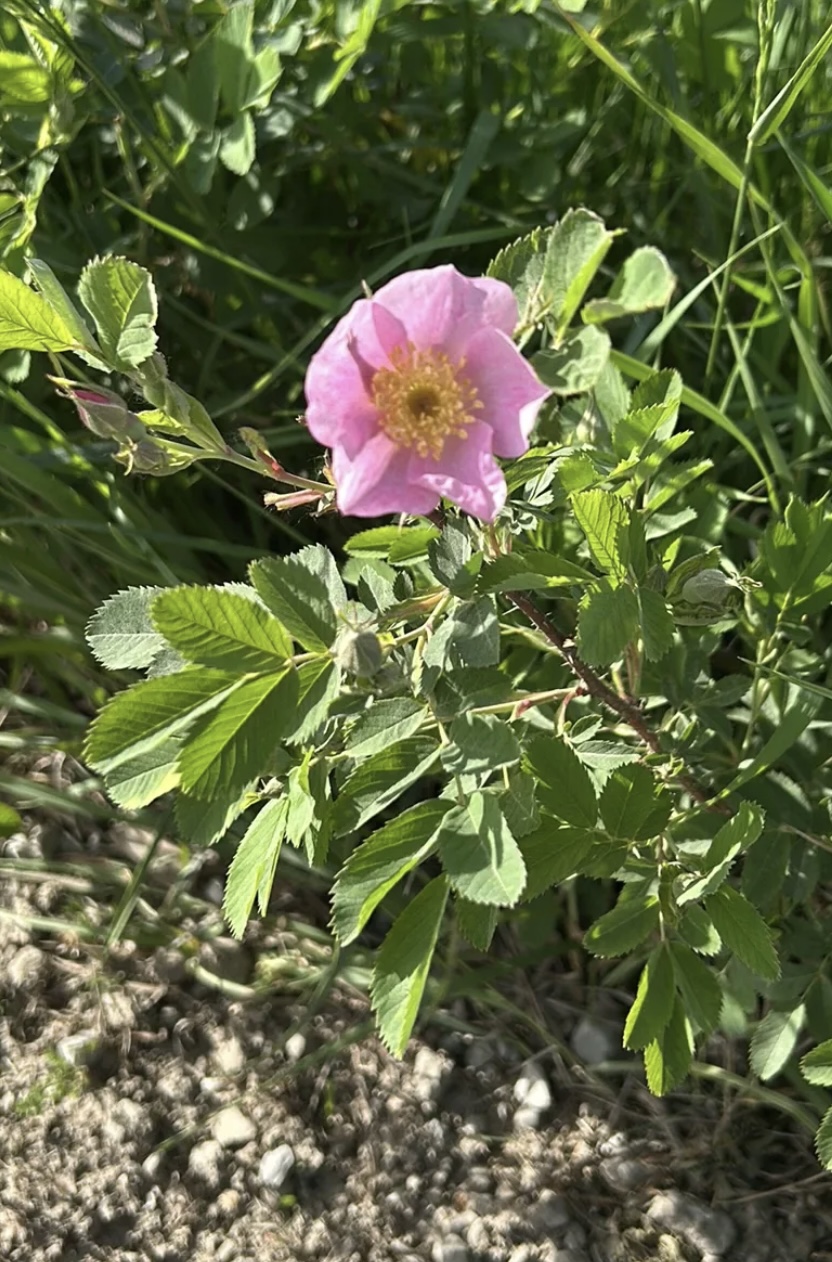
On a beautiful spring day in late May, we took Dave and Clancy out for a nice long walk. Along the gravel road, we noticed a variety of little flowers adorning the ditch at the edge of the road in front of Owl Acres. One that caught our attention was the wild prairie rose (Rosa arkansana). It was showing off its little five-petaled roses—only about an inch to an inch and a half across. Its petals were pink, with yellow stamens in the center. I reached down to inspect it. It had all the mean little thorns or prickles, one should expect on a rose, wild or not, and some of them came off the stems and stuck in my fingers. Ouch! I took a more cautious approach to my inspection after that.
The wild prairie rose is sometimes called the sunshine rose, the dwarf prairie rose, or the Arkansas rose. It has been honored by both Iowa and North Dakota as the state flower.
Wild prairie roses are native to North America. They grow like a small shrub from one to two feet tall and spread about the same amount. Hardy perrenials, they are happy to grow in sand or gravelly soil, and they can handle dry hillsides. Along our gravel road, they find full sunshine and excellent habitat. As a native to Iowa’s tall-grass prairies, the wild prairie rose evolved to withstand the periodic wild fires that swept across the prairies. The plant puts down an extensive root system which is deep enough to escape the fires. This makes them excellent for erosion control, and explains why, during the dust bowl of the 1930s, this hardy survivor was one of the few natives that thrived.
The rosebush we stopped to look at was covered in flowers. The centers were yellow, sporting stamens loaded with pollen. The flowers were buzzing with bees busy spreading their pollen and drinking the nectar in the flowers. With their wide-open shapes and abundant pollen, prairie wild roses don’t have to specialize to get pollinators. Bees, flies, beetles, and wasps all join in the fun. Bumblebees are particularly fond of wild roses, perhaps because of their generous and predictable supply of pollen.
Wild roses bloom from May to August, and develop a fruit known as a rose hip for each flower. The rose hips are about half an inch in diameter and turn bright red in the fall. They contain several light-brown seeds. The seeds have hairs on them that can be irritating if eaten.
And wild rose hips are edible. Pheasants and deer eat the fruits in the fall and winter. Skunks, rabbits and gophers help spread the seeds by eating the fruits, stems and leaves. Apparently they don’t mind the little prickles on the stems. Along with this assistance, the wild prairie rose spreads locally through its spreading root system, forming dense thickets. The leaves turn orange in the fall before dropping to the ground, and the bright red fruits remain into the winter.
People use Rose hips to make syrups, jellies, jams and teas. The rose hips are high in vitamin C. They can also be eaten cooked or raw, but the layer of hairs between the fruit and the seed can be an irritant. The petals can also be eaten or used to infuse rose scent into perfumes.
Wild prairie roses have been used for medicinal purposes for millennia. Native Americans used infusions of the roots to treat convulsions, bleeding wounds and eye infections. . The infusions were also used as stimulants and tonics.
The wild prairie rose has its honored place in native American lore. Several traditions included legends about the rose. These stories were used to teach and to entertain. Roses also found their place as motifs in quillwork, beadwork and other native arts.
Here along the road, they offer a lovely and sturdy accent to the landscape. Perhaps we’ll get some to plant in our prairie garden.
Photo by Author. Alt text: Iowa’s State Flower is a ditchweed. Flat, open pink flower with five petals and yellow center, it blooms on a stout shrub by a dusty roadside. Wild Prairie Rose is a hardy native, adapted to its sometimes-harsh habitat. Even though the virgin prairie is long gone, the area near the gravel road mimics the wild rose’s preferred conditions, and the plant flourishes here.