The thought of cockroaches gives me the willies. They were a fact of life in our apartment in Maryland, and I worked very hard not to bring them home with me. And we didn’t. But those little German horrors are only one species of cockroach, and some of them, it turns out, aren’t bad at all.
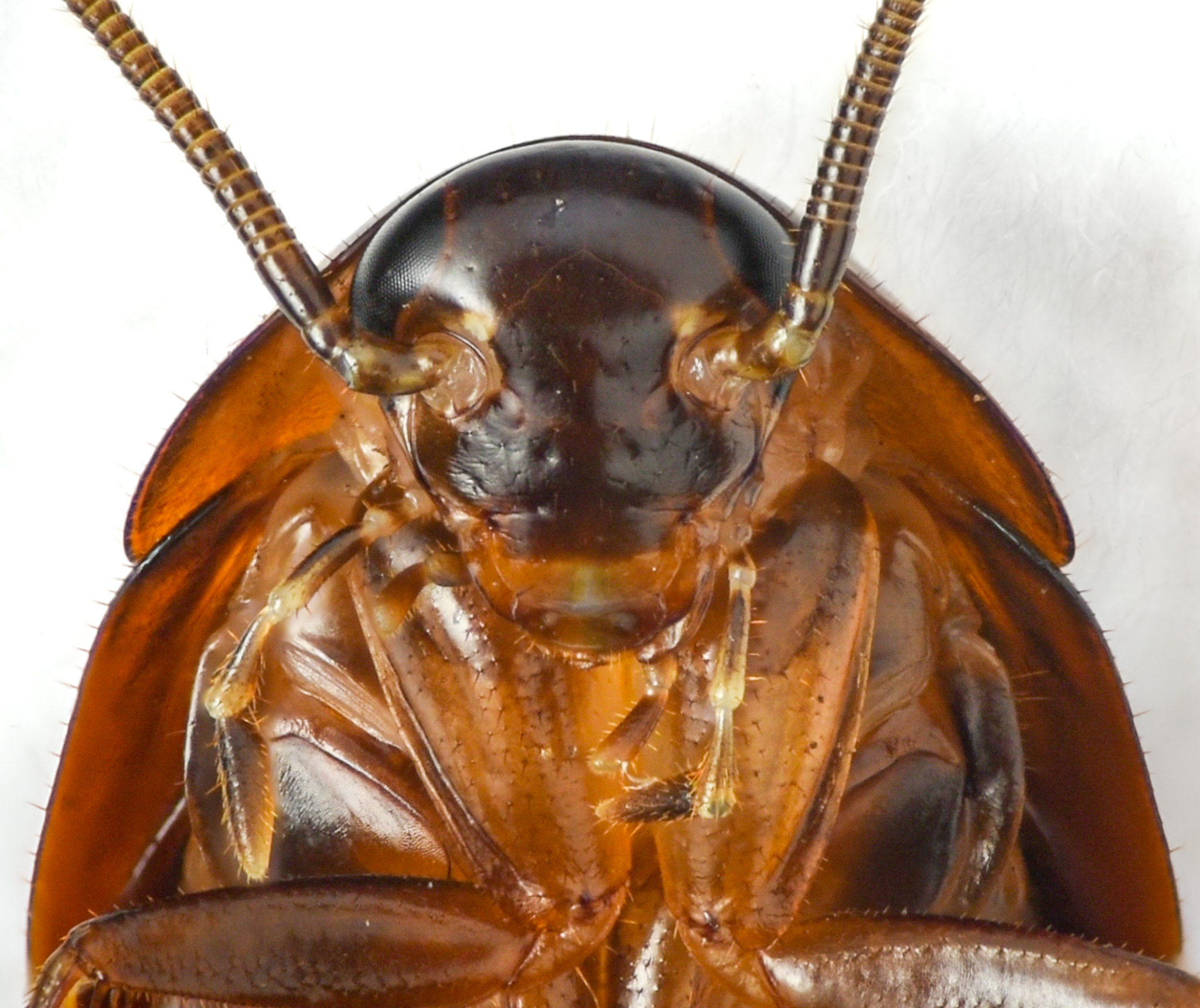
Take, for instance, the American (AKA western) wood cockroach (Parcoblatta americana). We found one lying on its back on the basement floor—quite dead. It died because it found itself in the wrong place. It couldn’t live on that dry, clean, exposed floor tile. So it dried out and died.
Wood cockroaches don’t want to be in the house at all. If they get into the house, it’s an accident—they don’t like it here. It’s too dry, and there’s nothing to eat. Their primary responsibility in the ecosystem is to clean up decaying things, and I’m happy to say there aren’t any decaying things in my basement. They live happily in moist places outdoors, like under rocks and woodpiles, under bark and leaf litter. They like to be in damp places with lots of decaying plant material. Small insects, alive or dead, add protein to their diet. Actually they will eat just about anything.
As is typical with roaches, the body of the wood cockroach is somewhat oval-shaped and flattened. It is divided into basic insect sections—head, thorax and abdomen. It is covered in a shiny chestnut-brown exoskeleton and has six spiney legs that splay out to the sides. They can run really fast. The little, rounded head supports two long antennae, and it has chewing mouth parts. Male wood roaches have wings and can fly. Female wood roaches have either no wings or stunted, nonfunctional wings and cannot fly. So for mating, the female sends out her pheromones and the male comes calling. After a bit of antennae fondling, she climbs onto his back and evaluates his secretions. If it’s a go, he twists himself around to insert his abdomen in the proper receptacle. She untwists him and they spend an hour passing sperm from him to her. If they get disturbed, she takes off, dragging him along behind.
Once this process is successfully completed, she develops and lays her eggs. After she lays about 40 eggs, she deploys her chemical arsenal. She has two glands which secrete different chemicals. Once those chemicals come into contact with each other, they harden into a Styrofoam-like substance, forming a case around the eggs called an ootheca. The female hides the ootheca in a damp place, tucking it into a crack or crevice and covering it with debris. About a month later, the eggs hatch, and the little nymphs have to work together to escape the ootheca. To crack it, they all suck in as much air as they can, swelling up their bodies. In this way, they put pressure on the ootheca from the inside until it cracks.
Meanwhile, a type of parasitic wasp may lay her eggs in the ootheca. When the wasp eggs hatch, the wasp larvae eat the roaches. If some of the roaches die, there may not be enough of them left to crack the ootheca.
If all goes well and no wasps come along, the little roach nymphs will start eating whatever is handy. They’ll spend the summer growing through several nymphal stages, and then overwinter in the soil. The next spring, they’ll emerge as adults ready to mate. Sometimes the nymphal stage takes two years to complete.
About 12 species of wood roaches are living in Iowa, and are, for the most part, very hard to tell apart. They are native to North America and have been around in some form since the dinosaurs and maybe longer. Termites and mantises are their relatives.
As noted earlier, wood roaches have a job to do in helping to clean up detritus. We’ll leave them to it, and if one accidentally wanders into the house, we will just remove it.
Okay, it’s true. They still give me the willies.
Photo from Wikimedia.org by Don Loarie Alt text: This is the creepiest image we could find. A close-up of the face of American Wood Cockroach. Brown and shiny, its antennae sprout from the triangular head and go out of the frame. The compound eyes occupy two corners of the triangle above the antennae attachment points. The mouth forms the bottom point.
1 comment
As always, fascinating!