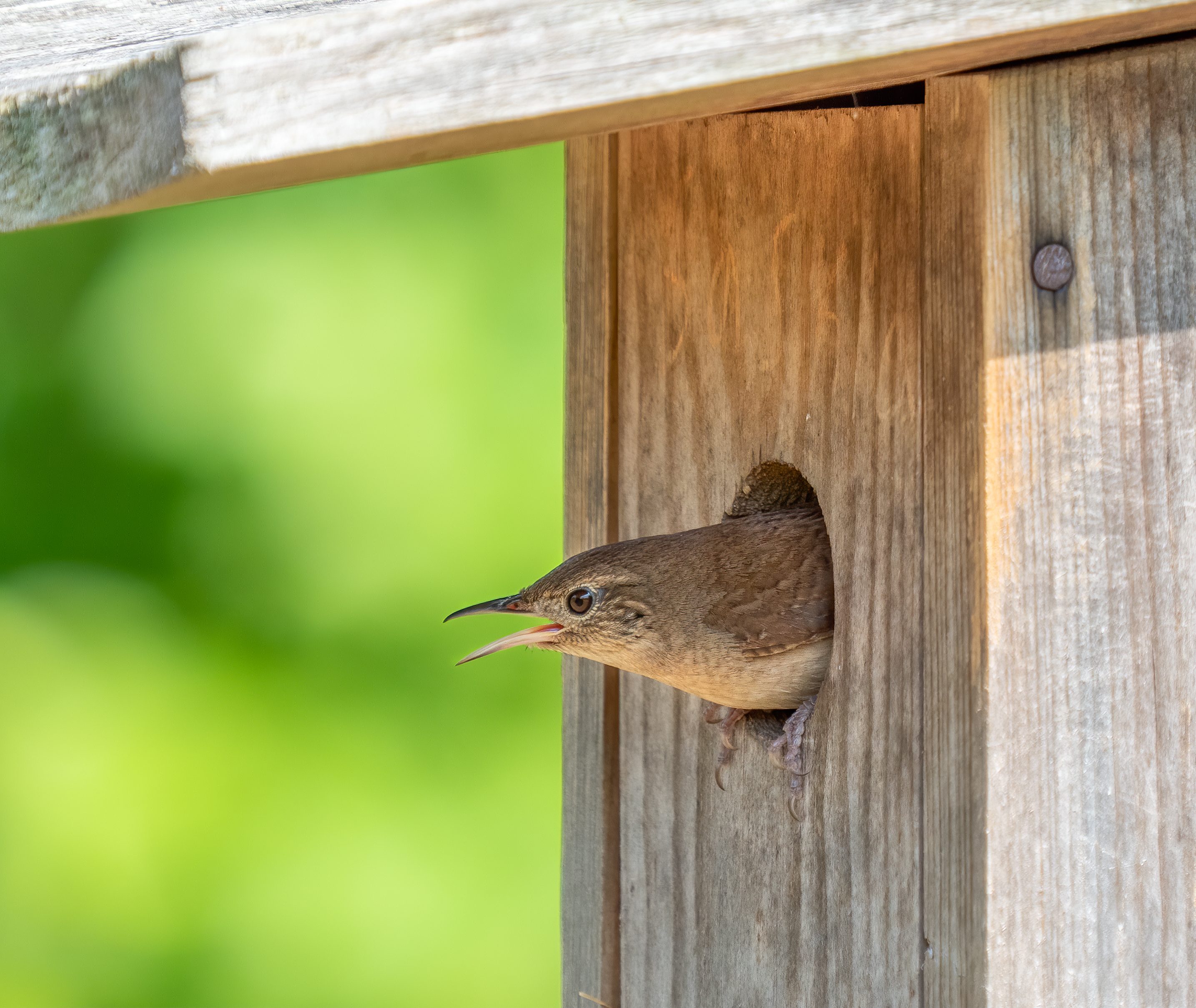
One of the best things about spring and summer is waking up to the morning chorus. Since I’ve been paying close attention, I’m even getting better at identifying its members. I still have a long way to go, but one loud and persistent singer has my attention this summer. It’s the northern house wren, (Troglodytes aedon). This drab little bird competes constantly to out-sing its larger, flashier neighbors like the cardinals and the orioles. In fact, competition is what this little fellow is all about.
When he returned in the spring from his winter in Mexico, he started looking for nest sites. He likes holes in tree branches, nest boxes, brush piles, and all sorts of human constructions including planters, pots, drain pipes, laundry baskets—you name it. Even the intake pipes on the furnace. We had to put wire mesh over them to keep the birds out! In spite of his willingness to improvise, he has his opinions about what he wants, and if somebody else got there first, he’s not shy about barging in, shoving out nest materials, eggs and even adult birds to claim his due. What he wants is a nest site that will satisfy a potential mate. He starts several nests, hoping one or two will win approval. When the ladies arrive, they will evaluate his work and judge whether he’s a good mate prospect. If she likes his nest, he wins, and she completes the nest, lining it with soft materials to make a cozy space for her eggs. Her eggs have a thicker shell than most birds, possibly because other male northern house wrens may come along and usurp her nest. She’s not averse to slipping out to rendezvous with the neighbors, but she’ll stick with her nest-builder to raise the current brood. He doesn’t mind having multiple partners, either, but will do his duty.
Later in the summer after the nestlings have fledged and moved out, she’ll lay another clutch of four to six eggs and raise a second brood for the year.
In their natural habitat, in forests and woods, wrens nest in holes such as those excavated by woodpeckers. In fact, their scientific genus name Troglodyte means cave dweller. Their species name, aedon, comes from Greek mythology and refers to Aëdon, a daughter of Pandareus who mistakenly killed her son. Zeus took pity on her and turned her into a nightingale.
Throughout the breeding season, wrens’ nests attract parasites like mites that feed on the nestlings. Perhaps to combat the mites, the mother wren will bring spider egg sacs into the nest. When the spiders hatch, they will eat the mites. Wrens eat mostly insects, so perhaps after the spiders eat the mites, the wrens eat the spiders?
Once the male has claimed a nest site, he has to defend it. If he encounters an intruder, he will crouch, spread his tail, droop his wings and raise the feathers on his back. Now, looking bigger and fiercer, he can take on his enemies.
Actually though, he’s barely as big as a sparrow, weighing only about a third of an ounce. His wingspan reaches about six inches, and his body length is less than five inches. He has a rather flat head and a relatively long, curved beak. His wings and tail are rounded, with the tail squared off at the end. His coloring is mostly drab grayish brown with faint darker bars on his wings and tail. When he perches, he assumes a typical wren posture, cocking his tail upward. His mate looks just like him, although she may be somewhat smaller.
Our northern house wren sings songs that seem much larger than he is. He has an extensive repertoire of jumbled variations and can carry on nonstop for ten minutes or more. The wren singing just now has an eight-note song that drops in pitch after the first six notes or so and finishes at a lower pitch. He has many other songs and calls as well. Somebody counted 130 different songs and calls made by northern house wrens. No wonder they’re hard to pin down!
Female northern house wrens also sing, although their songs are simpler than the male’s.
The house wren is most often seen flitting about through brush and trees close to the ground with their tails cocked upward, chasing insects.
Judging from the songs in the trees, I am guessing that we have several pairs of northern house wrens on Owl Acres this summer. They’ll be raising their second broods soon and then will turn to the south, bringing their youngsters with them.
Photo from Wikimedia.org by Rhododendrites Alt text: Little grey-brown bird peeks out from a nest box. Northern House Wren displays a sharp beak and bright, clear eye.
1 comment
My Grandpa Bruns built wren bird houses. He’d whistle for them, too, and I thought he sounded just like the little birds. Thanks for the memories.