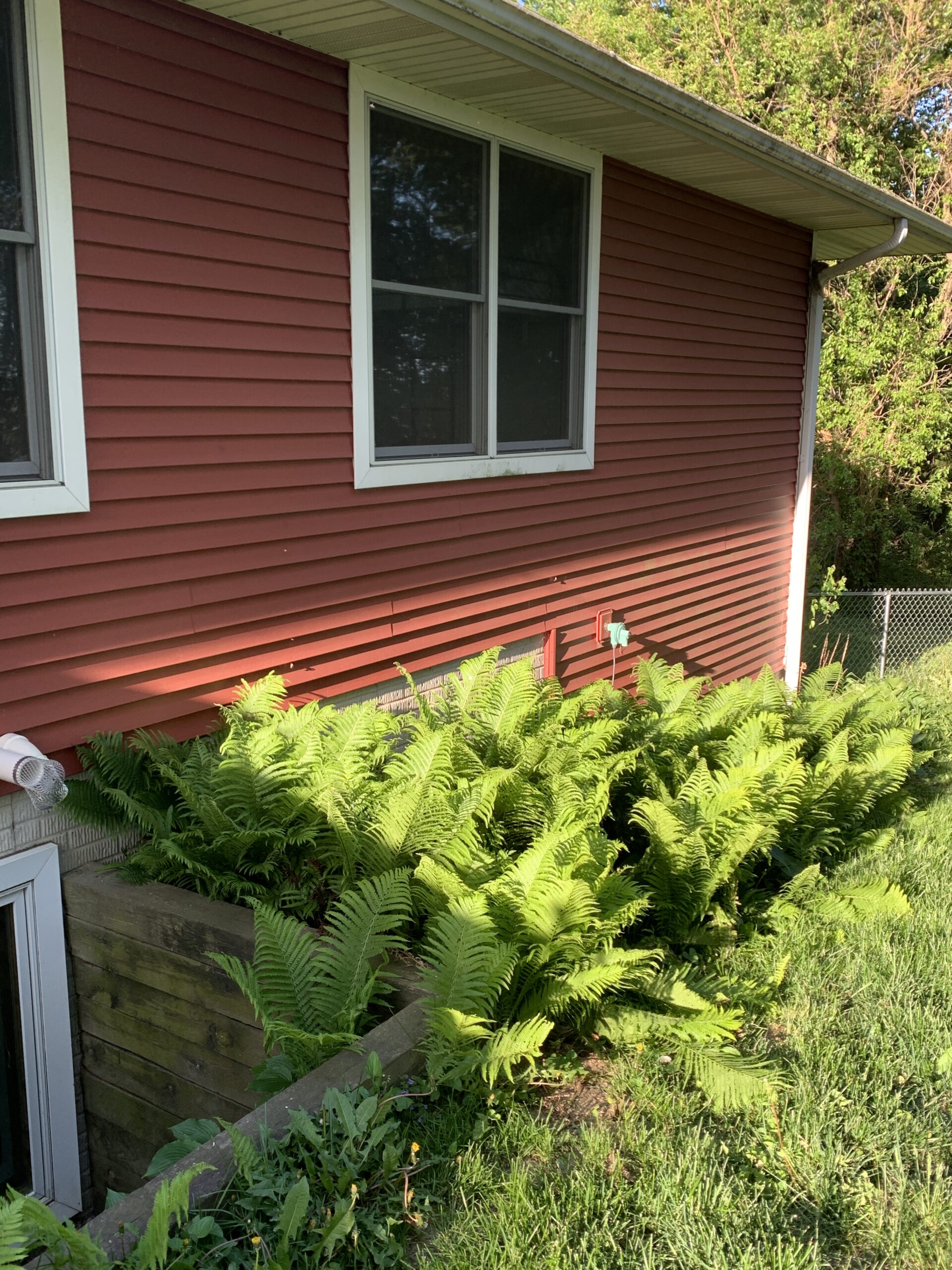
About 20 years ago my friend Lisa gave me some starter ostrich ferns (Matteuccia struthiopteris, also known as fiddlehead fern or shuttlecock fern). I planted them on the north side of the house. They have survived the dogs and the rabbits, and are growing in lush patches filling in between the air conditioner and the window well. They started out in early spring with their fiddleheads, which uncurled to liberate the tall, arching, leafy fronds. The stand is creeping a bit into the yard, but that’s not really a problem where they are.
Ostrich ferns get both their common and scientific names from the shape of the fronds which are wider in the middle at taper both top and bottom. The shape reminds us of ostrich feathers.
Ferns are some of the oldest plants on earth, with fossil records dating back some 390 million years. They are vascular plants. That is, they have tubes that conduct water and nutrients throughout the plant. This allows them to grow quite large, unlike mosses for instance, which have to remain small because they don’t have these structures.
Ferns are also not flowering plants. Instead, they reproduce via spores. These characteristics put ferns in their own category in scientific classification. Some 10,500 species of fern survive today.
Our ostrich ferns are about four feet tall with their fronds spreading vaselike from the center outward. They started earlier in the spring as little flat spiral-shaped fiddleheads. We could have eaten the fiddleheads earlier in the spring, when they were tender and full of vitamins. Now, though, they have unwound themselves from the fiddleheads into long, feather-like fronds that look like ostrich feathers.
These ferns most likely are growing from a substantial root system that has been established over the years. Each year the roots extend farther outward, expanding the colony and filling up the spaces.
Ferns also grow from spores. The ostrich fern starts out with a spore that germinates and grows into a new, heart-shaped plant that produces male and female gametes. The male gametes have tails and must swim to the females. Once fertilization occurs, new structures full of spores are created. These bead-like capsules are located on the fronds in the center of the fern plant.
The ferns have both sterile and fertile fronds. The sterile fronds are arrayed around the center of the plant in a vase shape. The fertile fronds hide in the middle. The fertile fronds grow later in the year and develop the structure that holds the spore-forming organs that contain the spores. They will wait until spring to open and toss the spores on the wind.
Fern ancestors dominated the landscape during the carboniferous period (299 to 368 million years ago). They thrived in vast swamps. When they died, they sank into the swamps where no oxygen was available to support decaying bacteria. These swamps were later buried by terrestrial forces, locking up carbon into what would become today’s coal.
The ostrich ferns in my back yard descended from their ancestors in Eurasia and North America. Their spores helped them spread worldwide and compete with the new kids on the block, angiosperms or flowering plants. A lot of the fern species went extinct under the pressure of the flowering plants, but some, like the ostrich fern, did survive.
During the Victorian era, people were crazy about ferns. They developed new subspecies, built elaborate fern gardens, and competed for the best presentations. The word Pteridomania was even added to the dictionary to express this craze. By the beginning of the 20th century the fad had passed, leaving behind some of the fancy fern varieties developed.
Medicinal uses of ferns were also catalogued. Fiddleheads are said to taste like asparagus and contain vitamins A and C and antioxidants. The roots were used as a poultice, and ingesting ferns was thought to purify the blood, stimulate the kidneys, and enhance digestion.
My landscaping is simple, and those ferns in the back yard survive the dogs, the rabbits, and the weather. If they encroach on the yard a little, it’s no problem.
Photo by Author. Alt text: Karen’s Ostrich Ferns growing along the north side of the house on Owl Acres. Because of its location, this image can only be captured from late spring to early fall when the morning sun is far enough into the northern sky to shine directly onto these shade tolerant plants.
1 comment
Fascinating stuff, Karen. Loaded with information, and antioxidants. 🙂 Thanks for the info. – Joe