Mothers are everywhere and come in all shapes and sizes, but the work they do is similar no matter who or what they are. Let’s take a look at some of the mothers that live on Owl Acres and the work that they do for their young.
Mothers have to select the place where their young come into the world so that they will thrive. A human mother will set up a nursery, line up a midwife or doctor, lay in a supply of diapers, get a car seat and all the other equipment that baby needs to flourish in today’s world. A drone fly mother has to find a place near water to lay her eggs so that her offspring can swim when they hatch. Monarch butterfly mothers know they have to lay their eggs on milkweed so that the larvae will have food to eat when they hatch.
Some mothers not only choose the right place, but prepare food for the little ones when they arrive. A solitary bee mother will make little balls of bee bread out of fermented pollen and nectar. She’ll lay one egg on each ball of bee bread so each baby bee will have enough food to eat until she can find her own. A cicada wasp will capture an entire cicada, drag it into a burrow and lay her eggs on it. The larvae will feast on the cicada when they hatch.
Bird mothers, of course, have to find the right spot for a nest. The tufted titmouse will choose a hole in a tree. The indigo bunting will set her nest in shrubs near the ground. Wild turkey mothers make their nests directly on the ground. And then there’s the Baltimore oriole who weaves her nest just so and hangs it under a branch. Whatever the shape, birds almost all line their nests with soft materials like hair, feathers, spider webs and soft grasses to make a cozy space for the babies.
Some mothers rely on others to do the mothering for them. The brown-headed cowbird is notorious for laying her eggs in somebody else’s nest and leaving the chicks to be fed by the mother who built the nest. Sometimes the nest-builder raises the cowbird chick, and sometimes she doesn’t.
Once the location is secure, mothers dedicate their time to protecting and nurturing their offspring. Mouse mothers make a nest and nurse their young. If they think their young are in danger, they’ll go so far as to move them, one by one, carrying them by the nape of the neck to a more secure location. Opossum mothers carry this to extremes. An opossum is a marsupial, so she carries her young in a pouch for about 90 days before they drop off and emerge.
Mothers take on the responsibility of keeping the place clean. The white-breasted nuthatch removes shell fragments and fecal sacs from the nest. She also takes a piece of animal fur or a crushed insect and sweeps the entrance to her nest with it. The northern house wren worries about mites in her nest, so she brings spider egg sacs into the nest. When the spider eggs hatch, the spiders will eat the mites. Then the wren will eat the spiders.
Mothers pass on important life-saving substances to their young. A human mother passes antibodies and nutrients in colostrum through her milk. Because of the way rabbits digest food, they need particular bacteria in their gut. A rabbit mother passes the bacteria needed to digest food to the baby rabbits through her feces.
A mother’s job is also to teach. Mother bats teach their offspring to hunt. Mother white-tailed deer teach their fawns to avoid danger. Mother owls teach their young to fly and mother pheasants lead their chicks to food and teach them what is good to eat.
Mothers are fierce protectors of their young. Redwing blackbirds will chase intruders away if they get too close to their territory. A killdeer will attempt to draw a predator away from her nest by feigning a broken wing.
There are many more mothers on Owl Acres. They’re all busy raising the next generation of offspring to populate the world. Let’s wish them all a happy Mother’s Day.
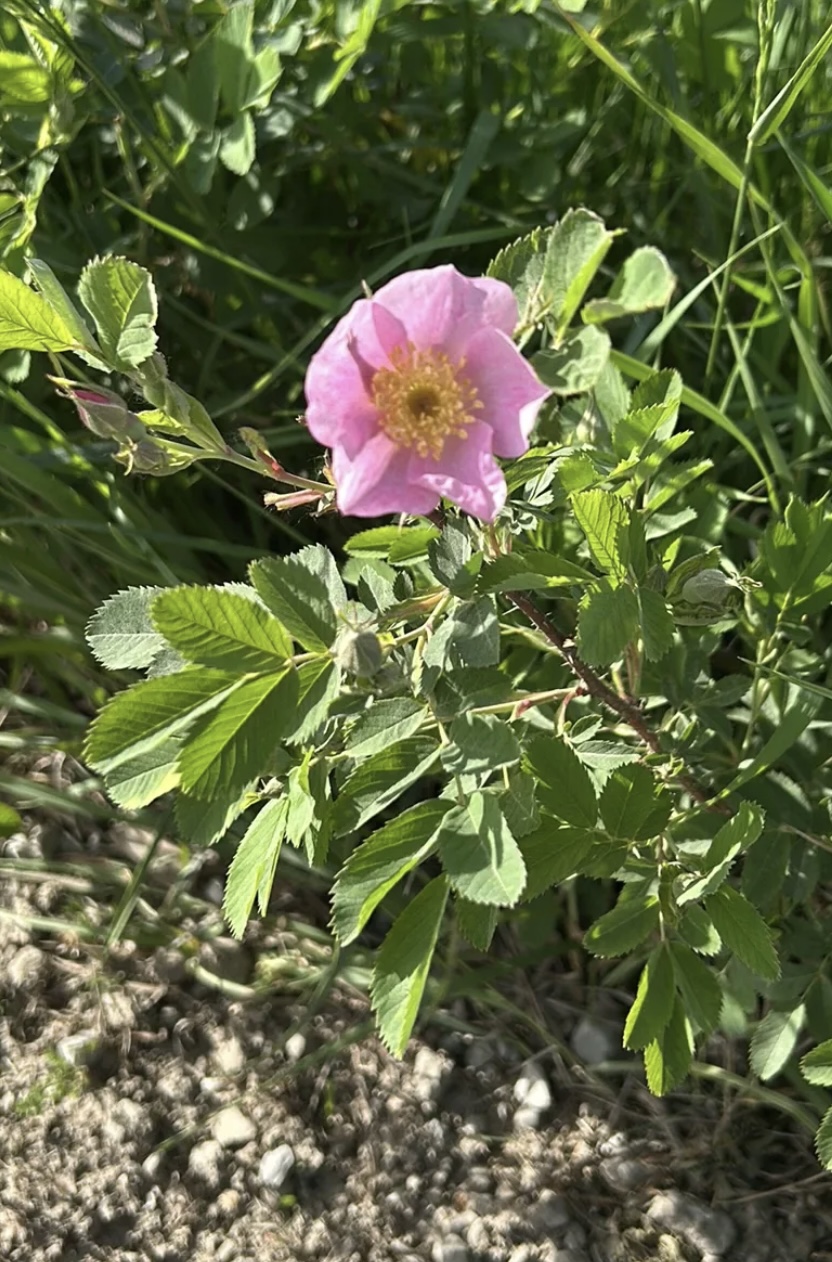
Photo by Author. A perfect Wild Prairie Rose for Mother on her Day. Alt text: Iowa’s State Flower is a ditchweed. Flat, open pink flower with five petals and yellow center, it blooms on a stout shrub by a dusty roadside. Wild Prairie Rose is a hardy native, adapted to its sometimes-harsh habitat. Even though the virgin prairie is long gone, the area near the gravel road mimics the wild rose’s preferred conditions, and the plant flourishes here.
1 comment
All your writings are wonderful but this one is a particularly spectacular writing. Thank you for sharing.