When Jesse Reeves bought his 160 acres of virgin prairie, there was a lot of work to do. In the 1850s and 1860s, farmers used the strong, slow-moving oxen to drag the plows through the virgin prairie, to pull stumps and move rocks in order to clear the land for farming. Once the really heavy work was done, farmers shifted from oxen to horses to provide the power needed for ongoing farming. This wasn’t all, though. In 1869 the first steam-powered tractor was brought to Iowa by Thomas C. Minnis of Meadville, Pennsylvania and demonstrated to great applause. The steam-powered plowing tractor never really succeeded in Iowa, though. It was too expensive to justify its use on the relatively small plots of land in Iowa. It would find its home on the open plains farther west. But Iowans were creative, and found other uses for steam that suited the farming practices in Jasper County and throughout the state.
In 1849 the first portable steam-powered engines were built. Unlike the massive steam engines used in eastern manufacturing, these portable engines could be moved from place to place by being pulled by horses or mules. By 1890, they were being built as self-propelled traction engines.
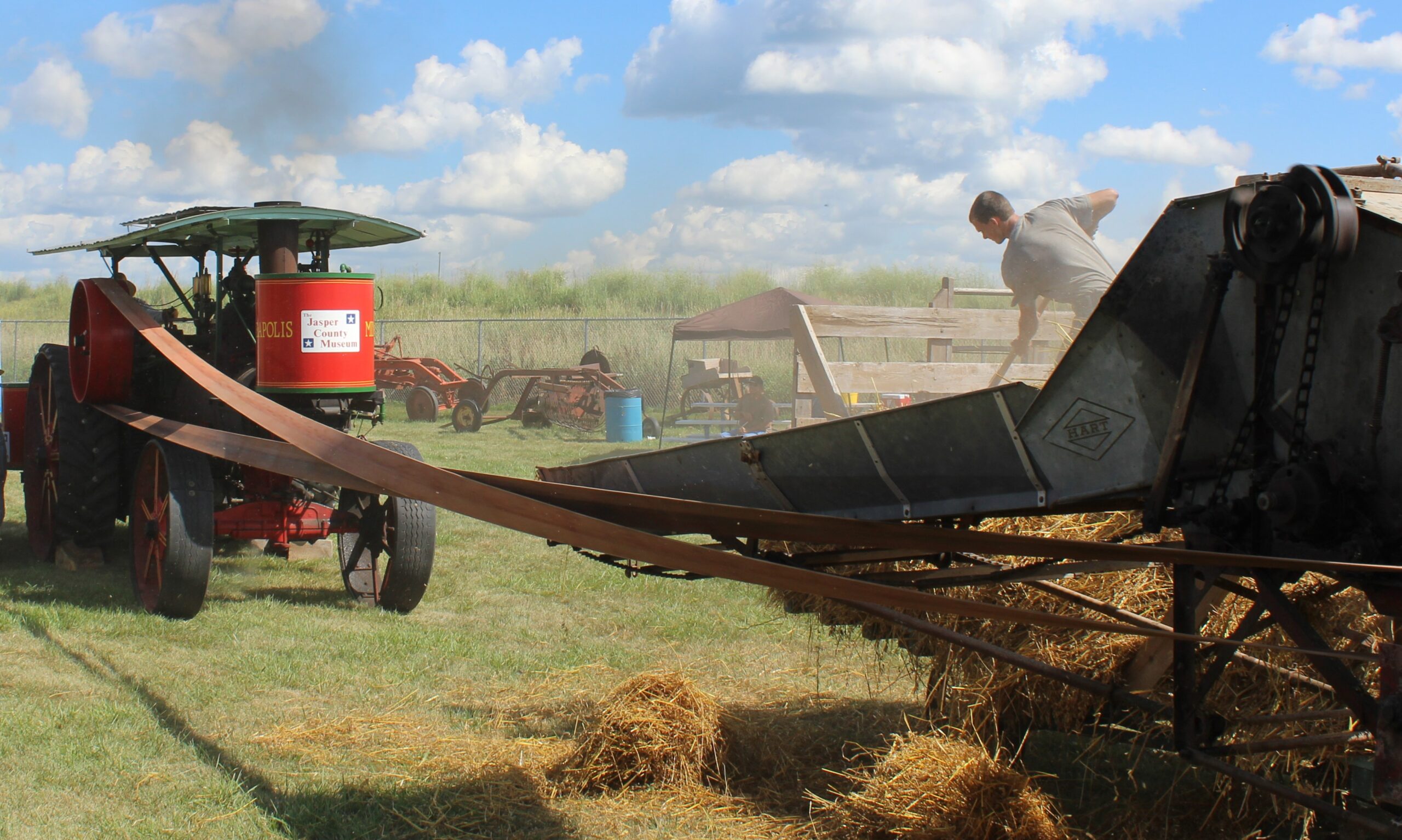
When the Dammeier brothers bought Owl Acres and its surrounding land in 1890, itinerant harvesters would travel throughout the country with their steam engines, to thresh grain. By belting the steam engine to the threshing machine, its power could be used to run the threshing machine and thresh the farmer’s oats or wheat in short order.
When I bought Owl Acres, we found pieces of a sawmill in the fence row. The Dammeiers used the saw mill, attached to a neighbor’s steam traction engine, to cut wood for buildings on Owl Acres.
Neighbors also borrowed the steam engine to thresh their oats or to power a grain elevator or a corn sheller. Threshing dinners were a part of rural life during this time. A famous Grant Wood painting depicts a typical threshing dinner.

Grant Wood painted this 6-1/2-foot-long image in oil on hardboard in 1934. In the collection of The Fine Arts Museums of San Francisco, Dinner for Threshers was inspired by Grant Wood’s childhood memories of the annual threshing ritual on his family’s Iowa farm. Wood’s cutaway view of an Iowa farmhouse interior recalls early Renaissance paintings depicting the Last Supper of Christ and his apostles.
Steam engines were large and heavy, weighing up to 20 tons. That sometimes caused problems as they were moved about, particularly on some of the bridges crossing streams. In one account reported in the article “Steam Threshing in the 1880s and 1890s” in the publication Farm Collector, Marcus Leonard tells of a very close call in the fall of 1897.
“The Little Rock River flowed west across the road four miles south of our former home in Lyon County, Iowa. A steel bridge, high above the water, spanned the river at that point, in 1897. That fall I operated a new 16 hp Gaar-Scott engine, belted to a new Gaar-Scott fully equipped separator.
The day we finished the season’s run, we were south of the river and it was necessary to cross that bridge to move the machine home. The bridge was more than twice as long as the rig. We drove onto the bridge about 3 o’clock, with the complete rig. The owner, a short man, was guiding the engine.
The engine was moving slowly and all went well, until it was about two-thirds of the way across the bridge, when the bridge began swinging sideways, violently, and it seemed every second the bridge would drop into the river. I all but stopped the engine, glanced at the owner, the bridge stopped swinging, I gently opened the throttle, the old Gaar-Scott crept across the bridge and we went home.
It just did not happen but no other two men came more nearly going into a river than Frank P. Fetzer and I did into that Little Rock, and his face was never more ashen, when laid in his casket than when I glanced at him that day.”
https://www.farmcollector.com/steam-traction/
In 1869 while the steam plow was being demonstrated, steam was already being used to power trains across the newly completed railroads. For 50 years, steam had been used to power steamboats on Iowa’s adjacent rivers. So steam engines were well understood.
A steam engine works by utilizing the properties of steam. Water is boiled under pressure in a boiler and then fed in controlled bursts into the chambers of a cylinder. When the steam reaches the chamber at one end of the cylinder, pressure is released, the steam expands instantly and pushes a piston forward. Steam is then allowed into the chamber at the other end of the cylinder and it pushes the piston back to the other side. The piston going back and forth drives a crank, which turns a shaft that drives the wheels on a train, or the paddlewheel on a boat, or the flywheel on a traction engine. In the case of the flywheel, another piece of equipment is belted up to the flywheel so that when it turns, it runs the thresher or the saw mill.
In 1936 Jack Healy, one of the Dammeiers’ neighbors, bought a steam traction engine for use on his farm. He also loaned it out to his neighbors, including the Dammeiers to power their sawmill. Today that same steam engine graces the Jasper County parade every Fourth of July.
Feature photo by Author. Alt Text: A 100-year-old steam traction engine is belted up to a separator threshing oats. The old Minneapolis worked on a farm nearby to Owl Acres in the early and mid-20th century. Owned today by the Jasper County Historical Museum, it appears annually in parades and shows in central Iowa.
2 comments
Loved reading about this. Is Bryan related to the Jack Healy in this piece or is that merely a coincidence?
Jack Healy is Bryan’s grandfather.