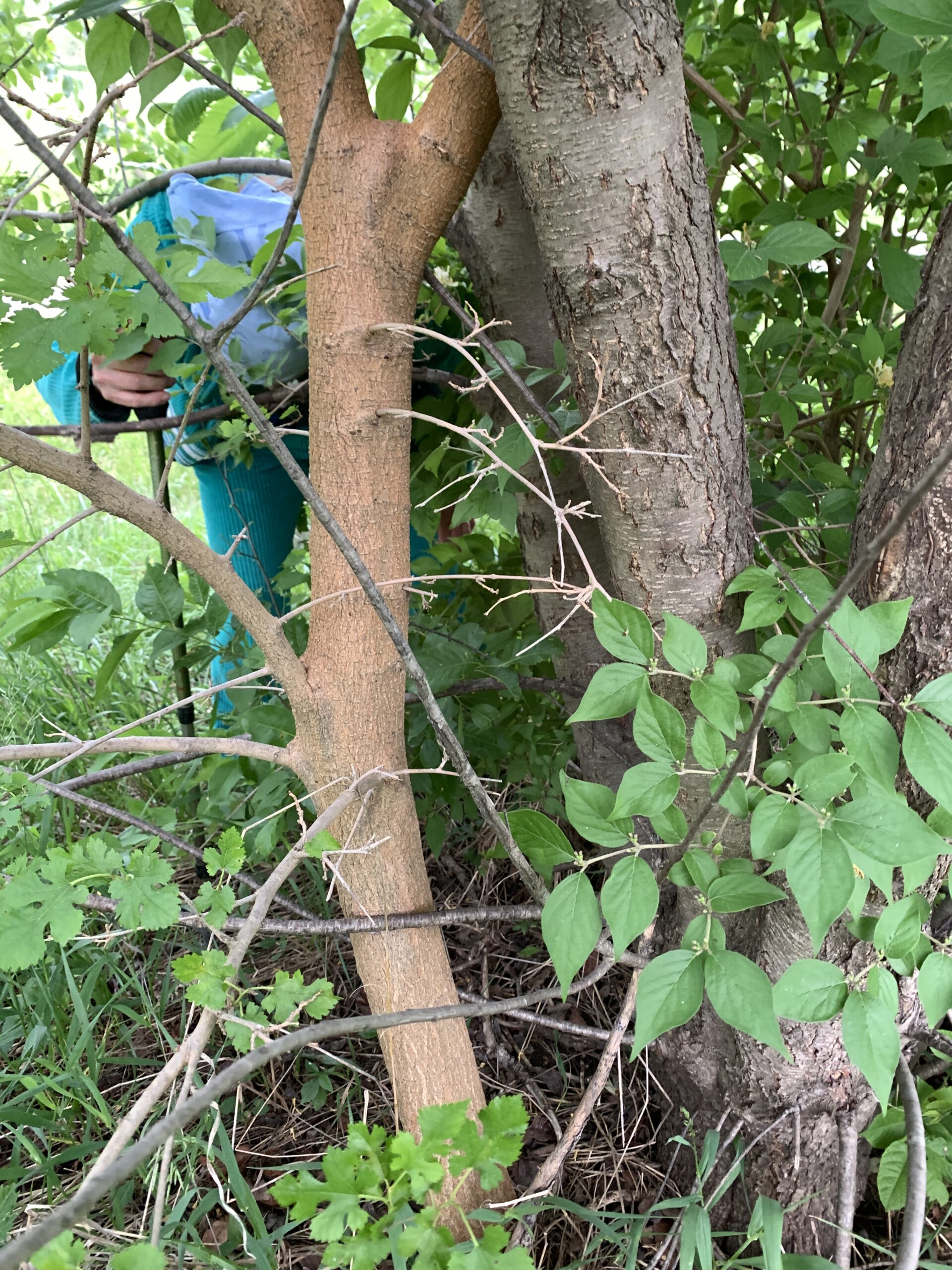
A wild black cherry tree crouches in a thicket on Owl Acres, reaching out its arms to the birds. The cherry tree shares its space with an American elm, a mulberry, and a tangle of honeysuckle. The cherry tree is decades old, with two main branches rising from a common trunk. It was probably mowed off as a youngster and then, as the people left the farmstead, the cherry tree and its compatriots were left alone to grow into today’s tangle. The thicket, with the cherry tree as its centerpiece, shelters and feeds the wildlife on Owl Acres.
Wild black cherry trees (Prunus serotina), are native to North America. They are close relatives of the chokecherry and have evolved alongside other natives in their ecosystem. One example is the eastern tent caterpillar (Malacosoma Americanum. The adult moths emerge in late June and July. They are brown with black heads and white stripes down their backs. They don’t last long. They mate and lay their eggs in masses of 200 or more on twigs and branches of the wild black cherry. Then the female coats the egg mass with a gray, varnish-like substance to hold it together. The larvae remain protected inside the egg case while they mature. Still in the egg case, they go into diapause to wait out the winter. They emerge in the spring as soon as the wild black cherry begins to leaf out. Voracious after their winter of fasting, the caterpillars start in on the new leaves. First, though, because nothing goes to waste in nature, they devour the egg case and covering. The hairy, 2-inch-long caterpillars are usually black with a white stripe down the back and brown and yellow stripes along the sides. The larvae colony spins silk and builds a tent in the crotch of a tree branch. They use the tents as shelter from rain and predators. The larvae don’t feed at the tent. Instead, they crawl to another branch, spinning an anchor thread as they go. When they’re done feeding for the day, they will follow their silk thread back to the tent. They mark these paths with pheromones as well to alert their siblings to a good food source.
During four to eight weeks of feasting, the caterpillars go through six instars and reach their final size of about two inches long. They expand the tent as they grow. When they decide it’s time to spin a cocoon and pupate, they drop to the ground, reconstitute themselves and emerge as hairy brown adult lappet moths.
The tent caterpillars have one generation per year. They don’t usually damage the tree. Even if they defoliate the tree, it’s early enough in the season that the tree is able to put out new leaves and keep going.
The timing here is not by accident. These two native species—the wild black cherry and the eastern tent caterpillar, have refined their dance so that the caterpillars emerge just as their food is ready. They leave the tree while the tree can still recover. These caterpillars play a foundational role in the spring food web, providing high-protein snacks for over 60 species of birds as well as a variety of invertebrates
Meanwhile, the tree puts out pollen and nectar in bunches of little white flowers that hang down from the branches. The flowers attract native bees, flies, and flower beetles. These pollinators go about fulfilling their roles, so that in mid-summer tiny, pea-sized cherries develop. The cherries are black when ripe, with a single seed in each one surrounded by a fruit that is bitter and unpalatable for humans. Wild cherries have traditionally been used to flavor rum, however, as the flavoring in cherry bounce, and thus have acquired the nickname rum cherries.
The cherries, in turn, will feed the birds, the mice, and other woodland creatures throughout the fall and winter.
At the same time that all this is happening, other native insects such as the caterpillars of the cherry scallop shell moth take their turn on the tree. Cherry lace bugs, aphids, scale insects, borers, leafhoppers, and the dreaded Japanese beetles all use the tree for food and shelter. Most of them are native species, respecting their host and their community, taking what they need but leaving their host healthy enough to survive.
Cherries are still my favorite fruit, but we’ll leave these wild ones to the birds. We’ll pick our domesticated cherries in mid-June.
Photo by Author. Alt text: A tangle of species forms a thicket on Owl Acres. Visible are American Black Cherry, White Mulberry, Amur Honeysuckle and a few leaves of American Elm, growing tightly together in competition for sunlight, nutrients and room to grow. The cherry has a head start, but the Mulberry is aggressively invasive. We’ll eventually have to put an end to it by cutting everything out to give something else a chance. (Homo sapiens is also visible crouching amid the thick foliage.)
2 comments
That’s a thicket, alright. Is there a tent caterpillar in the photo?
Nope, no tent caterpillars. For some reason we haven’t seen many of those critters here on Owl Acres. If we find some, you’ll read about it on these pages. Thanks!