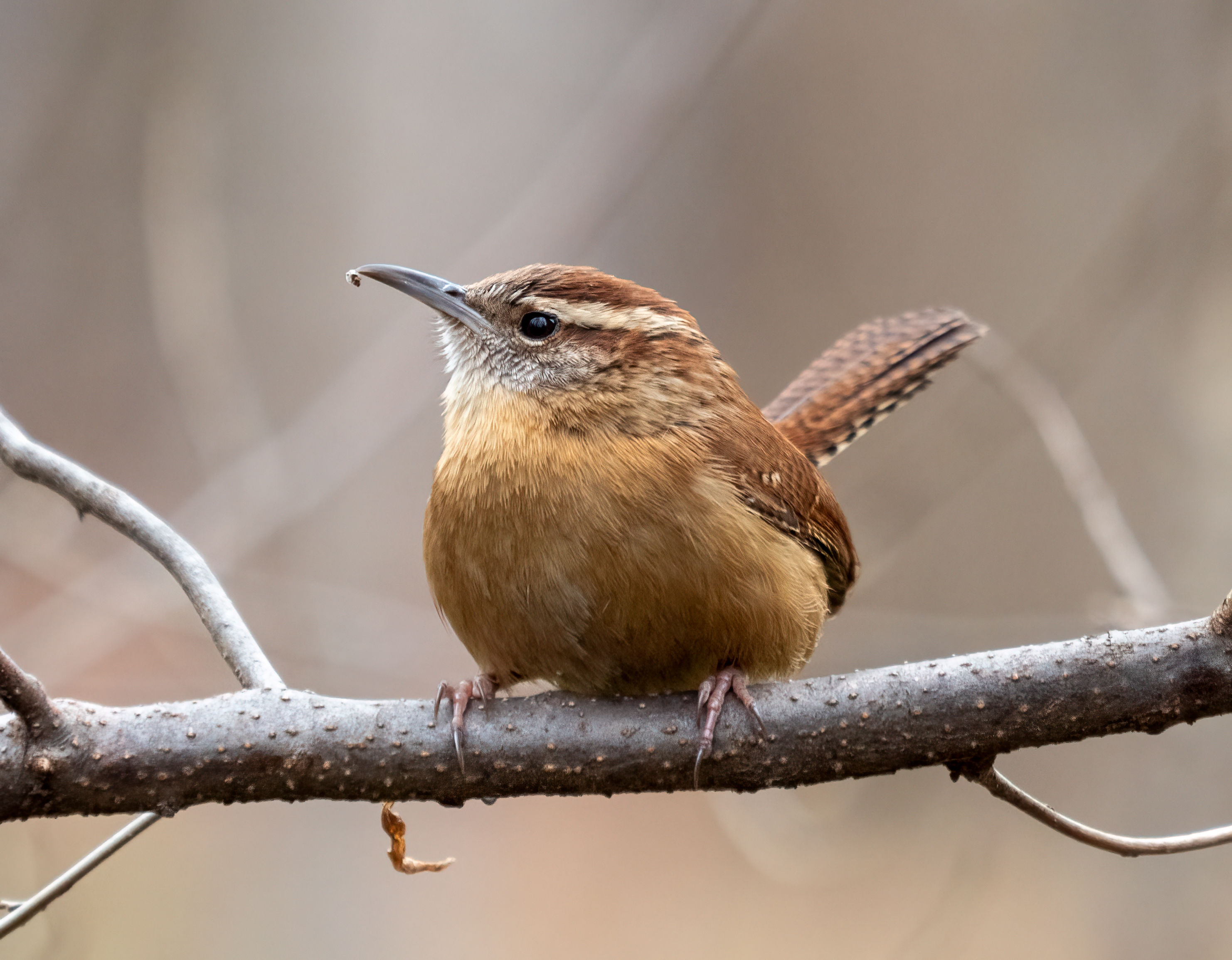
Throughout the spring and summer of this year, I have taken a few minutes each morning to explore the soundscape. With the help of the Merlin Bird ID app, I capture the voices of whatever birds happen to be singing or chattering at the time. Since the first day of spring, and periodically thereafter, we hear the Carolina wren’s song. Merlin tells me there’s a problem here. Carolina wrens don’t live in Iowa. They don’t migrate, and they live in the Southeast. They are expected to stay put in the Carolinas and not show up at my bird feeder ever, let alone in March when winter hasn’t truly left yet. But here they are, repeatedly adding their voices to the dawn chorus on Owl Acres.
Have they been here all winter and we didn’t recognize them? Carolina wrens are, in fact, home bodies, mating for life and setting up housekeeping in the same place year-round. Scientific studies have determined that they are both monogamous and faithful. So what are they doing here?
Two factors seem to account for their spread north from their ancestral thickets. First, winters are warming, and these little guys can find the food they need without contending too strenuously with deep snow or frigid nights. The second factor is we the people. We have set up bird feeders all across the country in order to enjoy watching our feathered friends go about their daily business. In return, the Carolina wrens are stopping at those bird feeders to snack on the suet blocks, peanuts, sunflower seeds and mealworms. With plenty of food easy to get, they can safely expand their range farther north. When harsh winters occur, though, that expansion is curtailed, and they either move back south or don’t survive.
We’ve kept our bird feeder full all last winter, offering the wrens and finches, chickadees and nuthatches and the other winter-dwelling members of our community plenty to eat. So perhaps the Carolina wrens have been dining there all along.
These little visitors are sparrow-sized bird with reddish brown back and wings, a rich buff-colored undercarriage, and a white eyebrow. They carry their tails cocked upward, and fly on rounded wings.
They build their nests in dense undergrowth like the fence row on Owl Acres. The nests are dome-shaped with an entrance on the side. Like other birds’ nests, they are lined with soft materials to cushion the eggs, and the nestlings when they hatch.
The female will lay four to six creamy-white eggs speckled with brown spots. The patterns on the eggs are specific to the Carolina wren. In fact, each breed of bird has its own color and marking scheme for its eggs. As the egg gets close to the end of its development journey in the oviduct, it passes by little “paint guns” that mark the egg with the appropriate color and pattern. All birds seem to use just two pigments for this task–a blue-green pigment and an orangey-brown pigment. Subtle combinations of these two pigments create everything from blue to orange and shades in between. Coloring their eggs serves several purposes. It helps to camouflage them so predators are less likely to spot them in the dense undergrowth or on the open ground. The coloring also helps birds recognize their own eggs when a cowbird or cuckoo adds their eggs to a nest.
Once the Carolina wren nestlings have hatched, both parents take on the job of feeding them. This lasts for a couple of weeks. Then the little birds are off to find and claim a place of their own. That leaves the parents free to initiate another family.
With warming winters, we are likely to see more of these bright songsters around our bird feeder on Owl Acres. We’ll have to pay more attention.
Photo from Wikimedia.org by Rhododendrites Alt text: Carolina wren sits on a twig. Round songbird faces the camera, looking up and left in frame. Tail is carried high with rakish white eyebrow and buff colored breast to complete the suite of visual cues. We’ve only heard its call here on Owl Acres, but we’ll try to pick it out from the crowd at the bird feeder.