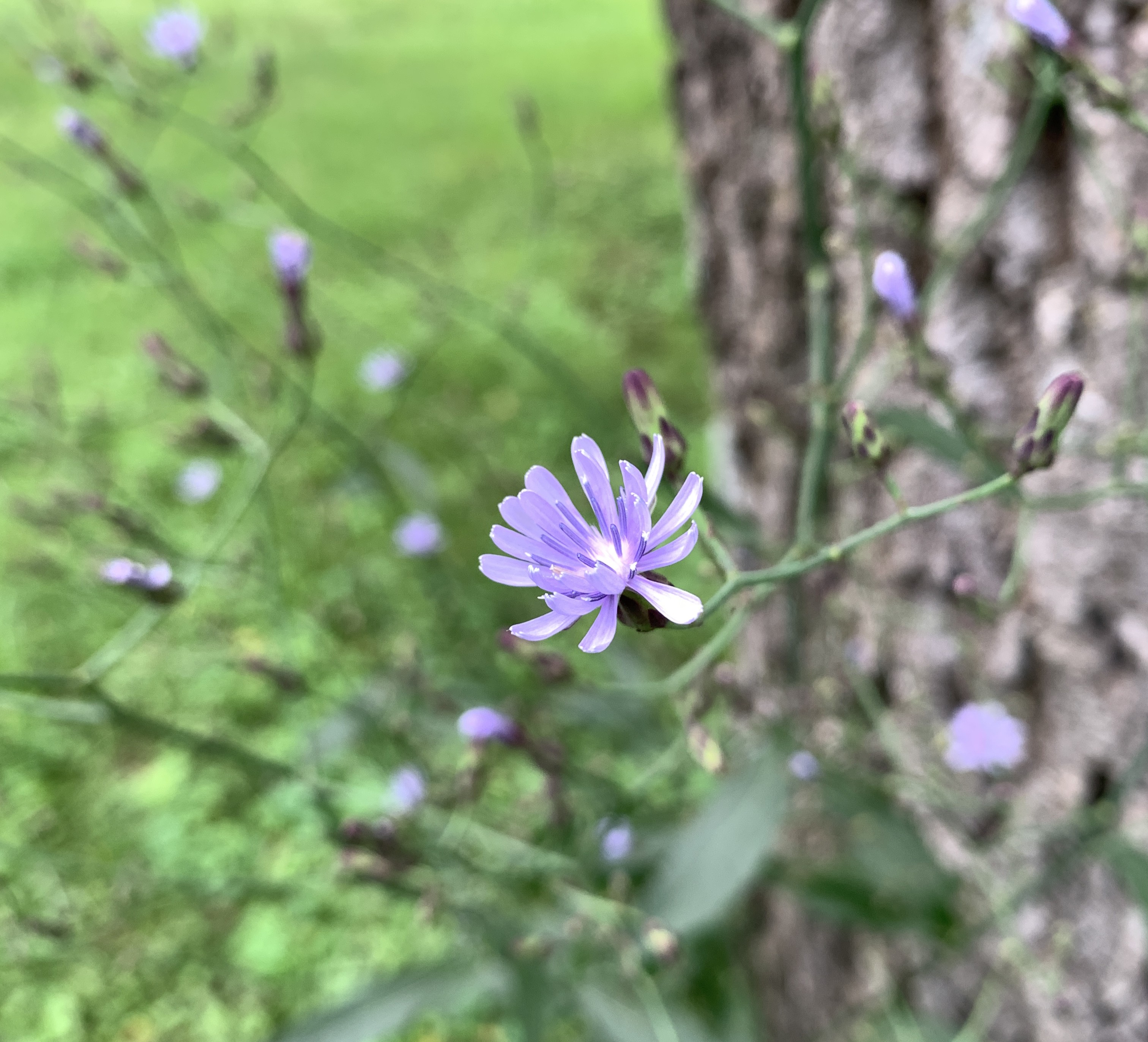
Lettuce, in my experience, comes in heads, wrapped in plastic from the grocery store. Or maybe in bags with a few other veggies. But here’s another kind of lettuce. It’s six feet tall and has a spray of pretty blue flowers at the top. It’s growing up in the shade right next to a walnut tree. Apparently, the chemicals that the walnut spreads around itself to discourage other plants from crowding in aren’t a deterrent to these pretty woodland flowers.
The plant is called woodland lettuce (Lactuca floridana). It’s also known as Florida lettuce or false lettuce. It’s not restricted to Florida, of course. It is native to North America and can be found throughout the east and middle of the continent as far north as southern Canada. It is shade tolerant, growing where many of our sun-loving plants don’t thrive.
The leaves are large at the bottom of the plant, composed of a central triangular piece that measures up to 12 inches long and 8 inches wide with wings on either side. Like sunflowers and Jerusalem artichokes, their cousins in the aster family, the leaves are scratchy. The leaves get smaller towards the top of the plant, and at the very top, an open spray of little bluish flowers occur at the ends of little stems. Instead of being flat like a daisy or a sunflower, each tiny flower is composed of 20 to 30 upright rays or petals. The flowers open in the daytime inviting pollinators to sample their nectar and carry their pollen. The flowers will be replaced with seeds once they’re fertilized. The seeds have evolved a couple of strategies to spread far and wide. First, like dandelion seeds, each seed has a pappus, bristles at the top of the seed. The pappus acts like a parachute, helping the seed stay aloft as it floats on the wind. Second, the seeds are buoyant, so they can float on water if necessary.
Both the scientific name and the common names are based on the features of the plant. Lactuca comes from the Latin “lac” meaning milk. The leaves, stems and roots of the plant all contain a bitter milky substance. And the leaves, although bitter, can be cooked as greens or used in salads when young and fresh.
The genus Lactuca also encompasses the lettuce family—both domestic (Lactuca sativa) and over a hundred species of wild lettuce.
Woodland lettuce blooms in late summer, offering nectar and pollen to sweat bees and leaf-cutter bees. Several species of moth larvae enjoy the leaves, and a bunch of different aphids join the late summer banquet. Cottontail rabbits, white-tailed deer and domestic livestock will sometimes eat it in spite of the bitter latex in its leaves.
Woodland lettuce has a history of medicinal and culinary uses. Among these are pain relief, and as an aid to relaxation and sleep. I found a long list of other uses, ranging from whooping cough to sexual dysfunction, all with a disclaimer that scientific evidence was not conclusive.
Photo by Author. Alt text: A pale purple, daisy-like flower tops one of about a dozen separate stalks on Woodland Lettuce.