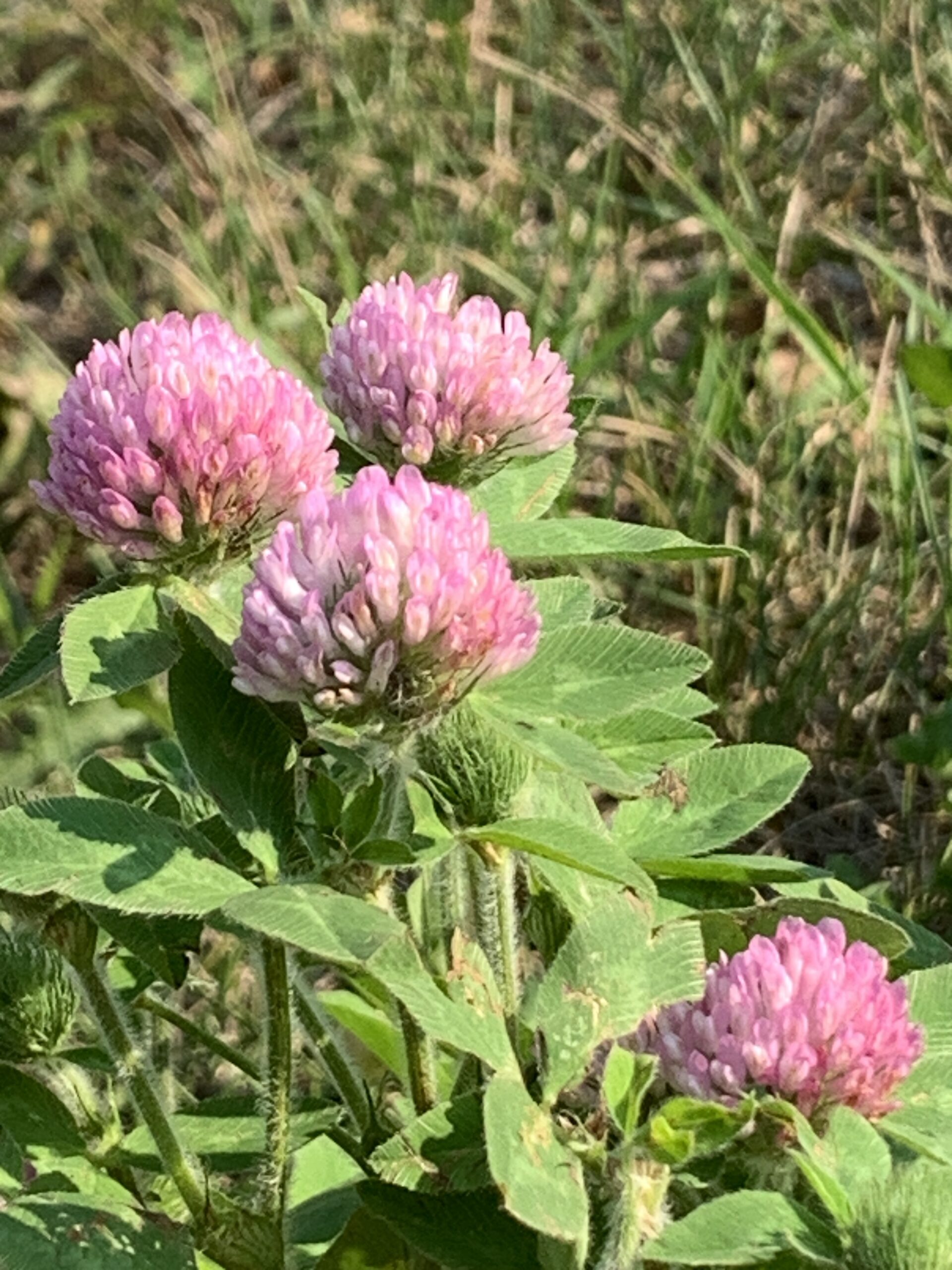
Red clover, (Trifolium pratense), those sweet-smelling perennials that grow on Owl Acres, offer something more than their pretty flowers to the landscape. They offer nitrogen.
Nitrogen is one of the crucial building blocks of life. Living things use it to build DNA, RNA, amino acids, and most living tissue. Nitrogen Is all around us in the air, making up about 78 percent of the atmosphere. Ironically, though, plants and people can’t use that nitrogen. It has to be “fixed”, that is captured and combined with something else. This can be done in a factory. By employing high heat and pressure, the factory can combine hydrogen and nitrogen to produce anhydrous ammonia (NH3. This is the form that farmers put on their corn fields as fertilizer. Plants don’t use the anhydrous ammonia directly, but it quickly combines with water in the soil to create ammonium, (NH4), a nitrogen compound that plants can use. It remains in the soil until it’s needed. This is how corn, for instance, gets the nitrogen it needs to flourish year after year in the same field.
Without fertilizer, most plants get their nitrogen from the soil. Decomposing plant matter, manure, and other natural sources recycle the nitrogen so that living things can use it. But if nitrogen-hungry plants like corn are grown in the same field year after year, they use up the recycled nitrogen and need to have more added.
One type of plant, however, is lucky enough to help manufacture its own nitrogen and share it in the soil with their neighbors. These plants belong to the bean (Fabaceae) family,and are known as legumes. like soybeans and peas. They grow nodules on their roots which become little nitrogen fertilizer factories. Instead of using high heat and pressure, they use a bacteria called rhizobia. The rhizobia fixes nitrogen to make the same anhydrous ammonia as above. The ammonia in the soil then reacts with water to form ammonium. The ammonium stays in the soil until it is needed by plants. Another type of bacteria in the soil adds oxygen to the ammonium to create nitrites. Still other bacteria in the soil add more oxygen to convert nitrites to nitrates. Plants can’t use the nitrites, but they can use the nitrates. When there’s an over-abundance of nitrates in the soil, yet other bacteria change the nitrates back into gaseous nitrogen in order to complete the nitrogen cycle and balance the ecosystem. This balance is extremely important for plants and the environment and can be unbalanced by the addition of nitrogen fertilizer. Plants can’t thrive if they don’t have enough nitrogen. However, Too much nitrogen can be toxic to plants. They grow too much biomass in the form of leaves and stems, but they don’t grow a sufficient root system. When nitrates wash into rivers and lakes, they basically fertilize the algae and aquatic plants that live there. After a riotous blooming period, they die. When these aquatic plants and algae die, the decomposition process sucks all the oxygen out of the lake or river, creating dead zones where nothing can live. Along with nitrate impact on the rivers and lakes, it also gets into drinking water and is thought to cause several kinds of cancer over time.
It’s these excess nitrites and nitrates that are leeching into our rivers and lakes and raising concerns about water quality. . The Environmental Protection Agency (EPA) mandates a maximum of 10mg of nitrates per liter of drinking water from public water utilities. In a natural, unpolluted river, the rates average between 0.01 and 1.0 mg/l. The water utility that serves Owl Acres publishes test results that range from 2.5 to 3.1 MG/liter.
But I digress. What does clover have to do with any of this? The answer is that clover is a member of the bean family, so it therefore fixes nitrogen so that plants can use it. In a natural, balanced ecosystem, the clover’s contribution to the nitrogen in the soil would help balance the cycle of growth and decay.
The red clover growing on Owl Acres grows to about two feet tall and produces dense clusters of pinkish-purple flowers. It is a perennial imported from Asia in the 1600s. Because it is a legume, it is often used as a cover crop to enrich the nitrogen in the soil. It is also used as a forage crop for cattle. Like other clovers, red clover leaves comprise three leaflets, each one with a V-shaped mark in its center.
The red clover will continue to bloom until fall, providing food for our native bees and butterflies. Later they’ll set seed for the birds. They’re one of the hundreds of inhabitants of Owl Acres making their unique contributions to our little ecosystem.
Photo by Author. Alt text: Balls comprising dozens of tiny red-pink flowers sit atop upright stems of Red Clover. Foliage of this important forage species is made up with leaves of three leaflets each.