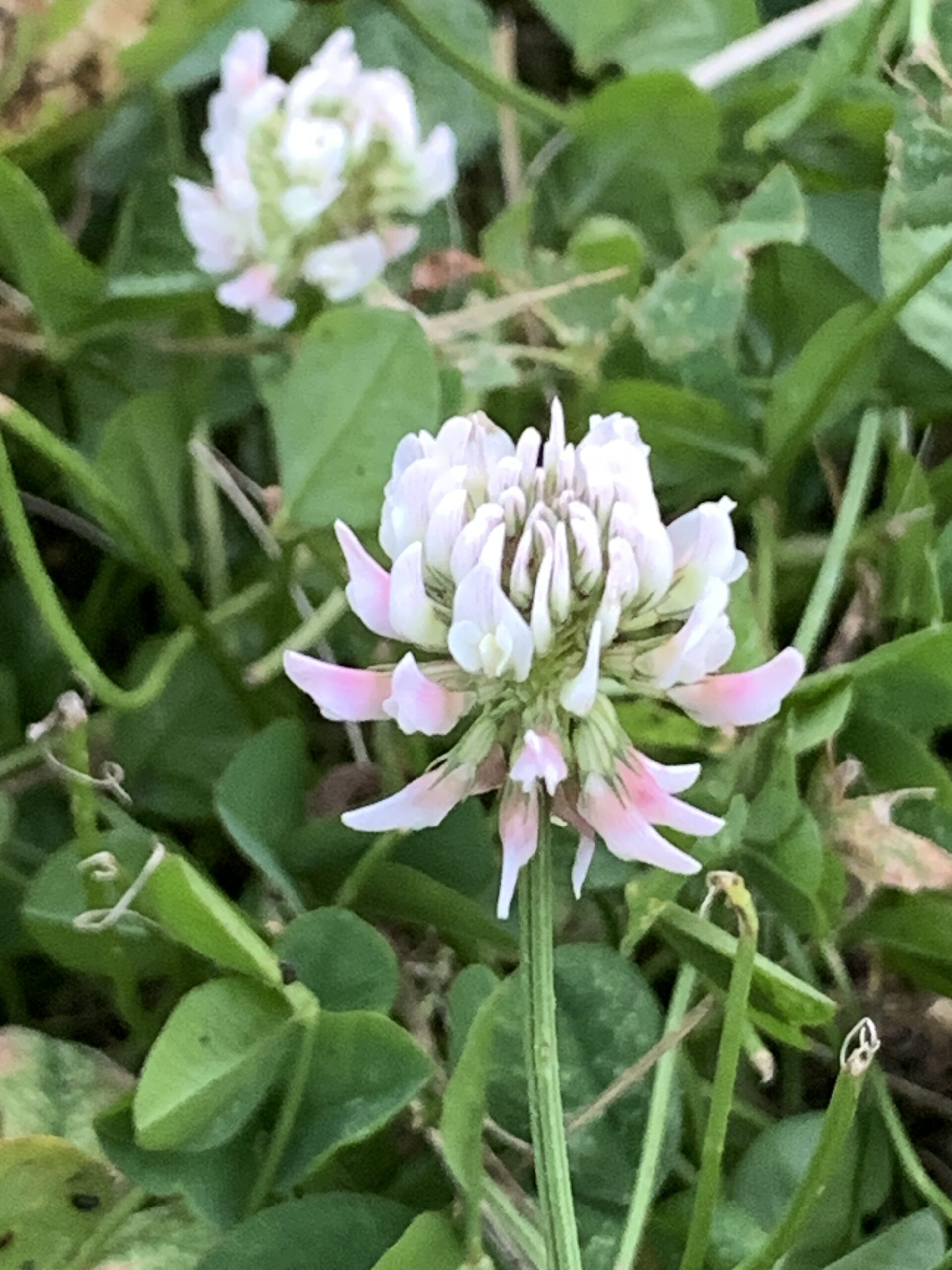
Have you ever seen a four-leaf clover growing wild? If so, you are considered one of the lucky ones. You are one out of 10,000 folks. That doesn’t count the four- and five-leaf clover plants you can buy with their genetic modifications. Are we trying to create our own luck here? In the natural setting, the four-leaf clover simply has a fairly rare mutation.
Like its cousin red clover, white clover is a legume. With its ability to fix nitrogen, it is beneficial to a healthy lawn. It’s not always appreciated, though. It grows and spreads into the bluegrass using stolons that reach out across the ground and root from nodes along the stem. This creates a mat of vegetation that doesn’t please the avid lawn-owner. In the 1950s clover seed was actually packaged with grass seed specifically because of the clover’s nitrogen-fixing abilities. Today, lawn care involves chemical fertilizer instead of patches of little white flowers. And it takes a lot of fertilizer to get the lush, dense carpets of grass that I love to walk barefoot in. We don’t have that kind of grass on Owl Acres!
White clover is a perennial that blooms all summer, producing balls of 20 to 40 tiny white flowers on stems up to 12 inches tall. It spreads both by seed and through its stolon system. Its leaves come in groups of three and usually have an inverted V-shaped watermark near the bottom of each leaf.
The traditional, unmodified wild white clover (Trifolium repens) that is popping up in the grass on Owl Acres is native to Europe and Asia. It is a common sight in Ireland, where it has a particular mystique associated with St. Patrick, the patron saint of Ireland. St. Patrick, the story goes, was born around 400 A.D. in Scotland. When he was sixteen, he was captured and enslaved by the High King of Ireland. After six years of herding sheep, he escaped, found his way home, and studied for the priesthood. He became a bishop and the Pope sent him back to Ireland to convert its people to Christianity. In his efforts to explain the Holy Trinity, he plucked a three-leaf clover and used it to illustrate the concept of three in one. Today another interpretation assigns the three leaves to faith, hope, and charity; and if there’s a fourth leaf, it’s for luck.
Many species of white clover exist throughout the world, so there is some disagreement about which specific species is actually the shamrock of Ireland. Two species vie for top billing—ours (Trifolium repens) and Trifolium Dubium (the lesser clover.) Results of two botanical surveys, one in 1893 and one in 1988, attempted to settle the matter. The results were not conclusive.
As herbal medicine, white clover has been used as an anti-inflammatory and pain reliever, as well as a remedy for coughs, congestion and fever. It can also be added to salads as a salad green offering vitamin C and antioxidants.
Our lowly white clover thus takes its place on the world’s stage, with shamrocks gracing many things Irish and promising us luck into the bargain, even if we have to engineer it ourselves.
Photo by Author. Alt text: Like its larger red cousin, White Clover blooms with balls of tiny white flowers. By far most of the leaves of this legume have three leaflets, but about one in ten thousand has four.