Monarch butterfly rests, wings spread, on a milkweed. Colors are bold orange with prominent black veining, and white spots. This photo was chosen for its similarity to the photo of the Viceroy elsewhere in the post. There are differences in markings, but they’re easy to miss on casual observation.

Warning, Poison Here: Monarchs, Viceroys, Tussock Moths and Milkweed Bugs

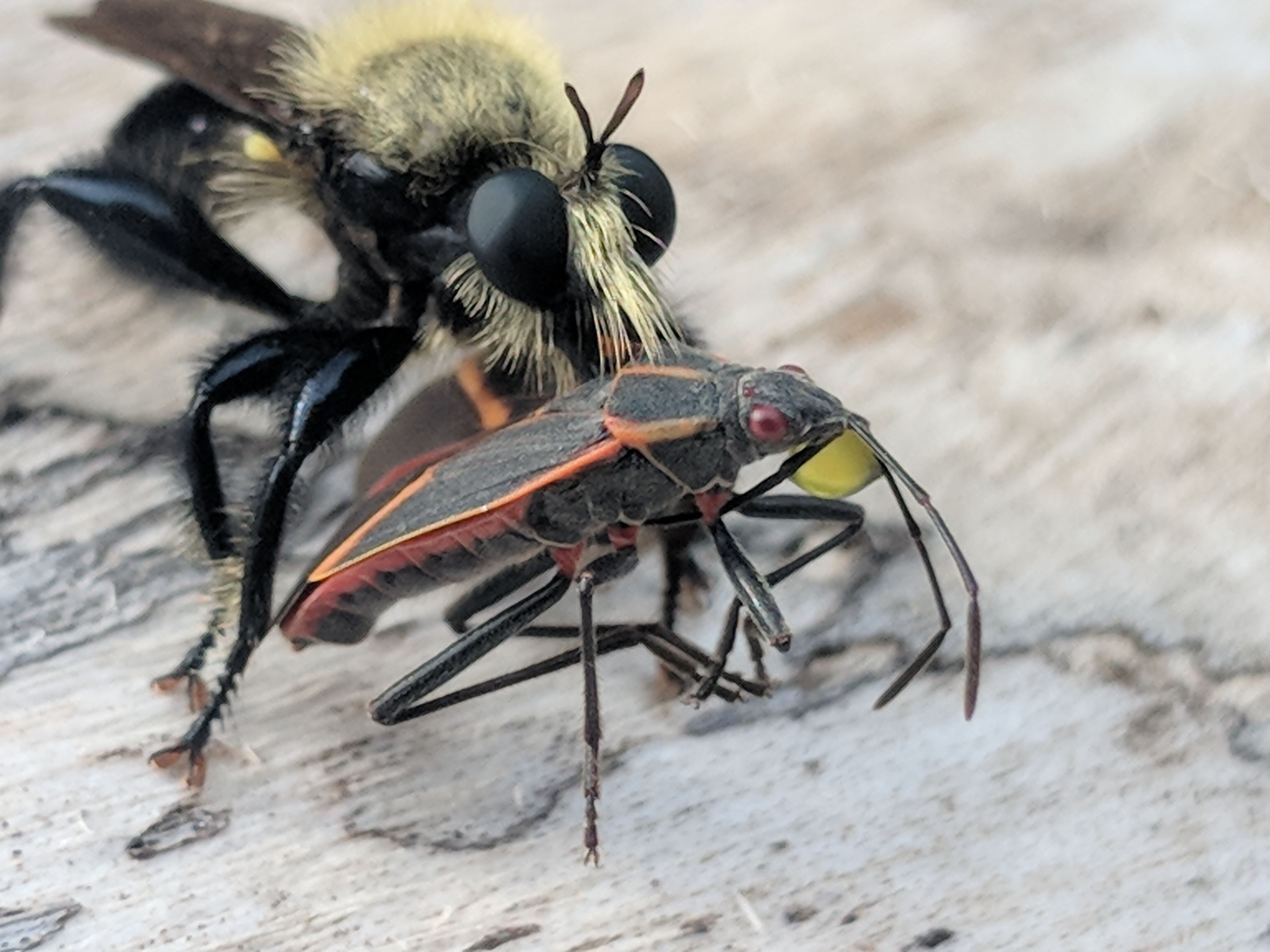
My favorite time of the year has just opened its arms to launch a festival of colors and aerobatic displays. Birds are beginning to migrate, and so are the monarch butterflies. Most birds make their migratory trips south and back north all in one generation, but the fragile and beautiful monarch butterflies (Danaus plexippus) have […]

Continue reading Warning, Poison Here: Monarchs, Viceroys, Tussock Moths and Milkweed Bugs
Karen's hands are shown as she inspects a dust-covered common milkweed plant in the road ditch next to Owl Acres. Five nubby seed pods are clustered at the top of the plant.

Milkweed

There’s a clump of common milkweed (Asclepias syriaca) in the ditch on Owl Acres. This is a happy place for those beautiful and amazing monarch butterflies. The milkweed has hosted their larvae and now they’re getting ready to undertake that long and convoluted migration of theirs. But the milkweed they leave behind has its own […]

Continue reading Milkweed
Whole lot o’ growing going on here. Karen stands on a riotous green hillside, surrounded by all three varieties of foxtails found on Owl Acres. Panicles of giant foxtail nod over her head, while green and yellow foxtails carpet the ground at her feet. Cornfield in the background, and an astonishingly productive Jonathan apple tree stands at the top of the hill. Karen is actually inspecting a velvetleaf, aka buttonweed, a broadleaf weed that will be featured in an upcoming post.

Weed or grain: Foxtail

It’s late summer now and the world is turning tan. Grasses are tired. Crops are drying, and three species of foxtails are waving their bottlebrush heads and dropping their seeds. The smallest are the green foxtails (Setaria viridis), also known as green bristle grass, bottle grass, pigeon grass and wild millet. They stand about two […]

Continue reading Weed or grain: Foxtail
A field of tiny, cone-shaped holes in the sand next to the house. Antlion traps.

Angle of Repose: Antlion

What’s up with this array of perfectly cone-shaped pits in the sandy soil along the foundation of the house? The pits are all exactly the same size with scribbly, doodly tracks in the sand between them. What we have here is an antlion larva, pronounced ant lion (Myrmeleon spp.). Its name is of old, showing […]

Continue reading Angle of Repose: Antlion
Hard to take a picture of something made out of air (like a heat dome), so here’s one of an airborne activity happening at Owl Acres on a hot summer morning. A large quad drone is being used for aerial chemical application to the adjacent cornfield. The aircraft flies a pattern over the field, controlled by a computer and guided by GPS. It’s applying a broadleaf herbicide that kills every plant in the field that’s not corn, and a broad-spectrum (pyrethrin) insecticide that kills every insect it touches.

Too Darn Hot: Heat Dome

For several days this summer, the temperatures climbed into the high nineties during the day and stayed in the high seventies at night. Days like that are the worst of the summer days. The humidity is so high that when I walk out of my air conditioning into the heat, the air feels alive as […]

Continue reading Too Darn Hot: Heat Dome
Soybean pods covered with fine hairs hang in clusters from central plant stem

Farmer’s Fixation: Soybeans

The little field across the road from Owl Acres is planted in soybeans this year. Last year it was corn. It’s late summer now, and the soybeans (Glycine max) are beginning to dry and change color. Green leaves and stems are turning yellow, and the pods hanging from the plants are darkening to brown. When […]

Continue reading Farmer’s Fixation: Soybeans
The unkempt woods on Owl Acres. The house is faintly visible in the morning haze.

Soil Part 6: Mycorrhizal Fungi

Wherever I walk on Owl Acres, there’s a living web under my feet holding it all together. That web is created by a particular type of fungus called mycorrhizal fungi. Sometimes they pop up various varieties of mushrooms like the beloved morels, but generally they are busy doing other things. Mycorrhizal fungi consist of a […]

Continue reading Soil Part 6: Mycorrhizal Fungi