I heard the name curly dock often when I was growing up in the shadow of WMT radio. WMT was the Cedar Rapids radio station that my dad listened to whenever he was in the house. On summer days, He would come in from the field at noon for dinner. He would turn on the radio to hear the news and the market reports. The farm news was interspersed with ads for all kinds of things relevant to farmers including herbicides to kill curly dock. I had a vague impression that curly dock was not a welcome trespasser in Dad’s fields. I never paid much attention, though, and at that time I had no interest in learning about weeds of any kind. Now I realize that a lot of the work my dad did in the fields was combatting weeds like curly dock so they wouldn’t crowd out his soybeans or corn.
And then, this summer, curly dock became a fixture in the front yard on Owl Acres. Too busy with other things, the solution was just to mow it off. The leaves of the curly dock succumbed to the mower, but the roots didn’t. It popped back up as soon as our back was turned. The plant sends down a fleshy tap root which may reach as deep as four feet. It also sends out lateral roots that reach three feet or more and can add more tap roots if it thinks it needs them. No wonder it keeps coming back!
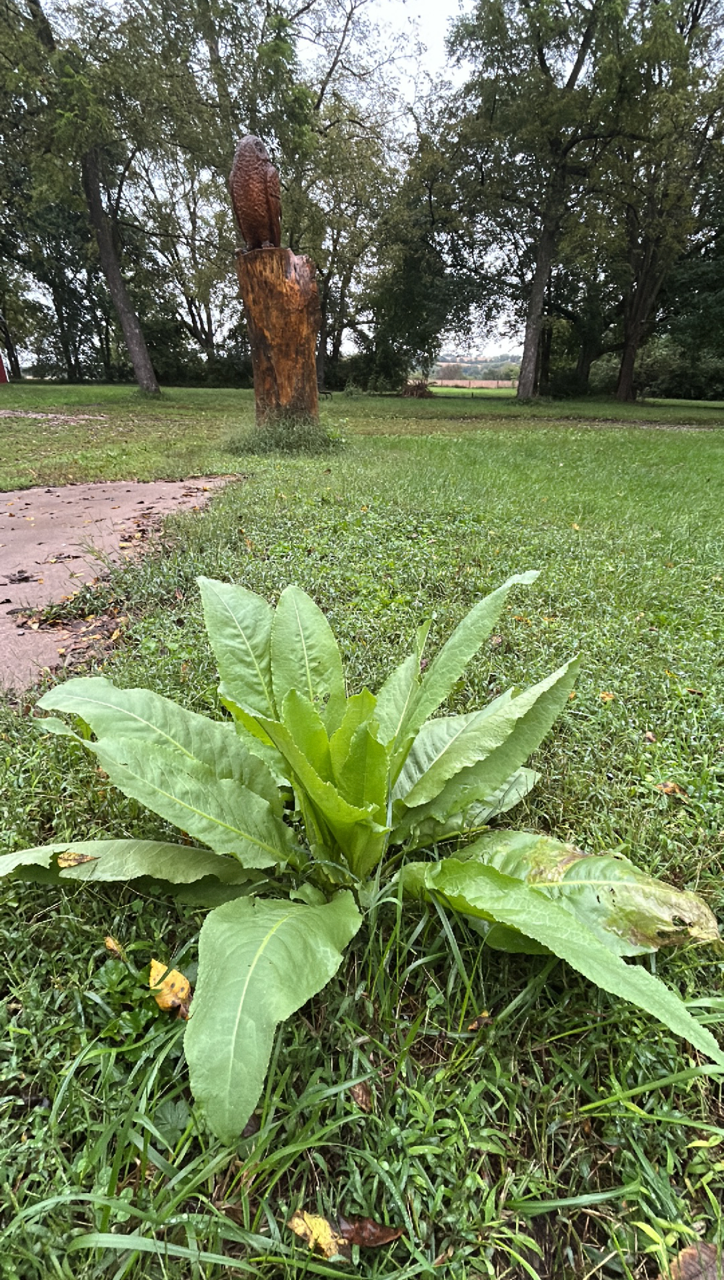
Curly dock (Rumex crispus) is a broad-leaf perennial. It spreads by casting up to 60,000 seeds per plant on the wind. When it germinates, it starts growing a rosette of leaves on or near the ground. The leaves are up to 12 inches long and two to three inches wide. They are a dull green and have crinkly or wavy edges.
In the spring and summer, and into the fall, it sends flower stalks up three feet or so. Each stalk has a few leaves on it and dense panicles of flowers at the top. The flowers have no nectar so don’t attract pollinators. They are green and pollinated by the wind. The flowers mature into small winged seeds. Equipped with a chemical that prevents microbial decay, the seeds can lie dormant in the soil for 50 to 80 years before germinating. Its seeds don’t all germinate in the spring. They are genetically programmed to germinate at various times throughout the growing season. The result is that even if you kill them all in the spring, more are waiting to germinate later in the year.
Curly dock is native to Asia and northern Europe. It was introduced to North America in the 1700s, probably in a shipment of grain. Today, it thrives in disturbed areas, pastures, roadsides and fields throughout the world. The only place it is not found, “according to sources at the University of Colorado, Boulder” is in Greenland.
Very young leaves are edible if boiled several times to remove the oxalic acid., as they mature, they produce more and more oxalic acid, which makes them extremely bitter. It also combines with calcium to form an insoluble compound that can damage kidneys. It can therefore be harmful to cattle, but its bitter taste discourages most mammals from eating it.
Curly dock may have a saving grace or two. If properly treated to get rid of the oxalate, it can provide a rich source of iron, phosphate, and vitamins A and C. It also serves as a host plant for the larvae of copper butterflies.
With its deep and branching root system, its prolific seed production, and its ability to grow in just about any circumstance, curly dock is very hard to get rid of. Research offers two solutions. Dig it up—remember those roots, or use Roundup herbicide on it.
Photo by Author. Alt text: Study in persistence. Large, wavy-edge leaves of Curly Dock tower over the short clipped grass in the front yard. The plant has been here all season and gets mowed off every time. And every time, it grows back just like this. The Owl Acres tree sculpture stands in the middle background. In the distance are black walnuts that are dropping nuts and leaves already on this first day of fall.
1 comment
No wonder Trump wants Greenland. There’s no Curly Dock? Ha!
Thanks, as always, Karen, for the well-researched info. – Joe