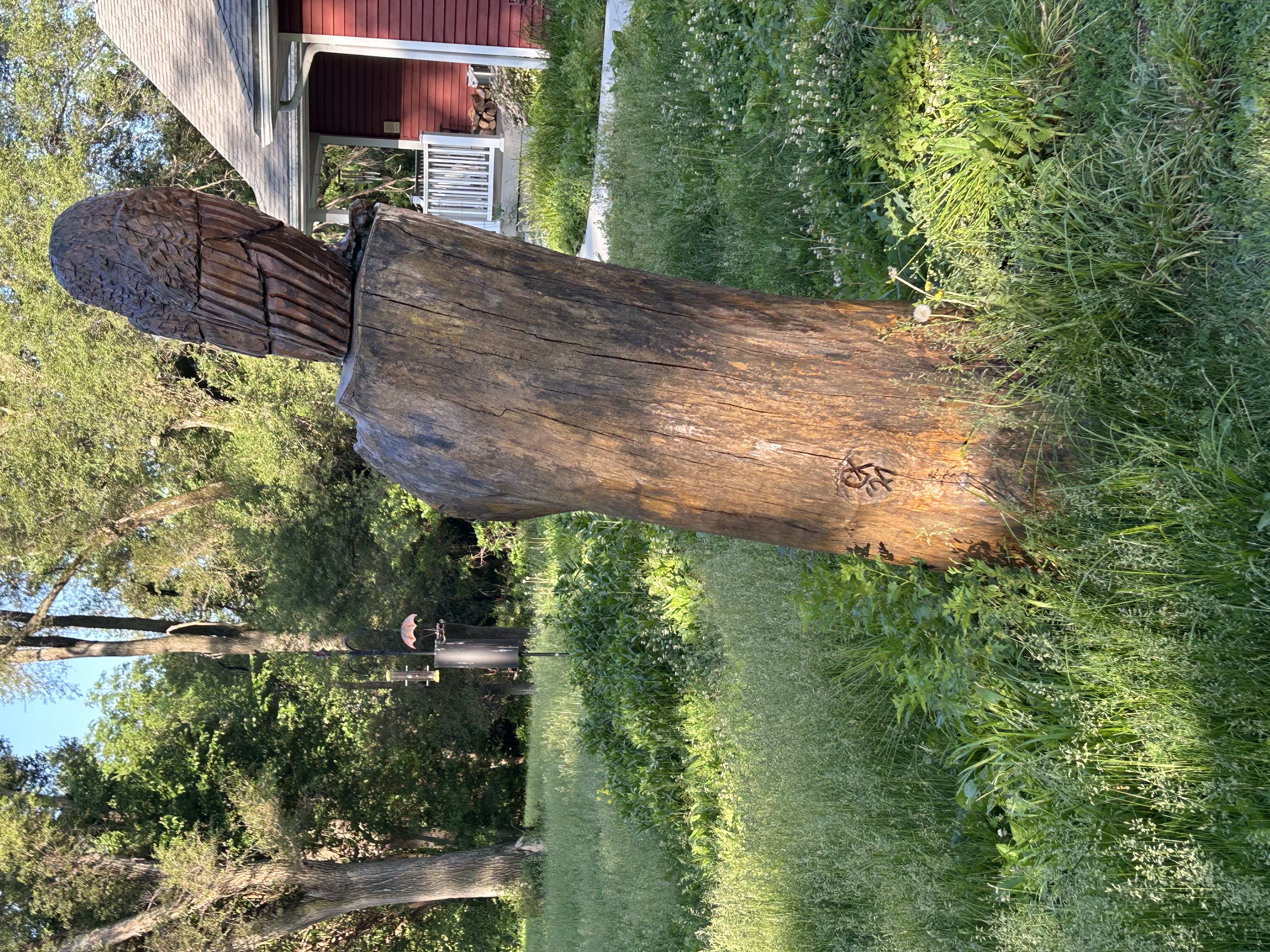
Standing in the yard near the birdfeeder, I am surrounded by jubilant life. That life is expressed in knee-high grasses and forbs. They have sprung up during May. They took their chances to sprout and grow and flower and, in some cases, to go to seed already. In most years, these residents of our yard don’t get a chance to thrive and bloom and prepare for their next generation. Instead, in a nod to convention and tidiness, Bryan mows them off. This year, however, during the ebullient month of May, the mower was broken. That gave the plants which are usually considered weeds, the chance to come into their own. And they did so with gusto.
Owl Acres consists of about four acres of woods and four acres of meadow or yard. Interspersed in the meadow are islands of growth anchored by trees. We leave these islands to their own devices, knowing that they are good habitat for our fauna. The woods, likewise, are allowed to grow as they will and are set aside in a forest reserve for habitat (and tax) purposes.
The meadow and yard portions of Owl Acres are usually mowed regularly throughout the growing season. Bryan mows these spaces with a 1947 Farmall A tractor with a belly mower underneath.

A small red tractor stands in tall grass in front of the red house on Owl Acres. The old Farmall is ideal for maintaining the nearly 4 acres of yard on the property. Author photo.
I bought the tractor for mowing. It was built to do this type of work on a farmstead. About 80 years ago. It has had a hard life since then. A previous owner left it out in winter to freeze. Repairs were made by someone who, Bryan thinks, didn’t really know what he was doing. Some parts were just left off, bolt threads were stripped, and the final drive unit was hanging by a thread, supported only by the frame of the mower. A couple of mowing sessions in April made it clear that it needed to be overhauled. Normally this would be a winter project, in the time-honored way of farm machinery of old. This couldn’t wait till next winter though, so Bryan took it out of service and made the repairs during May.
By June, the yard was a cacophony of rampant growth. Grasses claimed their spaces. Native forbs found a safe haven to flourish. Field mice had a protective cover as they went about their daily routines gathering seeds, bearing young. Birds landed on the bird feeder and kicked out some of the safflower and sunflower seeds. The ground patrol missed some of them, so these unexpected upstarts joined the motherwort, the wild mustard, the elm, mulberry and walnut seedlings and a bunch of other forbs and grasses.
On June first, the free-for-all was over. The tractor was repaired, the mower blades sharpened, and the weather was right. Most of the species that grew up around the bird feeder will live through the mowing even though their tops are sheared off. They will attempt to grow back, and they’ll be mowed off again and again throughout the summer. In celebration of this joyous exuberance of life, we acknowledge the individual species by identifying 20 of them. Each one has its own story and its own role in the symphony that is Owl Acres. The list includes:
Smooth Bromegrass Bromis inermis
Kentucky Bluegrass Pos pratensis
Orchardgrass Dactylis glomerata
Black Medick Medicago lupulina
Tree Spinach Chenopodium giganteum
Curly Dock Rumex crispus
Oval-leaf Sedge Carex cephalophora
Field Pennycress Thlaspi arvense
Summer Cypress Bassia scoparia
Blackseed Plantain Plantago rugelii
Common Sunflower Helianthus annuus
Common Blue Violet Viola sororia
Wild Mustard Sinapis arbensis
Safflower Carthamus tinctorius
White Clover Trifolium repens
Lambsquarters Chenopodium album
Giant Ragweed Ambrosia artemisiifolia
Let’s raise a toast to the tenacity, the variety and the generosity of life—it’s all around us.
Feature photo by Author. Alt text: The Owl Acres Black Walnut tree sculpture stands in the foreground of a chaotic, un-mowed yard of grasses and weeds. A portion of the barn red, white-trimmed house is on the right. In the middle background is the bird feeder, surrounded by plants sprouted from seeds kicked out by the birds. Siberian Elm yard trees and the east face of the woods form background for this little world of May green in Iowa.
1 comment
Really enjoyed this and the pictures. what a beautiful place you have.