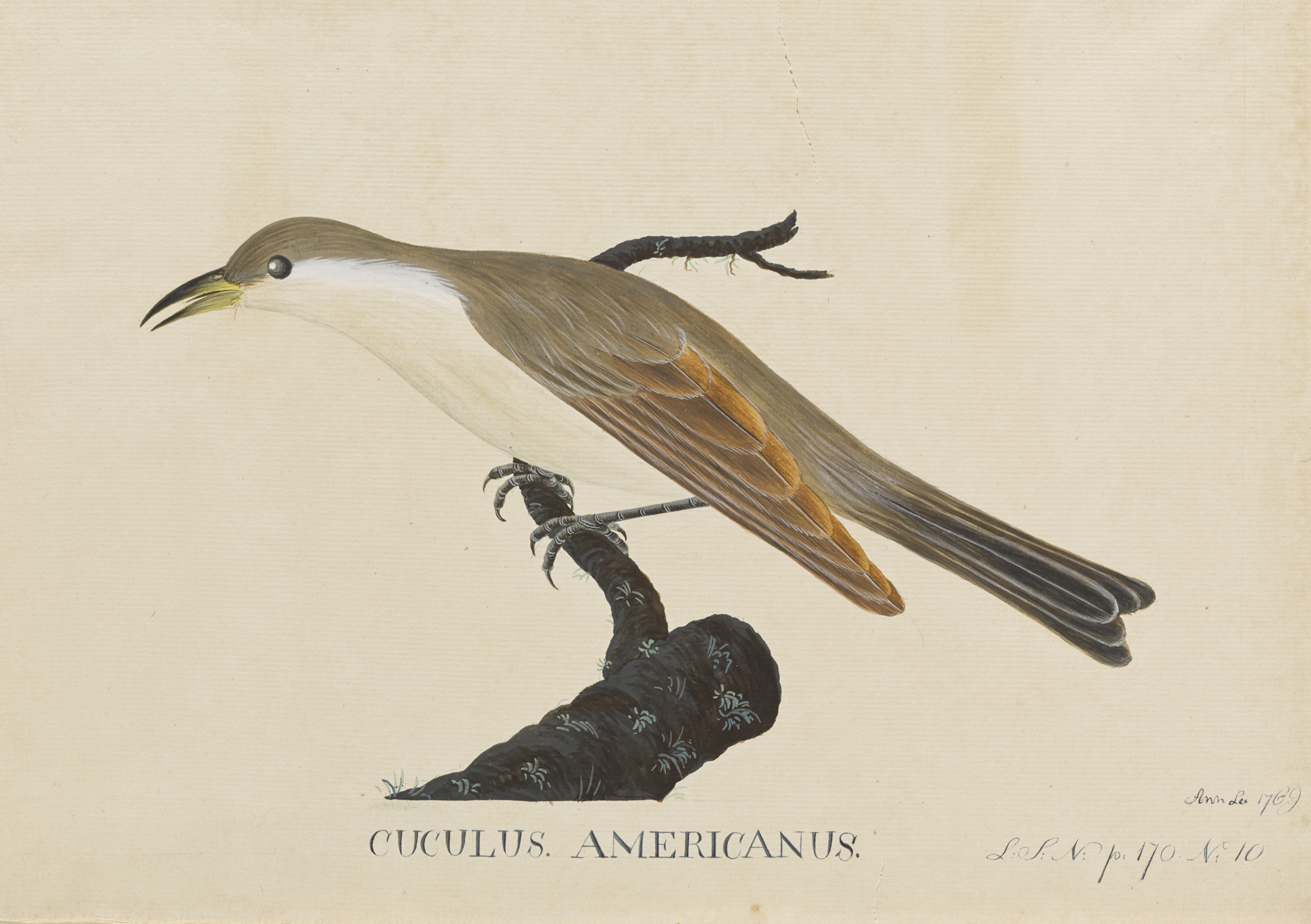
A few days into summer, around 6:30, I woke to a bird piping repeatedly outside my window. We hadn’t heard this bird before. It sang a greeting in a series of uniform piping calls. Perhaps it was looking for a mate, or perhaps he was just calling hello on his way to the forests farther north.
Our visitor was a yellow-billed cuckoo (Coccyzus americanus). Of course, he doesn’t sound anything like the cuckoos in the German forests that served as the model for a cuckoo clock. But his call was distinct, and easy to hear. He was chanting his song high in the trees of our forest preserve where we couldn’t get a sighting but could clearly hear him.
This cuckoo has a sturdy, mostly yellow bill that is somewhat down-turned at the tip. Both sexes are brownish on their backs and white underneath. They have black face masks around yellow eye rings, and bold black and white bands adorn the undersides of their long, rounded tails. In flight, they show off reddish feathers on their wings. They’re about the size of a robin with a long, slender silhouette.
Yellow-billed cuckoos are related to roadrunners and black-billed cuckoos, and are native to the New World. They are considered perching birds, with two toes going forward and two toes backward on each foot. They arrive on northern breeding grounds in June after a long and dangerous nocturnal migration from as far south as Argentina. They head back south in August. This doesn’t leave them a whole lot of time to mate, lay eggs, fledge their young and get them ready for thousands of miles of nocturnal flying.
In order to accommodate their short breeding season, these Cuckoos lay two or three large blue eggs. The larger eggs allow the chicks to be more mature than average when they hatch, and by the time they are seven days old they have their feathers and are leaving the nest to run along tree branches. Soon they will be able to fly, and within a few weeks they’ll head off with their parents for the wintering grounds in Central and South America.
Yellow-billed cuckoos mate in the spring and stay together while they raise their young. The male courts the female by bringing her sticks for her nest. When she gets around to laying her eggs, she might decide to take the easy way out and lay them in another bird’s nest. But she may choose her own nest and share incubation and feeding chores with her partner.
Caterpillars and grasshoppers make up around 70% of this cuckoo’s diet. They will catch and eat thousands of tent caterpillars in a season, chowing down on up to 100 caterpillars in a single sitting. Cicadas, beetles, wasps, and even preying mantises round out the buffet of treats they bring their chicks. They’ll even drop to the ground to chase and capture small frogs and lizards.
I love to catch the song of these migrants. The one that graced my morning recently was calling again a week or so later, so perhaps he’s decided to stay on Owl Acres and find a mate. Or maybe he’s decided to travel on. I’ll listen for that distinctive call throughout the summer.
Image from Wikimedia.org by: Ann Lee (1753-1790) Alt text: To join America’s 250th Birthday Party, Heartland Safari presents this image of a Yellow Billed Cuckoo. The watercolor painting was made 257 years ago by Ann Lee. We invite you to follow the link above and read more about the young lady whose work has time-traveled a quarter of a millennium to grace today’s post.