Often a well-chosen turn of phrase, or a name, can immediately conjure an image. These are the jewels that writers look for. And they’re the names that last through the centuries because of their aptness. And yet, as language changes, the name may be retained without the surrounding context to provide that image. Knowing where a name originated helps to rebuild that context at least to the point that the name makes sense.
Take the name of a plant called bouncing Bet. It is called that to evoke a particular image—that of a washerwoman vigorously scrubbing clothes on a washboard or on the rocks in a river. And the connection? Another name for this plant is soapwort because when you mix its sap with water, it lathers and makes a mild and useful soap. The soap can be used to clean wool, soften leather, or take a bath. The ancient Romans used it to make a nice sudsy lather to wash their togas.
Bouncing Bet likes to grow in disturbed places where it can get a foothold. It is happy to crowd out other plants and discourage insects with its unpleasant to poisonous sap. The sap contains saponin, the compound that makes it lather when mixed with water. It also makes it poisonous.
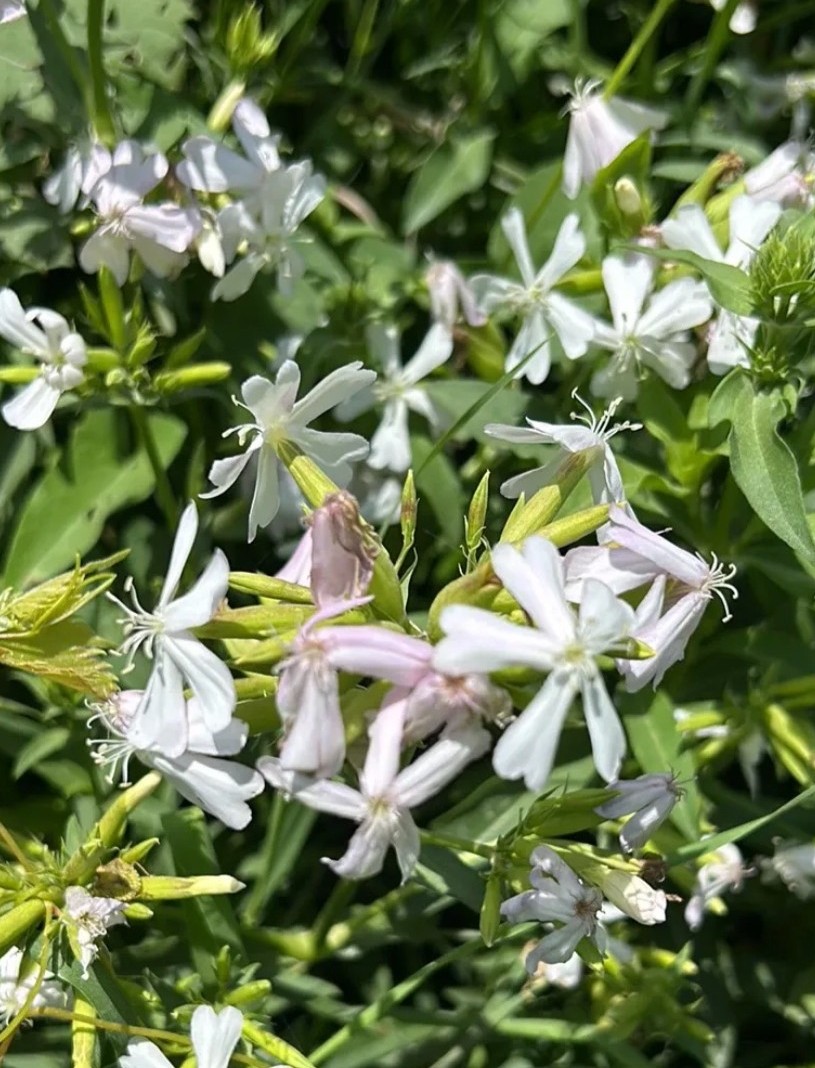
Bouncing Bet, (Saponaria oficinalis) grows in disturbed areas. Its roots and seeds are poisonous if eaten by people or livestock. The compounds that make it lather into soap also deter insects from eating it.
Bouncing Bet is a member of the carnation family and is native to Europe. Early settlers brought its seeds with them to the new world. It is a long-lived perennial that spreads by seed and also by vigorous rhizomes, crowding out native plants and forming dense colonies of its own. The stems reach about two feet tall and the flowers bloom at the tops of the stems in dense clusters of pink to purple. They have five petals which splay outward to invite pollinators into their centers. They bloom July through September and offer a strong sweet scent especially at night, inviting nocturnal pollinators to come and see.
Bouncing Bet goes by other names in various parts of the country. Wild sweet William, Lady by the garden gate, Common soapwort, crow soap, and sweet Betty.
Each name says something about the plant and its uses. A fuller is a person who processes wool, the sap from this plant is used to clean and process wool. Thus, fuller’s herb. Bruisewort suggests its use in removing the discoloration of a bruise. (Several other plants are also known as bruisewort.) Because it smells like cloves, some people call it dog cloves. I wonder where crow soap came from.
Photo by Author. Alt text: Twenty or more fived-petaled blossoms burst from green foliage in this photo from the fencerow. The blooms of Bouncing Bet are small, a little over half an inch across. Long white petals and short stamens splay from atop tube-shaped flowers.