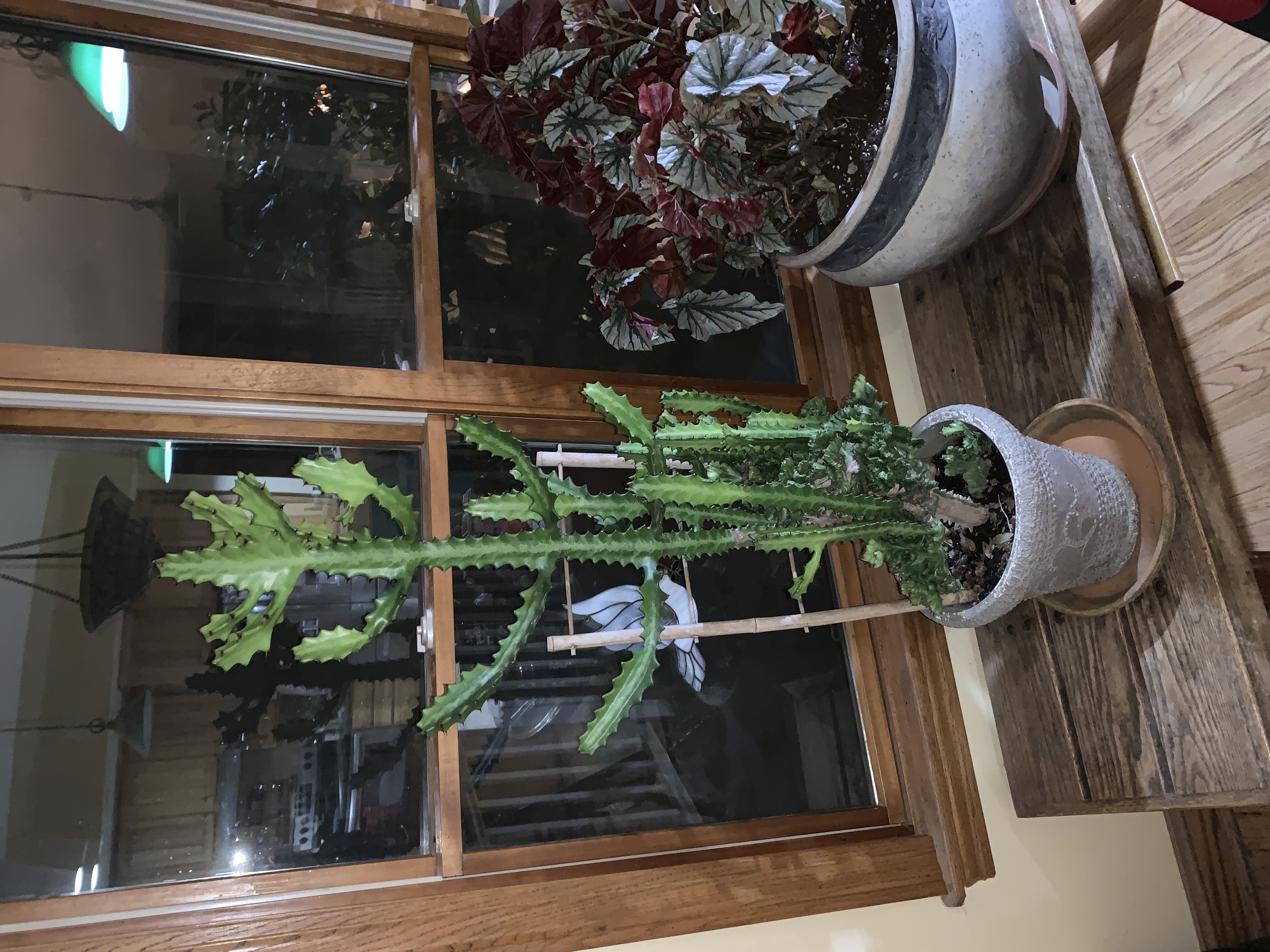
About fifteen years ago, I went to a fundraiser and bought, for $10, a little cactus. It was an odd little thing, about six inches tall with a triangular stem and a weird head at the top. It looked like a deformed little tree with spines on it. I decided I didn’t like it much after I got a few of those spines stuck in my fingers. Still, I set it in a window in my office and neglected it. It just sat there, needing nothing. My secretary must have watered it once in a while because it didn’t shrivel up and die. I wouldn’t have minded if it had.
When I moved to Washington, for some inexplicable reason, I brought the little fellow with me. It survived indoors for years. One year we dressed it up as our Christmas tree. And then one spring I set it out on my balcony. For the first time since it moved in with me, the little guy had direct Maryland sunshine. It began to grow. And grow. And grow. Bryan became very fond of it as each summer it got bigger and bigger and branched in all directions. I didn’t share his enthusiasm. Every time I came near it, it stuck me with its spines. I threatened to dispose of it. Bryan pleaded its case and it remained a member of the household.

On a tiny book case display in the Maryland apartment a lifetime ago, Karen topped her (then much smaller) spiny friend with an electric candle and called it a Christmas tree. Author photo.
When we moved back home to Iowa, it moved with us in spite of my protests. And once again, in the spring, it went out on the deck and found Iowa sunshine. And it grew. And grew. And now it’s time to bring it indoors so the frost won’t kill it. It has moved off the deck into the dining room where it gets a little bit of winter sun.
The plant is a succulent with fat, fleshy growths. It has a main stem supporting a jumble of branches. Each branch or stem is three-sided with stickers lining each of the three edges of the branch. The branches are dark green, with a light milky-green line running down the valleys between the prickly edges. It doesn’t have any leaves. Inside its fleshy branches is a milky sap that is poisonous to people and pets, but has been used very carefully in traditional medicines in India.
So what is this thing anyway? It’s called dragon bones. I could get behind that name! It’s also known as mottled spurge, false cactus, milkstripe, hatrack cactus, candelabra cactus, and a number of other permutations. Its scientific name is euphorbia lactea. It’s a member of the spurge family and in its native habitat it thrives in hardiness zones 10 to 12. Obviously it’s a house plant here in zone 4.
Our little dragon bones is over four feet tall by now, although in its native Sri Lanka it grows up to 15 feet tall. It has been introduced all over the world in subtropical and arid regions where the climate is right. It doesn’t mind poor soil but can’t stand to have its feet wet. Apparently it doesn’t mind neglect, either. Ours does have to be staked, though so it doesn’t tip over.
Now our not so little dragon bones stands as a living sculpture. It has grown into its intricate and unique shape as a result of every place it has lived. Just like we all do. And behind all the prickly parts, there’s something beautiful.
Feature Photo by Author. Alt text: A green, columnar plant sends triangular branches up from a central stem. Short spines line the edge of each lobe. Triangle cactus or Dragon Bones or any of numerous other names, it makes a great house plant.
2 comments
I loved the saga of your Dragon Bones plant.
What a great connection to the effects of place and lived experience on who we are! Really enjoyed this one!