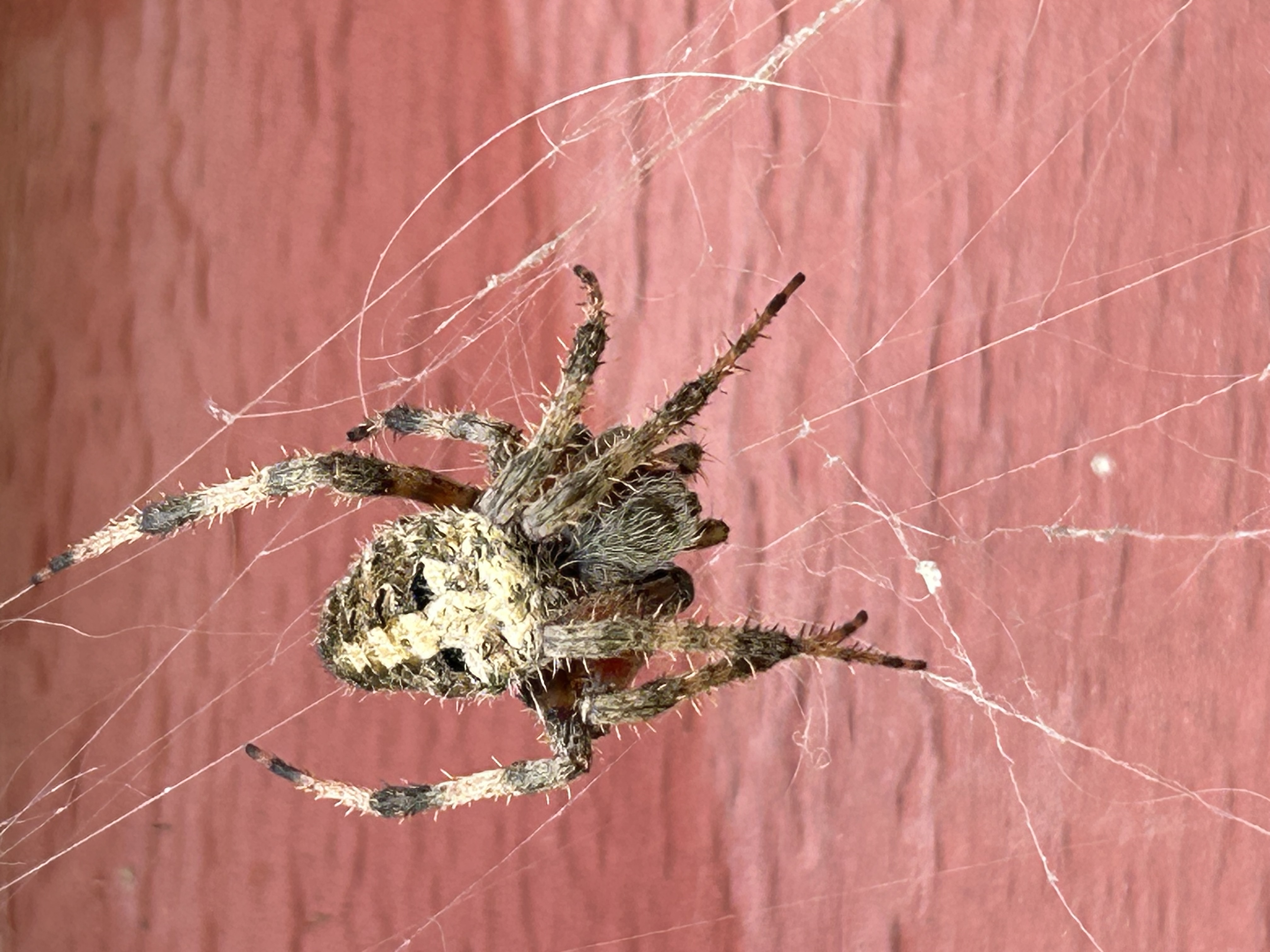
Earlier this fall, a yellow garden spider set up housekeeping beneath the morning-sun-facing window of my study. She has vanished, and in her place for a while another species of spider called a spotted orb weaver chose that same location to build her orb webs. Apparently that location is good for catching insects.
Our newest inhabitant is one of over 50,000 spider species worldwide. This one is native to Iowa and is known as a spotted orb weaver (Neoscona domiciliorum, AKA hairy field spider. She’s about half an inch long and has a rounded, rather bulbous light brown abdomen garnished with spots of darker color. The tops of her legs are red, and she has short gray hairs all over.
During her last days before the frost, our spider has been busy. She is nocturnal, so every day at dusk, she builds her web. It’s a carefully constructed orb web about two feet in diameter. She sits head-down in the center of her domain, waiting for small insects like ants and mosquitoes, to be caught in the sticky part of her web. At dawn, if she’s had enough to eat to support her growing eggs, she will tear down the web, eat it, and move to her daytime retreat—a bundle of leaves held together with spider silk built near the end of one of the spokes of the web. She has built this retreat of leaves and spiderweb material to protect herself during daylight hours. If she’s still hungry in the morning, she may leave the web up during the day as well. When an insect lands on the web, she senses the vibrations it sets off and goes to subdue it with her poisonous fangs, and eat it.
When she’s ready, she lays up to a thousand eggs. She encases the eggs in an egg sac that she makes by covering them with one of her six or so web types. She completes the process by covering the hardened egg sac with more web material, and attaching it in a safe place. Now she’s ready for frost. Neither the female nor the male will survive the Iowa winter. But she has left a myriad of offspring to increase the likelihood that her particular line of spider will survive and thrive in the spring on Owl Acres.
When the weather warms up enough, the eggs will hatch. The spiderlings will emerge in a crowd. They’ll want their own space to grow and feed, so they will disperse.
Spiders don’t have wings, so they can’t fly like a mosquito or a gnat. What they can do is called ballooning. The spiderling climbs to the highest available place it can reach. Then it points its abdomen into the air and sends out gossamer threads of silk. These threads form a triangular parachute, strong enough to carry the spiderling. Hanging from its parachute, the spider is lifted on the wind or on electrical currents in the air. It may float a few feet, or it may float high in the atmosphere for a thousand miles. Sailors a thousand miles out to sea have seen these spiders boarding their chips. In this way, spider species can spread across oceans to set up housekeeping in new lands.
Our spotted orb weaver is native to Iowa and is commonly found in gardens, under roofs, and in moist woodlands. World-wide, spiders account for some 25 million metric tons of living insects. They eat between 400 and 800 million tons of insects per year world-wide according to studies. That’s a lot of mosquitoes, aphids, flies, moths, roaches, ticks, and other disease-carrying and crop-destroying insects. Without spiders, we would have an unimaginable number of these pests each year. And unlike their prey, spiders do not spread diseases to humans. Most of them don’t bite humans, either.
Our colorful little spider is gone now, succumbing, no doubt, to the hard frosts we’ve had in November. She has buried her egg sac somewhere in the debris of the dying foliage, where it will overwinter with the eggs intact.
Photo by Author. Alt text: A hairy brown spider with white leg markings sits on a tangle of web strands. Behind the Spotted Orb Weaver is the red siding of the house, outside the window of Karen’s study.