We didn’t have horses when I was growing up on the farm. The year I went to college, though, my younger sister got her first horse. I learned to ride over the next couple of summers, and really loved it. Life took me away from the farm and the horses though, and the opportunities to ride were few and far between. Horses, however, played a major role in farming the land that would become Owl Acres.
Until the late 18th century, farming remained primarily a manual labor with some assistance from animals. The implements were wielded by hand for the most part. In 1830 for example, a farmer would need to spend between 250 and 300 hours of manual labor to get five acres worth of wheat. He would use a walking plow and a harrow. He would broadcast seed by hand and use a sickle and flail to harvest and thresh the crop.
The seeds of the Industrial Revolution were well planted in prairie soil by the time that Jesse Reeves bought the land that would become Owl Acres. The idea that machinery could make farming easier and more productive bloomed on the prairie. By 1854, patents and production of a variety of mechanical devices for farming had been filed and marketed. These included hay rakes, mowers and balers; corn planters and corn pickers; threshing machines; and the John Deere plow. The John Deere plow holds a special place in the history of Iowa farming because it solved the issue of keeping the plowshare from getting all gummed up by the thick prairie soil. It also made plowing easier, requiring less horsepower to do the job. No longer did the farmer need to use the powerful but slow oxen to drag the plow through the prairie sod. Horses could do it and do it faster.
Oxen had the weight and muscle power for plowing, but they were slow. One source reports that whereas working with oxen, a farmer could open two acres of land in a day, using horses instead, he could achieve seven acres. With the new plow, he didn’t need the strength of the oxen, but he did want the speed of the horses. While oxen would plod along at the steady rate of two miles an hour, a good draft horse could keep up a five-mile-an-hour pace and do It longer than the oxen could. Two miles an hour was a comfortable walking pace for people crossing the prairie, but it was too slow for the everyday chores of a prairie farmer.
The horses available to farmers in the middle of the 19th century comprised a number of breeds and favored lines. Early examples included Thoroughbred, Morgan, Bashaw, Black Hawk, Abdallah, Printer, Hambletonian, Trump, Copper Bottom, Rob Roy, Tuckahoe, Grey Eagle, and Bellfounder. These horses were relatively light, weighing around 1,000 pounds. They had been used for riding, pulling wagons and carriages, and now were employed more directly in farm work, powering these newfangled machines.
Iowa farmers discovered that, with their resources of pasture, grain, space and time, they could also raise horses for export back East. They developed a thriving market for their horses in eastern farms and cities.
As the farm machinery continued to evolve, heavier and stronger horses were needed to pull it. Iowa horse breeders began importing draft horses from northern Europe to breed with the lighter local mares. These draft horses were twice the size of the local mares, weighing in at 1,800 to 2,000 or more pounds. These imported horses were nearly as heavy as the oxen, but faster and able to work longer. Imported breeds included Percherons and Normans from France, Clydesdales from Scotland, Shires from England, and Belgians from Belgium. These horses broke the prairie sod, plowed, planted and harvested the Iowa crops into the 1940s when they were replaced by tractors.

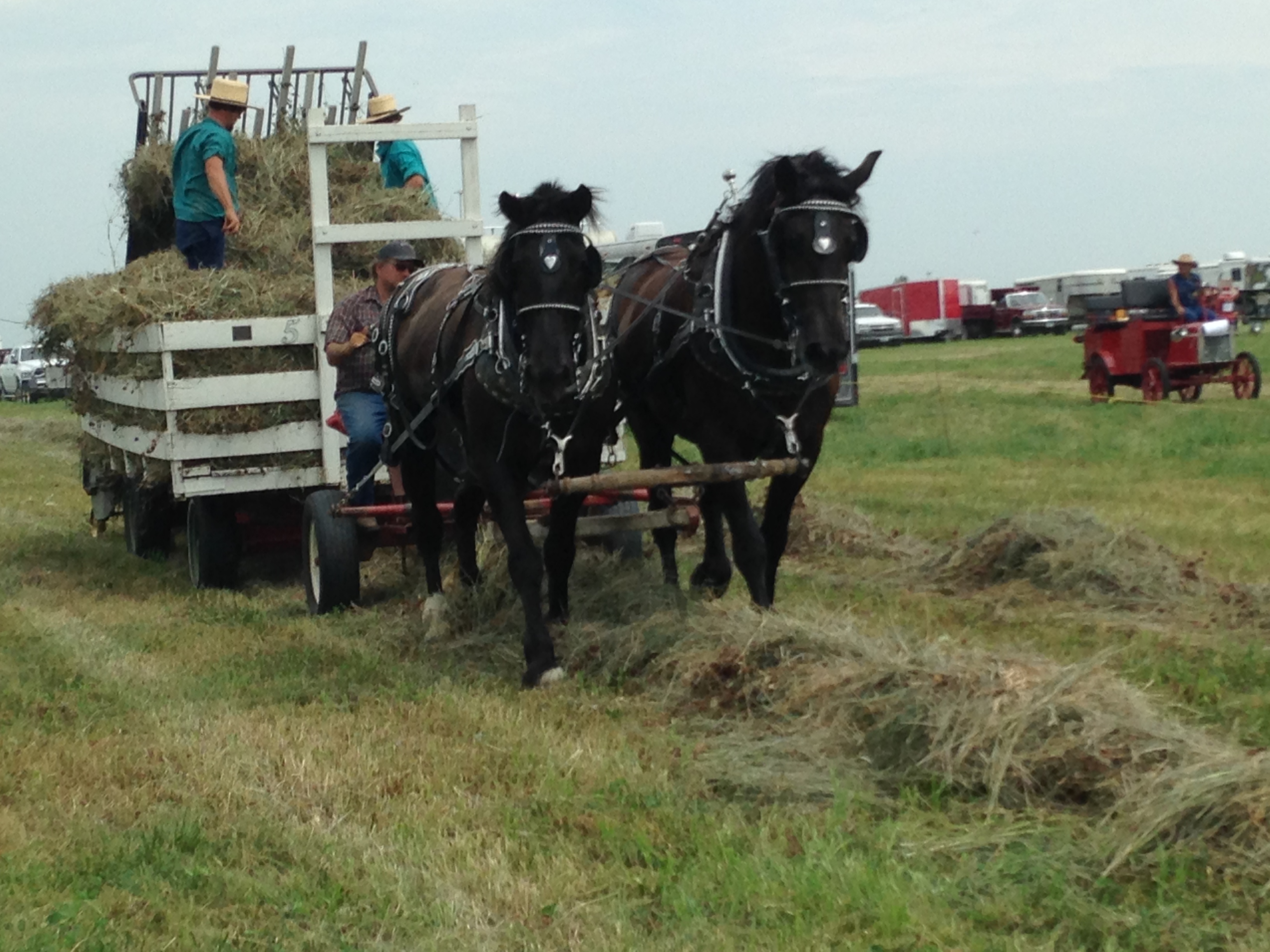
A hay loader works at the back of a horse drawn wagon. The team and wagon straddle a windrow of dry hay. The machine picks hay off the ground, walks it up a steep angle and drops it onto the back of the hay rack. Two men with pitchforks distribute the loose hay to load the wagon. From the field, the hay will be taken to a barn to be stored as loose, or fed to a baler. Author photo.
We won’t be seeing horses on Owl Acres these days. That time for me is past. Some of our neighbors have horses, though, and they always greet Dave and Clancy when we pass by their fence.
Photo by Author. Alt text: A team of black Percherons pulls a hay rack at an antique power show near Owl Acres. Two Amish farmers in straw hats pack the loose hay onto the wagon with pitchforks.