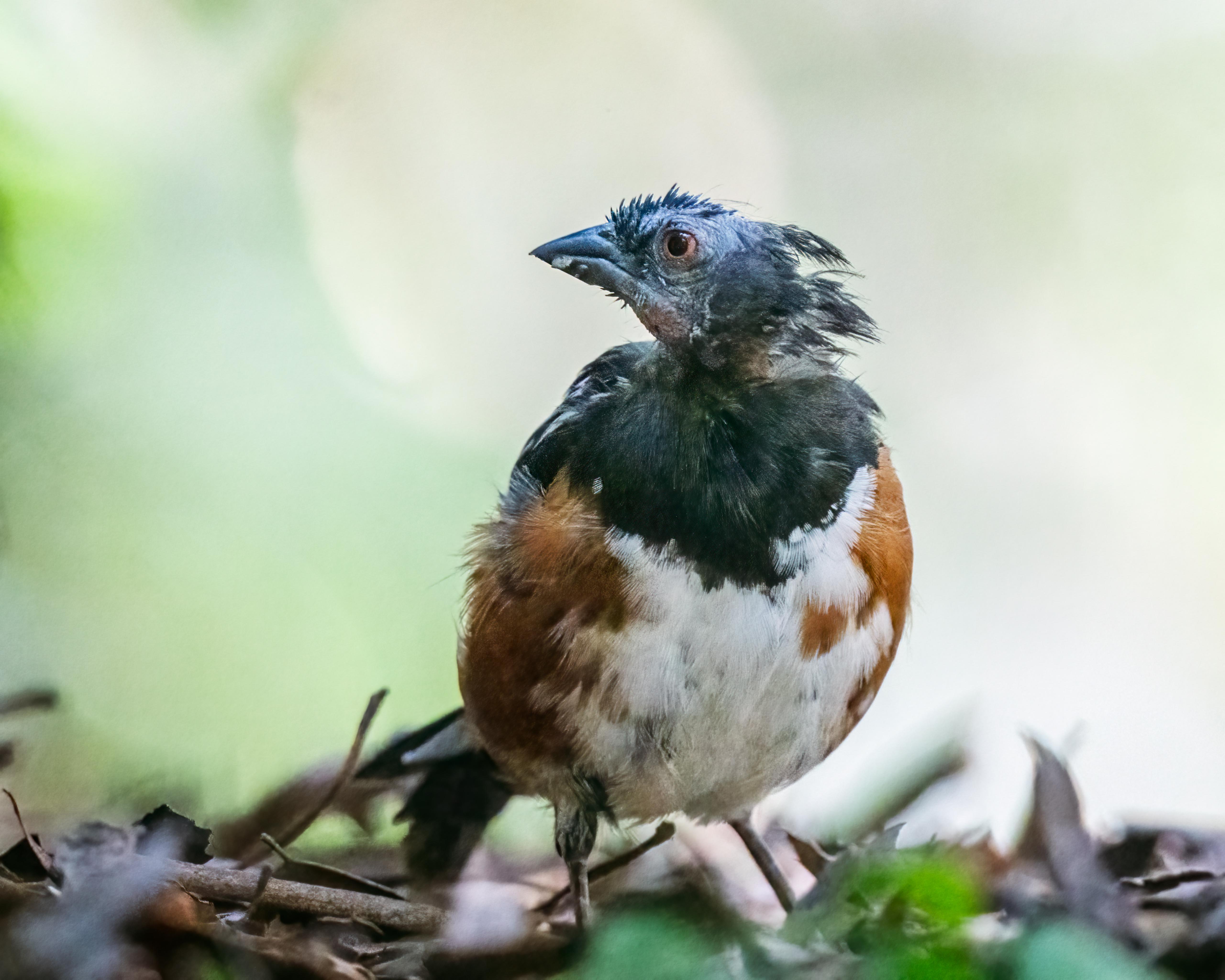
A spotted towhee (Pipilo maculate) is visiting Owl Acres. Perhaps he got blown off course due to all the wind we’ve been having, or maybe he’s on his way to the arroyos and canyons of the desert southwest, or the mountains of the Rockies after a vacation in the south.
Spotted towhees range from Western Canada to Texas. Some populations remain in the south year-round. Others prefer to breed in the mountains of the Rockies and migrate to the Great Plains in winter.
The spotted towhee is black on its back, head and throat with bright white spots and wing bars. It also has white corners on its otherwise black tail. Reddish-brown sides and a white belly compliment red eyes and legs and a stout black bill. Females are less dramatic, with brown and gray replacing the black of the males. They all have broad wings and long, rounded tails. Their cousins, the Eastern Towhee, looks very similar except that they don’t have the white spots and wing bars.,
One of its songs is a long, buzzy cheweeee. It reminds me of the redwing blackbird, but my Merlin Bird ID assures me this is a spotted towhee. Most likely, this spotted towhee will move on into Canada or go west to the mountains where he will find a mate and breed.
The towhee’s nest is just a little hollow in the ground which she scratches out and lines with soft plant and animal fibers. The female makes the nest and typically produces two broods in an average year.
Towhees eat mostly insects and spend their time on the ground hunting for them at the edges of thickets. They hide in dense bushes and undergrowth and are often heard before they’re seen because of their vigorous scratching on the ground.
The towhee’s name was first recorded in the 1700s by a naturalist in the Carolinas. It comes, most likely from the song that the male sings in spring and summer.
We don’t expect this fellow to stay long, but we’re happy to have him visit for a few days in March.
Photo from Wikimedia.org by: Channel City Camera Club from Santa Barbara, US. Alt text: In this “Only a Mother Could Love” view, a ragged-looking Spotted Towhee is pictured in molt. Most of his fluffy head feathers have been shed and he’s a sorry sight. This normal process will have the songbird re-feathered in a few days.