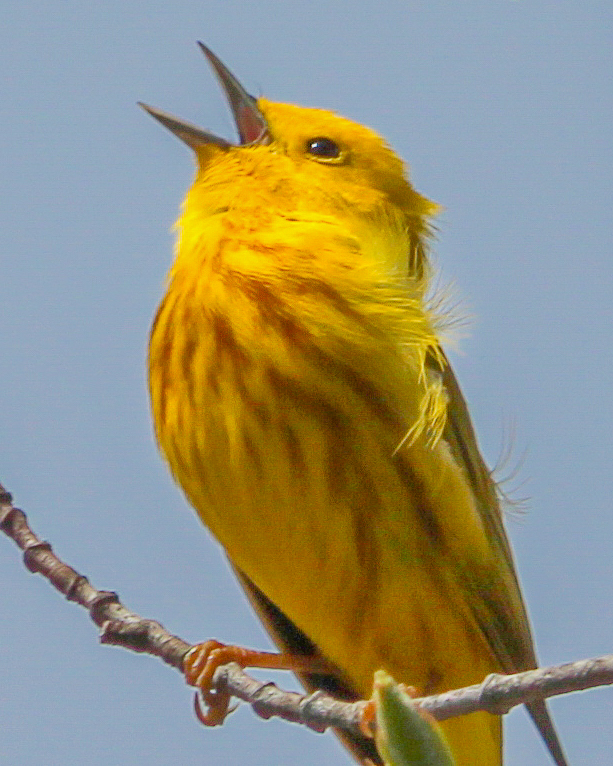
It’s the middle of March, and all the yellow warblers (Setophaga petechia) are in Mexico or the Caribbean for the winter. Some of them will stay there throughout the year, nesting in the mangroves. Others will populate the mangrove swamps in Mexico, the Caribbean, and South America during the winter but make the trek from South America to the Arctic Circle when the weather warms up. Yellow warblers in their various plumages are the most wide-spread warblers in the Americas, with an estimated population of 97 million birds. As they have settled into various habitats, such as the mangrove swamps of Central America or the Galapagos Islands, they have developed up to 37 subspecies, differentiated primarily by their coloration including the amount of chestnut on their heads.
When they arrive on their breeding grounds in Canada and the northern United States, the first order of business for the males is to stake out their territory. He will sing incessantly from the tops of tall shrubs or small trees defending his territory and wooing a mate. He may sing 3,000 songs in a day to get her attention. Once he has it, they select a nesting spot and she builds an open cup-shaped nest using grasses, nettles and bark, then supporting it with spider webs and plant fibers on the outside. Inside, she lines the nest with fur, feathers and soft fibers. She will steal material from other nests when she can.
We will begin to see these bright yellow birds and hear their “Sweet, sweet, I’m so sweet” songs in early May. About the time that the yellow warbler arrives on Owl Acres, its nemesis the brown-headed cowbird will come calling. Whenever a yellow warbler spies one of these enemies, it immediately warns its neighbors to beware. It has a special warning call used only to alert the others about the cowbird. Not only the warblers, but also the red-wing blackbirds, have a particular war with these parasites. When they hear the warning, warblers and blackbirds alike will rush back to their nests to protect them from the cowbirds. Brown-headed cowbirds don’t build their own nests. They lay their eggs in other birds’ nests. In the case of the yellow warbler, she will build a nest and lay her eggs in it. However, if she detects a cowbird egg in among her own offspring, she will cover up the nest with a new layer of material, burying the cowbird egg and her own eggs as well. Then she will lay another clutch of eggs. If the cowbird comes calling again, she’ll make another layer. As many as six layers of eggs have been seen in yellow warbler nests.
Once the chicks are hatched and have their feathers, some of them will follow their mother, and the rest will follow their father as they learn the ropes in the outside world.
The yellow warblers that we will see on Owl Acres about the first of May are greenish-yellow on their backs and wings, and brighter yellow elsewhere. They have round heads, black eyes, and sturdy bills along with rounded wings and square, notched tails. They are about five inches long with a wing span of six to eight inches. Male yellow warblers have chestnut-colored streaks on their breasts. Females are more subdued.
Yellow warblers eat mostly insects, including lots of caterpillars. They also eat mayflies, moths, mosquitoes, beetles, damselflies, treehoppers, and other insects.
The cowbirds have already arrived on Owl Acres. The warblers will be along soon to carry on their disputes with their nemesis.
Photo from Wikimedia.org by Gary Leavens. Alt text: View looking up at a handsome green and yellow songbird singing from a twig. Yellow warbler
1 comment
Great post! Really interesting example of an evolved strategy to avoid nest parasitism