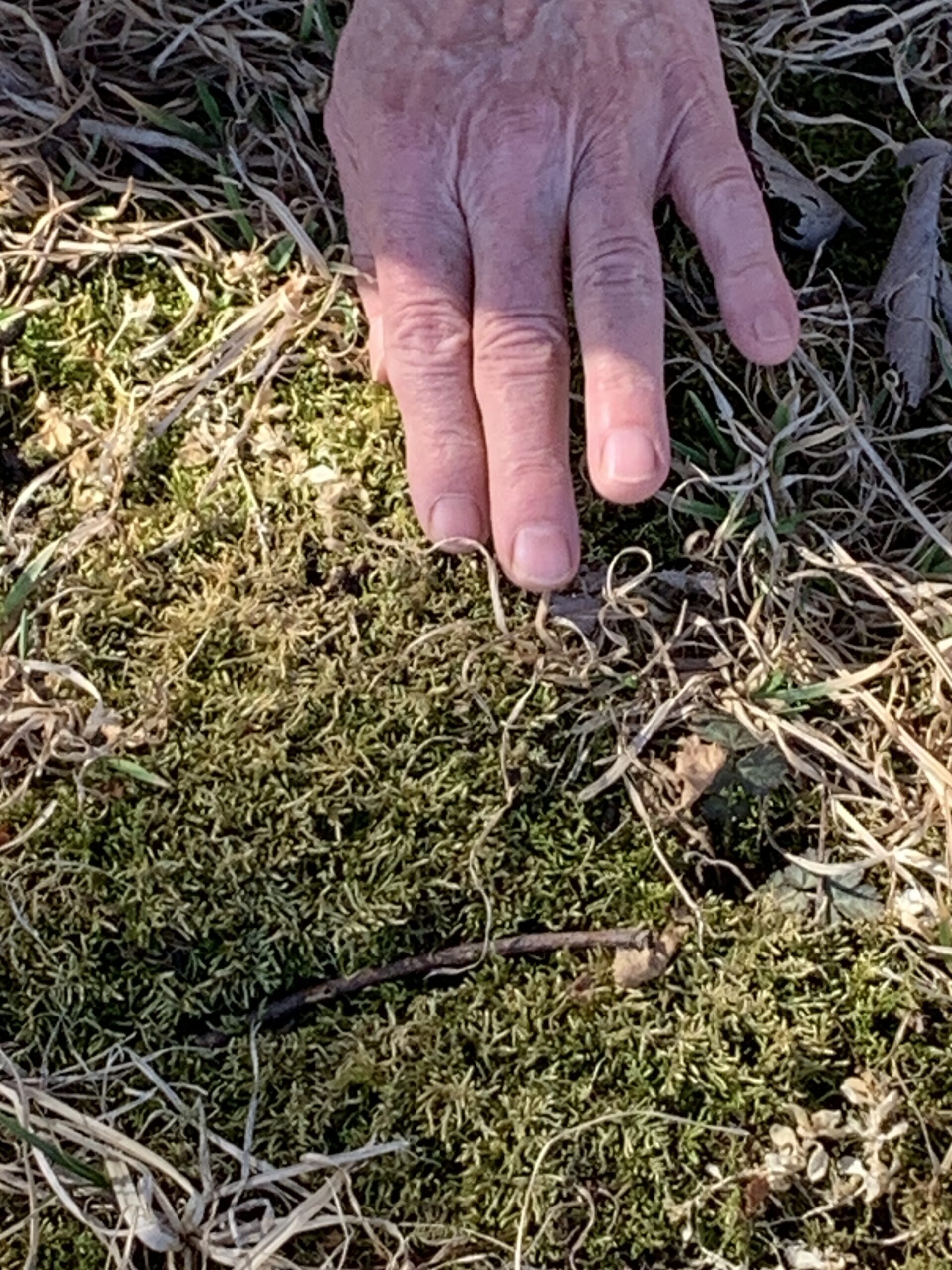
It’s taunting the winter blahs with its vibrant green patches beneath the American elm. It’s part of the life that flourishes all around us whether we pay attention to it or not. This particular member of the Owl Acres family is a type of moss. We’re trying to identify which particular genus and/or species it belongs to. We have over 275 types of mosses that grow in Iowa to choose from.
Mosses first started moving out of the ocean onto land about 400 million years ago. Since then, they’ve been evolving into thousands of species, each one specifically suited to its environment. And they’re found just about everywhere, including the woods and yard of Owl Acres.
Mosses are members of the bryophyte grouping of nonvascular plants. Several characteristics distinguish mosses and their close cousins liverworts and hornworts from other plants.
Mosses are nonvascular. they don’t have structures like trees do for transporting water and nutrients throughout the plant. They have to absorb everything directly into the leaves. This limits their growth, so they are usually only a few inches tall.
They don’t have roots. Instead, they have threadlike rhizoids that help them cling to surfaces like rocks, shingles, logs and dirt. Most of them don’t get water and nutrients through these rhizoids.
They don’t have flowers or seeds. Instead, they reproduce with spores.
Mosses carry on photosynthesis in their tiny leaves, manufacturing sugars and other things the plant needs to grow and reproduce.
It’s no wonder that mosses are so ubiquitous considering the ways they can spread. They can start a new plant from a fragment of an existing plant. They can create and disperse spores in asexual reproduction, and they can create spores through sexual reproduction. The sexual reproduction takes a two-phase lifecycle to complete. The first stage starts with a spore. The spore is just a single cell that contains the genetic material of the moss. It is called haploid because it only contains one copy of the moss’s chromosomes instead of two copies like we have. When a spore randomly alights on a surface favorable to that particular moss, the spore germinates. It puts down tiny fibers called rhizoids that anchor the moss plant to the rock or dirt it is growing on. Then it creates the green leafy structure that we see growing on logs and rocks and dirt.
This phase is called a gametophyte. The gametophyte is haploid—that is, it has only one set of chromosomes. Along with harvesting energy from the sun, the gametophyte makes both eggs and sperm. The sperm have flagella (tails) that help them swim to the eggs of nearby plants. they have to have water available for the sperm to swim in. When the egg is fertilized by the sperm, it becomes diploid—that is it has two sets of chromosomes, one set from the sperm and one set from the egg. Sound familiar?
What emerges from the fertilized egg is called a sporophyte. It looks like a slender stalk with a capsule at the top. It’s a structure where the DNA material is once again divided into haploid cells through meiosis. These cells are the spores that scatter on the wind when the capsule bursts open. When the spores are released, the cycle starts over again.
Moss can also clone themselves without going through this process. Fragments of existing moss plants can also grow, expanding a moss colony.
Most of our mosses are either cushion mosses or carpet mosses. The cushion mosses grow upright in clumps. The carpet mosses grow sideways, lying on the ground and forming intricate mats.
A couple of other types are sphagnum moss which you can buy to amend the soil in your garden, or dig out of a peat bog, and dendritic mosses that grow along the ground and then shoot up little things that look like tiny trees.
Mosses have long been used in traditional medicine as wound dressings and for their antiseptic, anti-inflammatory, anti-fungal and antibacterial properties. They’ve also been recognized as a source of antioxidants. Sphagnum moss bandages were used by both sides during World War I because they were discovered to absorb fluids and create an antiseptic environment so wounds could heal.
It’s been easy to ignore moss as we explore the life on Owl Acres. It was just background. Now that we’ve discovered this fascinating life form, we’ll be on the lookout for the species that live on Owl Acres.
Photo by Author. Alt text: Karen’s fingers rest on a soft cushion of moss, one of the early plants to green up in departing winter.
1 comment
Fascinating! I had no idea