For the past three years or so, I’ve been using the Merlin app to survey the birds on Owl Acres. I’ve sampled them in early morning most every day from March 1 into June. It’s been fascinating to find out which birds have stayed over the winter, which have moved in over the winter, and those that migrate past Owl Acres in the spring and the fall.
In the spring, the soundscape builds daily from a few desultory peeps in February to a full-throated cacophony in May and June. Each day or two we capture the song of yet another bird. On April 12, I heard the rapid single-pitch trill of a chipping sparrow (Spizella passerina). The song reminds me of a baby’s rattle, but more professionally it has been described as a thin trill all on one note. It’s quite distinctive either way. The song was coming from the red cedar trees just east of the driveway. the singer was quite persistent. Sitting high in a tree, he rattled away for several minutes before taking a break and moving to the woods west of the driveway.
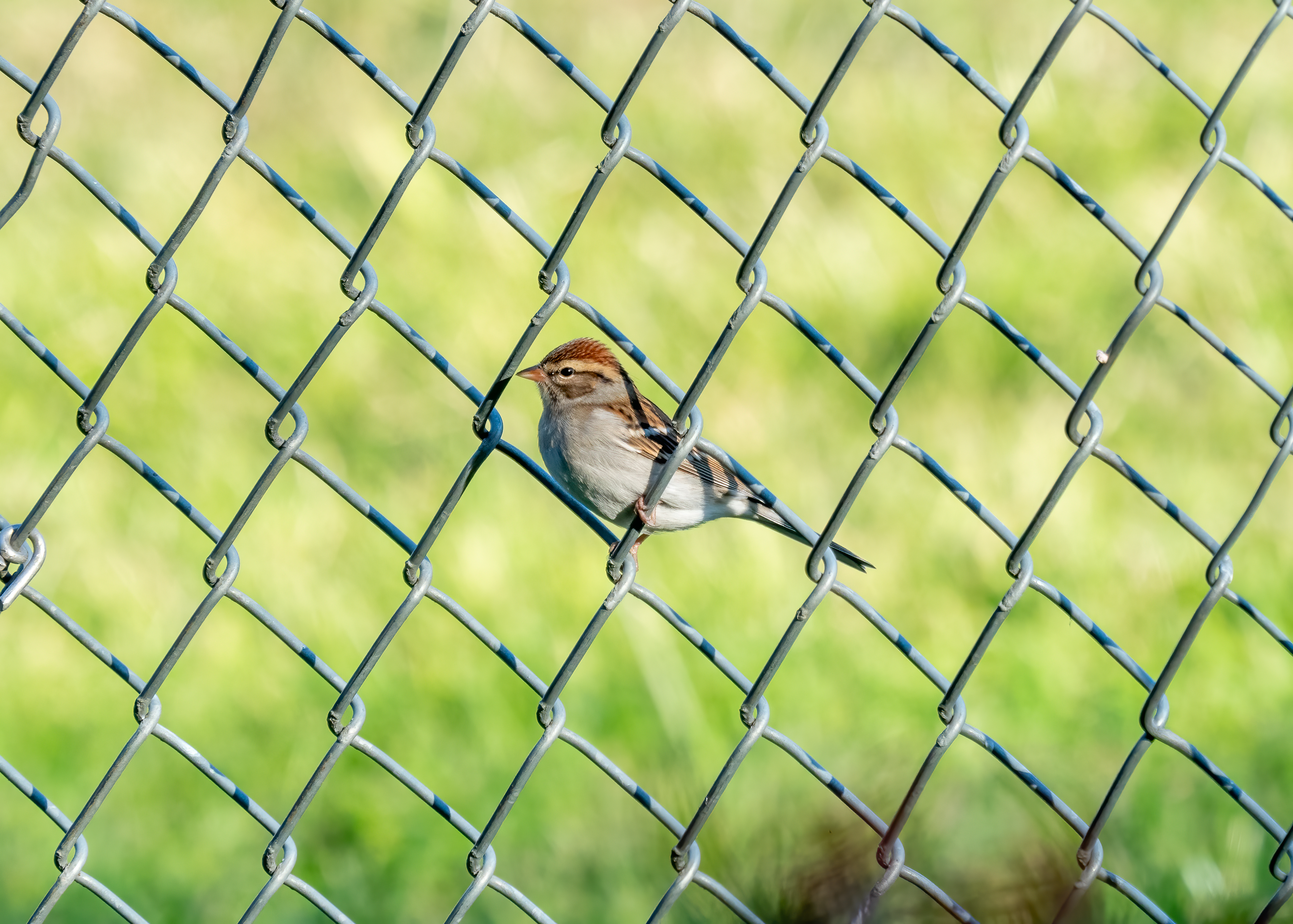
He’s hard to see. His streaky brown back and wings and gray underside make good camouflage. He does add a splash of color though with his bright chestnut-colored cap, white eyebrows and black eyeline.
Chipping sparrows are native to North America and are quite common throughout. They have adapted to modern landscapes in urban and suburban areas, open woods, and just about anywhere else–fields, meadows, grasslands, woods and forests. Some will remain in the south, taking up permanent residence in Texas where food is abundant year-round. Others Will spend up to two months migrating and eating their way northward to summer breeding grounds and then reverse the migration with their young ones in tow to go back south for the winter. They migrate in big flocks of mixed species. Indeed, when they’re not actively breeding and caring for young, they tend to forage and roost in flocks.
When the male chipping sparrow finds his mate for the year, he’ll stick with her through nest-building and egg-laying. He may have strayed though when she wasn’t looking, to court some of the neighbor ladies. They’ll raise two or three broods a year, but the odds are that only one brood will be successful.
Back in the day when horses were plentiful, chipping sparrows were known for using horsehair for the soft lining in their nests. Today, they have to settle for grass, animal fur and whatever else they can find. It takes the female three or four days to build her nest. The result is about four inches across on the outside and 2 inches diameter on the inside. It’s about an inch and a half deep and will hold an average of four eggs.
These nests are placed in the lower branches of trees and shrubs and occasionally directly on the ground. They are often parasitized by cowbirds. We’ve been hearing the cowbirds all spring, and we suppose that they will play their dirty tricks on any chipping sparrows who nest here. The cowbird egg is bigger than the chipping sparrow’s eggs, and is white with brown speckles and splotches. The sparrow’s eggs are a light bluish-green with brown, purple and black speckles. The chipping sparrow may abandon her nest when she detects a foreigner, but she may also go ahead and raise the interloper along with her own. You’d think she could always tell them apart. The male will try to keep the cowbirds out of his territory but isn’t always successful.
I’m hoping the chipping sparrows will lend their voices to the soundscape for a while now. And who knows—perhaps my surveys will catch lots of other species as spring gets going in earnest.
Photo from Wikimedia.org by: Rhododendrites Alt text: A grey-and-chestnut songbird perches in a diamond shaped opening in a chain link fence. Careful composition, placing the green background in soft focus, creates a portrait of wildlife successfully adapting to life in proximity with humans. Images such as this don’t happen by accident. They result from preparation, patience and opportunity. Heartland Safari salutes the photographers who create these gems and make them available for us to enjoy.