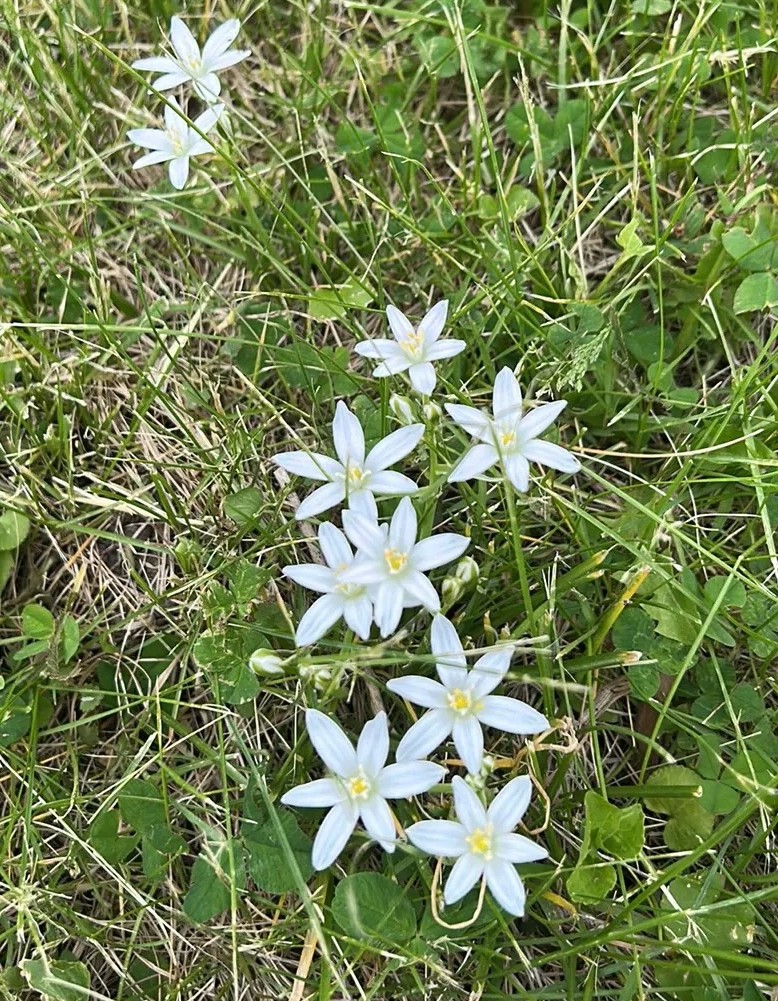
Along the edges of our prairie garden, we noticed some tiny, pure white star-shaped flowers. They were only a few inches high, and stood out against the green of the emerging grass.
The flowers have a variety of names. Some describe the flower’s setting—summer snowflake, star flower, grass lily, or snow drop. others describe what the flower does. Still other names hark back to ancient legends.
One of its common names is Star-of-Bethlehem. This name speaks both to the six-pointed star-shaped flowers and to a legend. According to the legend, the real Star of Bethlehem, the one that guided the wisemen to the Baby Jesus, fell out of the sky and shattered. The pieces of the star became these tiny flowers.
The common names eleven-o’clock lady, sleepy dick and nap-at-noon speak to the fact that the flowers don’t open until eleven o’clock or so and only stay open for an hour or two before closing up again. On cloudy days, they don’t open at all.
Another common name swathed in legend is Bird’s Milk. This name comes from an ancient proverbial phrase from both Greek and Latin that was used in two ways. First, it denotes something very rare or impossible. And second, if you said a person had bird’s milk, you meant that she had everything you could ever want.
The term bird’s milk is applied today in the botanical name for the flower. Ornithogalum comes from two Greek words, ornis meaning bird and gala meaning milk. Umbellatum refers to the way the flowers form an umbel, like and umbrella above the stalk. So, its botanical name is Ornithogalum umbellatum.
The plant, which we will call Star-of-Bethlehem, is native to Europe, Asia and North Africa. In North America, it’s considered a garden plant, not a weed. It can be invasive, though.
Star-of-Bethlehem is a perennial herb. In early spring, it develops a rosette of leaves around its base. A stem rises from the rosette and then divides into individual flower stalks, each with a flower at its top. The flowers bloom in May and June and are insect-pollinated. Each flower spreads a flat array of six-pointed white petals. The petals lure pollinators and, using a shining roadmap of ultraviolet color, they guide the bees to the pollen. If fertilized, the flowers will set seed in the summer, offering three-lobed capsules containing several seeds each to the birds.
Star-of-Bethlehem doesn’t rely on its seeds, though. It develops bulbs which survive the winter and send up new growth in the spring.
These pretty little flowers have a dark side. They are poisonous to people and livestock, especially the flowers and the bulbs. They contain compounds that affect the heart in humans similar to those found in heart medicines like digitalis. Too much will cause a long list of effects, none of which is good. In spite of this, some cultures use it in regional cuisines.
In folklore, Star-of-Bethlehem is loaded with symbolism. It is used to evoke honesty, hope, purity, innocence, and similar virtues and has been associated with the Crusades. Leonardo Davinci painted them in his Leda and the Swan, placing a bunch of star-of-Bethlehem flowers in the subject’s hand.
Back to Bird’s Milk. A few years ago we went to Poland, and when we landed, we saw a plane decked out in advertising for bird’s milk. That started a quest to find out what it was. We found it at the market. It was candy with a chocolate outer shell surrounding marshmallow cream. Only now do I understand its name!

View out the window of an airline flight in Poland. Engine nacelle has an image of flying cubes of marshmallow candy and its Polish name: “Ptashie Mlechko.” What else? “Bird’s Milk.” We had to find some and try it. Tasted like marshmallow. Author photo.
So, what’s in a name? Lots!
Feature Photo by Author. Alt text: Snow white, 6-petaled flowers with yellow centers smile up from the green jumble of species that make the yard of Owl Acres. Star-of-Bethlehem, Bird’s Milk or any of several other names, the inch-wide blooms were among the first to appear in mid-May.
1 comment
You’re the star of Jasper Co., Karen. Love the deep dive into birds’ milk. 🙂 – Joe