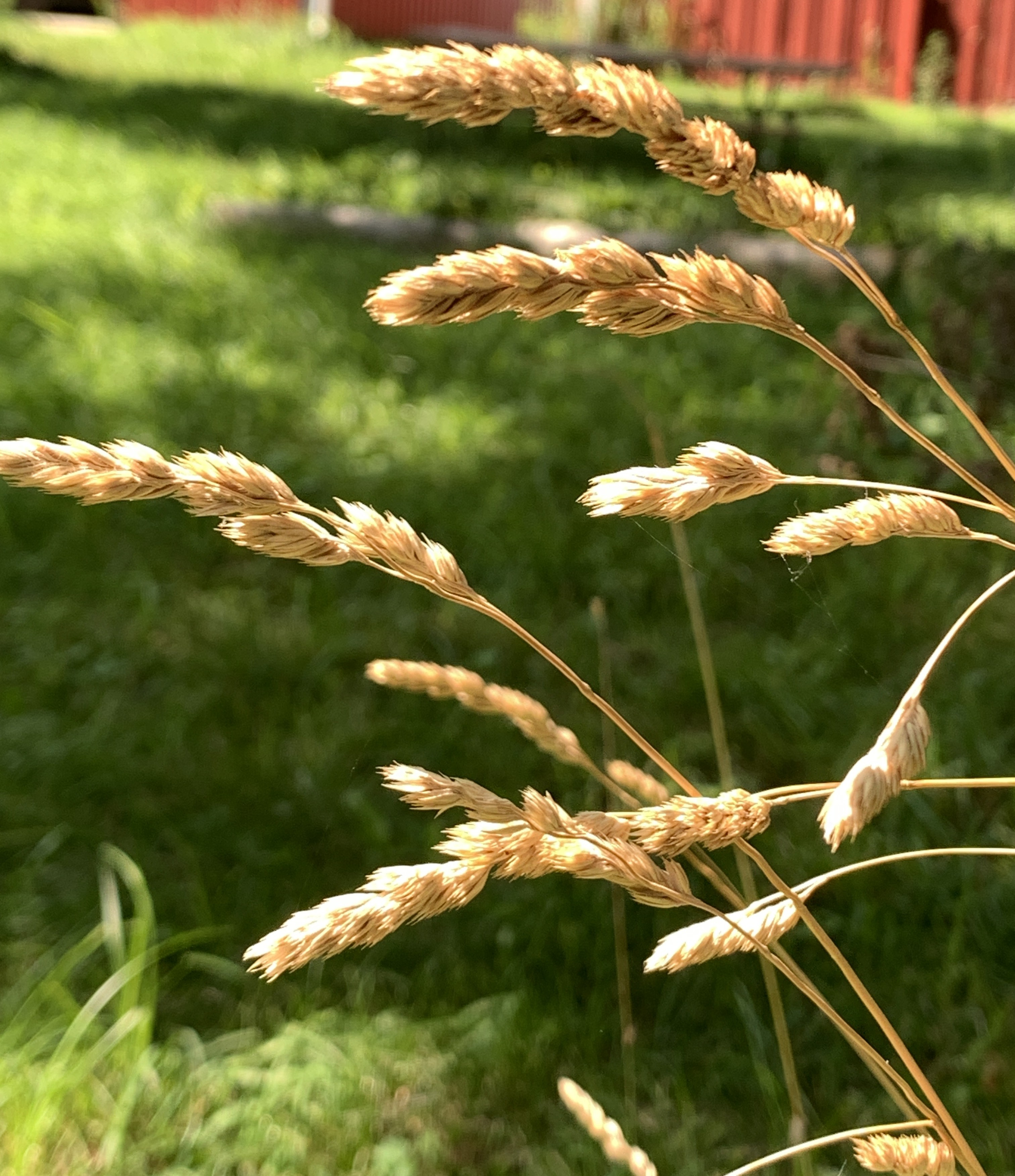
Orchard grass, (Dactylis glomerata) is another species of grass found on Owl Acres. It can grow up to four feet tall. On Owl Acres it grows at the edges of fence rows and has to be trimmed around the house and other obstacles. It’s called cat grass because cats like to chew it, and it’s called cocksfoot for the shape of its seedheads.
Like our smooth brome grass, orchard grass is not native to North America. It was brought to the New World as early as 1760 by colonists who knew from their experience in Europe that it made a good forage crop. Livestock of all types like it, and it makes good hay when it’s mixed with alfalfa, clovers and other grasses.
Orchard grass is a perennial bunch grass. It grows from a deep fibrous root system that extends two to three feet into the soil. It doesn’t have rhizomes (runners) like smooth brome, so it doesn’t spread very much. Instead, Multiple stems arise from its central shoots, and form stiff, wiry branches. The result is a clump or tussock. The grass grows upright to a height of four or more feet. At the top of each branch, two or more six-inch-long panicles (seedheads) develop from wind-pollinated flowers. The seeds are tan in color and about a tenth of an inch long. They kind of list to one side of the branch as they form.
Its leaves range in color from light green to dark blue-green and are up to 18 inches long and half an inch wide. They are alternately spaced along the stems every foot or so.
Orchard grass is another cool-season grass. It emerges early in the spring along with the smooth brome. It starts growing when soil temperatures reach 40 to 45 degrees F. and it flourishes in spring weather when daytime temperatures are between 65F and 75F. It goes dormant during the hot, dry summers on Owl Acres but wakes up in the fall when days are shorter, moisture Is more available, and temperatures are cooler.
Although it makes good feed for cattle, horses and goats, and it serves as good erosion control in many places, orchard grass is considered a restricted noxious weed in several eastern states. Lawns and gardens want beautifully monochrome turf grass. Anything else is an invasive enemy.
Photo by Author. Alt text: Tawny, chevron-shaped panicles of orchard grass fill the frame of this close up image. The distinctive shape of the seed heads is the easiest way to identify this soft, fine-bladed forage species.