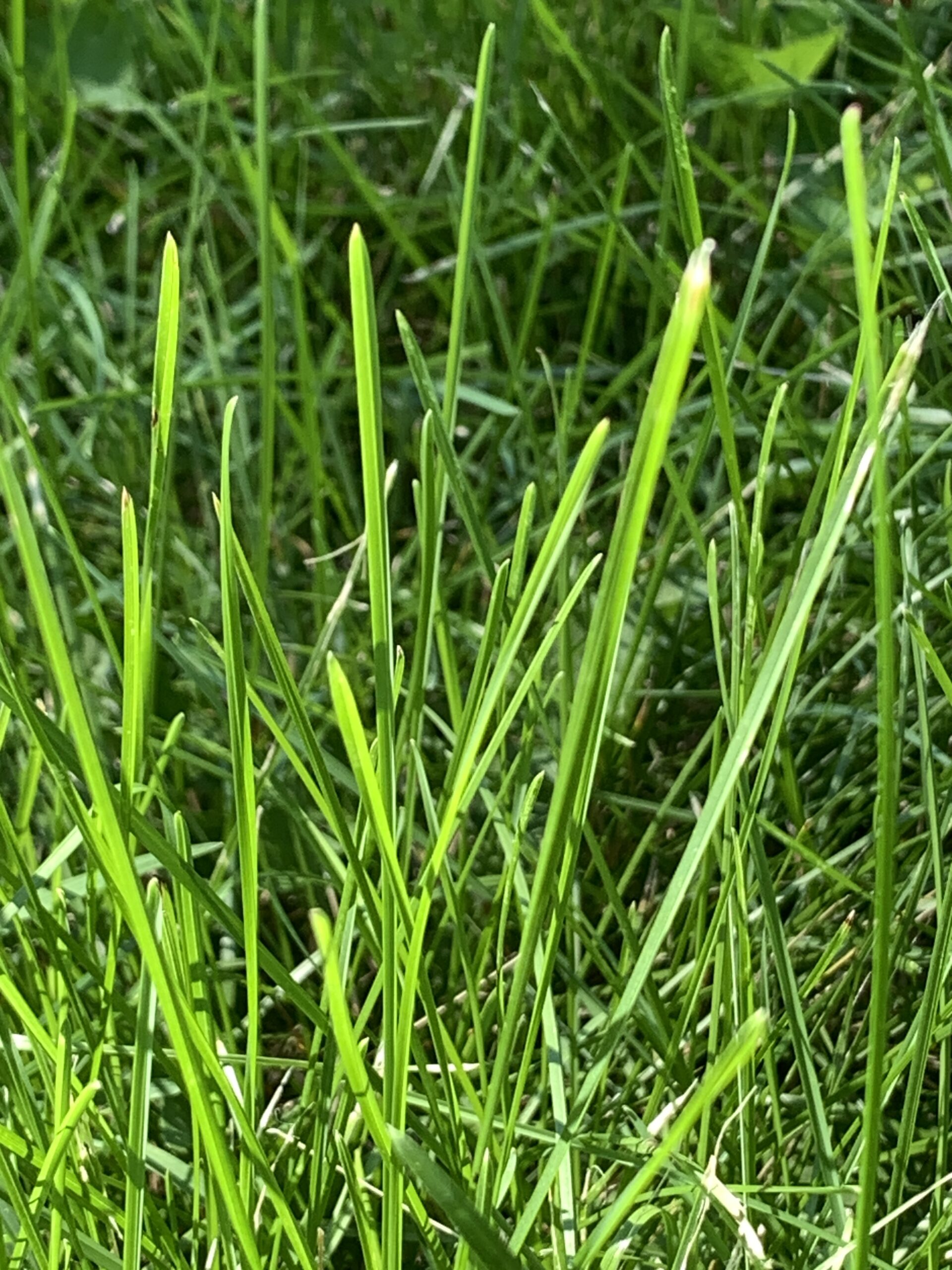
The third type of grass on Owl Acres is Kentucky Bluegrass (Poa pratensis). It is by far the most prevalent, filling all of the meadow area on Owl Acres with its short thick carpet. It’s the grass we all know and love in our yards, lawns, golf courses, parks and everywhere else we want a low, thick, monochrome living carpet of turf.
I love to walk barefoot in a lush stand of Kentucky bluegrass. So cool and soft and resilient beneath my feet. It takes a lot of work and resources to maintain that deep, luxurious turf though. Most of the grass on Owl Acres is Kentucky bluegrass, but we don’t water it or fertilize it. The result is more of a meadow or pasture grass than turf. Bryan mows it every week or two in the spring, setting off that delicious smell of new-mown grass.
Like the orchard grass and smooth brome, Kentucky bluegrass is not native to North America. It, like so many other imports, came with the settlers from Europe. The Indians called it “White Man’s Track” because it seemed to crop up wherever the white men went. It gets the appellation Kentucky because it was introduced to Kentucky early on and thrived in its limestone-rich soils. When a field of Kentucky bluegrass goes to seed, it casts a beautiful blue haze over the field. Thus, its name, Kentucky bluegrass. Its scientific name comes from the Greek word for grass and simply means a pasture grass that grows in a meadow.
When the ancient sod that blanketed Owl Acres was broken and removed in favor of wheat and corn, the native prairie grasses were torn from their long-established foothold and removed as weeds. In place of the deep prairie sod, over time, the pastures and farm steads were seeded with shorter European grasses more suited to cattle and horses, including Kentucky bluegrass.
As a cool-season grass, this favorite turf grass is one of the first to come up in the spring. It adds its lush green to the spring landscape, but gets tired and goes dormant when the weather turns hot and dry. In the fall when temperatures drop and moisture increases, the grass rouses itself. It gets busy expanding and fortifying its underground network in preparation for winter.
The familiar grass makes excellent commercial sod. It has a fairly shallow root system and aggressive colonies of rhizomes that reach out in all directions, creating a tangled, fibrous mat that holds together very well as sod. New shoots of grass also rise from the rhizomes, spreading the grass vegetatively.
Kentucky bluegrass has an asexual way of making seeds. Instead of the usual processes that combine genes from two “parents,” Kentucky bluegrass creates seeds that don’t undergo this gene-sharing process. Instead, they develop the seeds without fertilizing them first in a process called Apomixis. The result is cloning of the parent plant. Because of this asexual reproduction strategy, each generation of plants is identical to its predecessor, There’s no genetic contamination to alter the characteristics we want on our golf courses and in our lawns. Breeders have been successful at creating hybrids nonetheless, selecting for low, dense growth, deep green color, tolerance for close mowing, and disease resistance. These perks have come with their own sets of problems, though. Now we see different diseases, more thatch produced that has to be removed, and higher requirements for nitrogen fertilizer.
We have native grasses growing in our prairie garden. The European imports surrounding the garden will probably keep them confined to that space.
99% or more of the land in Iowa has been converted, over the past 175 years to an entirely different ecosystem. The tall grass prairie once rivaled the Amazon for diversity of species. With the help of the plow and a lot of hard work, those native forbs and grasses have been replaced by European varieties of grass and the corn and soybeans that Iowa is known for today. Herbicides, pesticides and fungicides along with genetic engineering have created long stretches of beautiful, productive monocultures to compliment our lush green lawns. It’s hard to know what we’ve lost.
Photo by Author. Alt text: What’s as uniform, or as boring, or as soft and luxurious underfoot, as Kentucky Bluegrass? Not much else to say, is there?