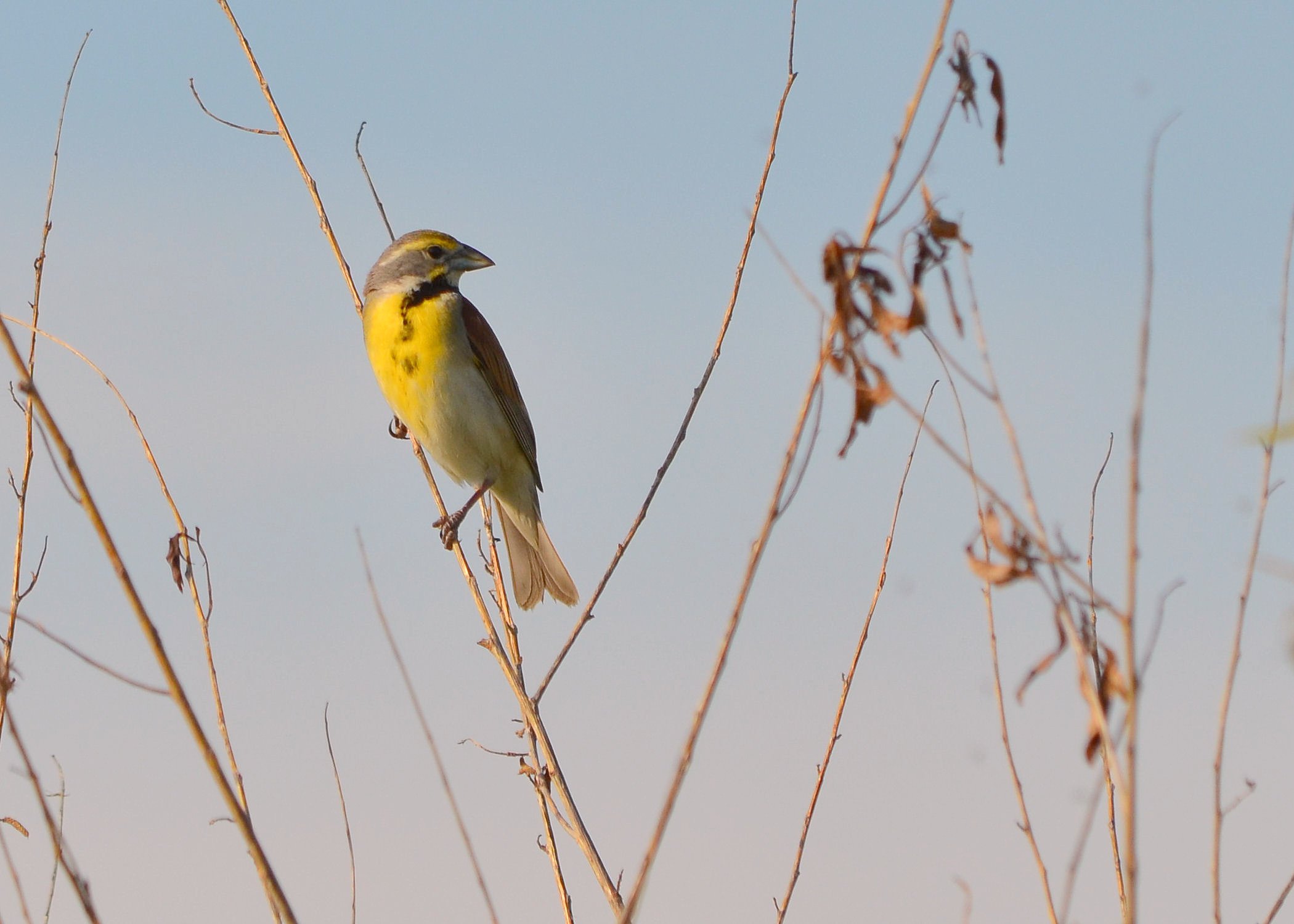
Birds are often named for their call. One infrequent visitor to Owl Acres this summer called his name in the morning chorus. He sang a buzzy “dick dick” followed by “seesle.” We call him a dickcissel. He has several other calls and songs, but this is the one we know him by.
The dickcissel (Spiza americana) is, as his scientific name announces, native to the Americas. Beyond that, scientists have not all agreed on who is closest cousins are. He looks rather like a black-throated bunting, but he isn’t a bunting at all. In the past ornithologist thought he was more like a new world sparrow, or maybe a member of the oriole and blackbird family. and now we think he is more like a cardinal. What is for sure is that he belongs to the Americas.
These native birds are about the size of a house sparrow. They have large, thick bills and short tails. They weigh about an ounce and have a wing span of about 10 inches. Adult males have a yellow face and chest with a black V on the chest. The head is gray and the back and wings are brown with reddish-brown shoulders. Females look like duller versions of the males and don’t have that striking black V on their chest.
Dickcissels are major migrators. They gather in flocks of hundreds to thousands and fly north in the spring as far as southern Canada and northern Central United States. There they disperse to find mates and nesting sites. Their ancestral breeding grounds included the tall grass prairies of the upper Midwest. Today with very little prairie left, they will stake out their territories in fields and pastures, roadsides and fence rows and similar weedy or grassy spaces. There the female will build a nest near the ground, hidden in dense grasses and sedges and lay three to six light blue eggs in the nest. She will feed her nestlings from the abundant smorgasbord of grassland insects and seeds while papa guards the territory.
In September, they will aggregate into huge flocks of thousands of birds and fly south. They may stop along the way on marshes and fields to fuel up, but the goal seems to be the Venezuelan plains where farmers are growing rice, corn, sorghum and other crops. These huge flocks of grain-eating birds land in great profusion on the fields to enjoy the wealth of food right there for the taking.
Venezuelan farmers are not fond of these birds for obvious reasons. Like a plague of locusts, they can strip the field of its grain in short order. For that reason, farmers have tried various strategies to kill them, including spraying the flocks with pesticides at night while they roost. Populations of dickcissels decreased significantly over the past half-century partly as a result of these illegal massacres. Dickcissels do their migrating at night and often fall victim to glass, wind turbines and towers cluttering their traditional migration routes. Habitat loss is another factor. Instead of grassy fields full of insects and seed-bearing grasses and forbs (aka weeds,) they find perfectly clean fields of corn and soybeans, where the insects have succumbed to pesticides, and the weeds have been eradicated with herbicides. So far, they seem to be maintaining a population of 28 million birds worldwide in spite of a 14% decrease in population since the 1970s.
I heard the first dickcissel in June, and the last one so far at the end of August. I’ll keep listening for them into the fall. The habitat for them isn’t ideal on Owl Acres, surrounded as we are by beans and corn fields. but maybe next year a pair will grace us with their songs.
Photo from Wikimedia.org by CheepShot Alt text: Songbird with bright yellow breast and black chest mark clings to a spindly late summer grass. Dickcissel has a stout bill and rakish eyebrow.