When I was growing up in the sixties, my science teacher had us learn the classification system for plants and animals. That is, we learned that there were kingdom, phylum, class, order, family, genus, and species. And we learned that there were two kingdoms—plants and animals. A lot of science and classifying has gone on since I was in junior high, including the recognition that there were not two, but five kingdoms of living things, and maybe even more than that. Fungi used to be considered some weird kind of plant, but now they have their own kingdom. Scientists realized that they’re not plants at all. They’re not animals either. They’re—well—fungi.
Fungi are woven throughout our world. They range from tiny single-celled yeasts to what is thought to be the largest living organism on earth—a huge fungus in Oregon. Called Armillaria ostoyae, it covers 2,385 acres and weighs an estimated 35 thousand tons.
One familiar and ubiquitous grouping of fungi closer to home creates what we know as powdery mildew. Species in the Erysiphaceae family are parasitic, living on nutrients from their host plants. They affect over 10,000 different plants worldwide.
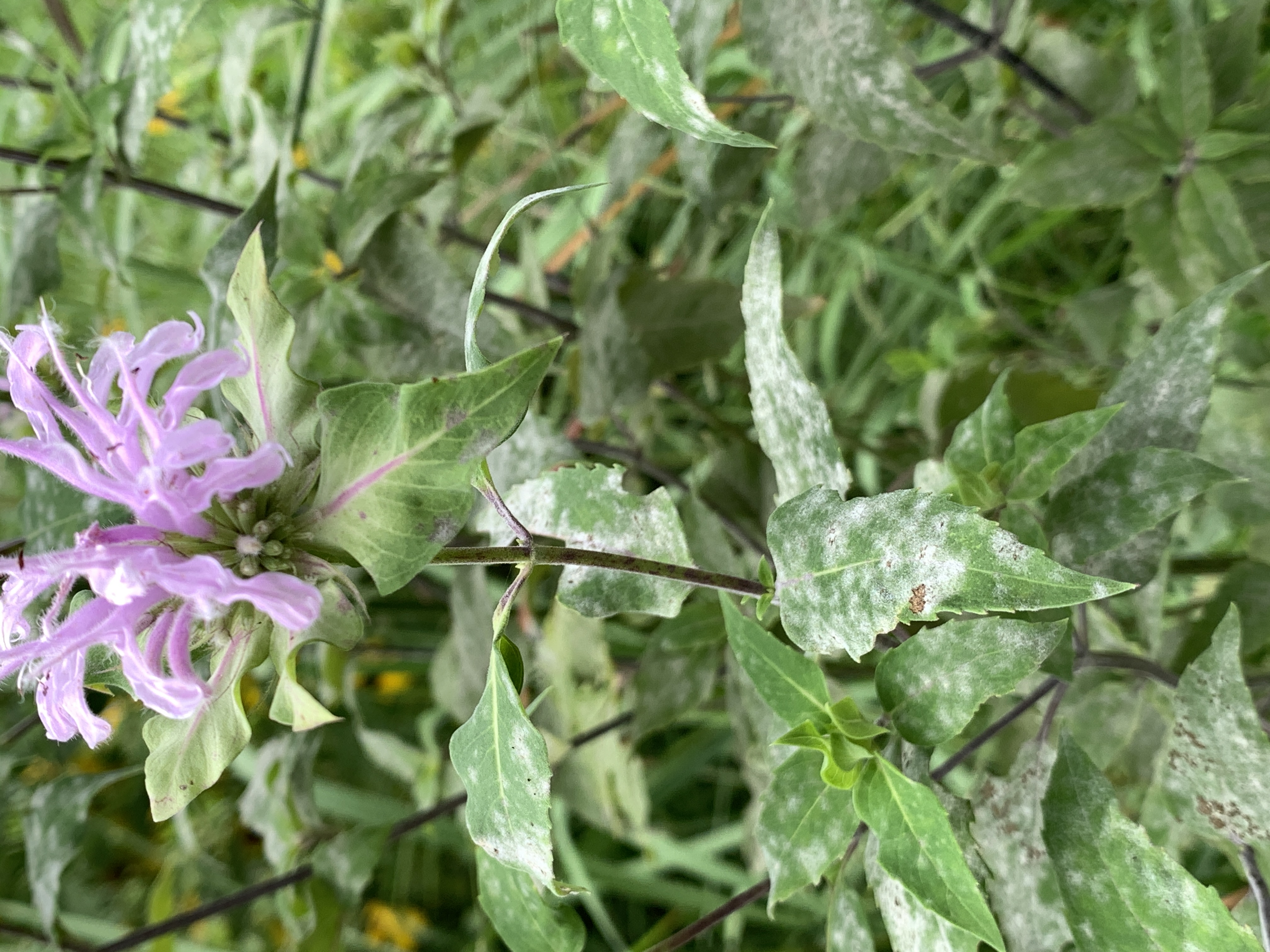
The fungus shows up as powdery white blotches on the leaves of our lilacs, peonies, roses, apple trees, and just about every other flowering plant. Except in very severe cases, the powdery mildew doesn’t kill the plant. It may disfigure the leaves and buds though.
Powdery mildew starts out as a spore carried by the wind. A word about spores here. Spores are a fungus’s answer to the seed. A spore carries the genetic material of the fungus and, like a seed, can start growing a new fungus when conditions are right. One difference between a seed and a spore is that the seed carries food for the baby plant, but the spore doesn’t. Another difference is that seeds are diploid. That is, they have two copies of their genes, like we do. Spores can be either diploid (two sets of genes) or haploid, having only one copy of their genes. The same individual fungus can create both types of spores.
When the spore lands on a likely host, it begins to grow mycelia, which form a collection of tiny connected tubes. The mycelia send out even smaller, threadlike tubes called hyphae. Specialized hyphae form a structure on the surface of the leaf that pierces the outer layers of the leaf and draws nutrients from it.
At first the fungus looks like fuzzy dots of baby powder on a leaf. Over time the patches grow larger, and the dots connect. In the right conditions, the fungus spreads until a mat of fungal hyphae cover the leaf. Powdery mildew thrives best in damp, shady areas where air circulation is minimal. It likes high relative humidity at night and hotter, lower relative humidity during the day. It doesn’t want to be wet though. Iowa summers fit the bill.
Powdery mildews are also particular about which plants they grow on. For instance, the species Microsphaea alni chooses lilac, elm, oak and catalpa but skips the roses and the turf grass.
The fungus has two ways of spreading its spores. First of all, it pushes up long chains of spores which stand vertically on the leaf until some of the spores break off and go flying on the wind. These spores are asexual, and are produced in huge quantities throughout the growing season. The spores, which look like chains of clear white balls under a microscope, make up most of the “powder” you can see.
Meanwhile, the fungus also creates pin-head-sized spheres called cleistothecia. These tiny fruiting bodies contain thousands of diploid spores and will overwinter safely. In the spring, spores will be released when conditions are favorable. With two strategies for reproduction, the fungus has a very good chance of spreading its offspring. Additionally, the mycelium body of the fungus can overwinter in buds of its host plant, giving it a third way to thrive.
We call the presence of these fungi a disease. After all, they disfigure, harm, and in some instances kill, plants that we want to grow. We see powder where there should be only green; disfigured leaves where there should be only perfection. And yet what we are witnessing is a lifeform so different from our own that it’s hard to think of it as anything but disease. Through another lens, though, we might find wonder in this alien-seeming marvel of creation. And, of course, fungi are not alien at all. They’ve been around for millions of years.
Photo by Author. Alt text: White dusty coating of Powdery Mildew on the leaves of Wild Bergamot in the prairie garden. The purple flower head of the host plant is visible at top of frame.
1 comment
Great post! It always a great exercise to re-frame from a different perspective to understand all of life’s possible connections.