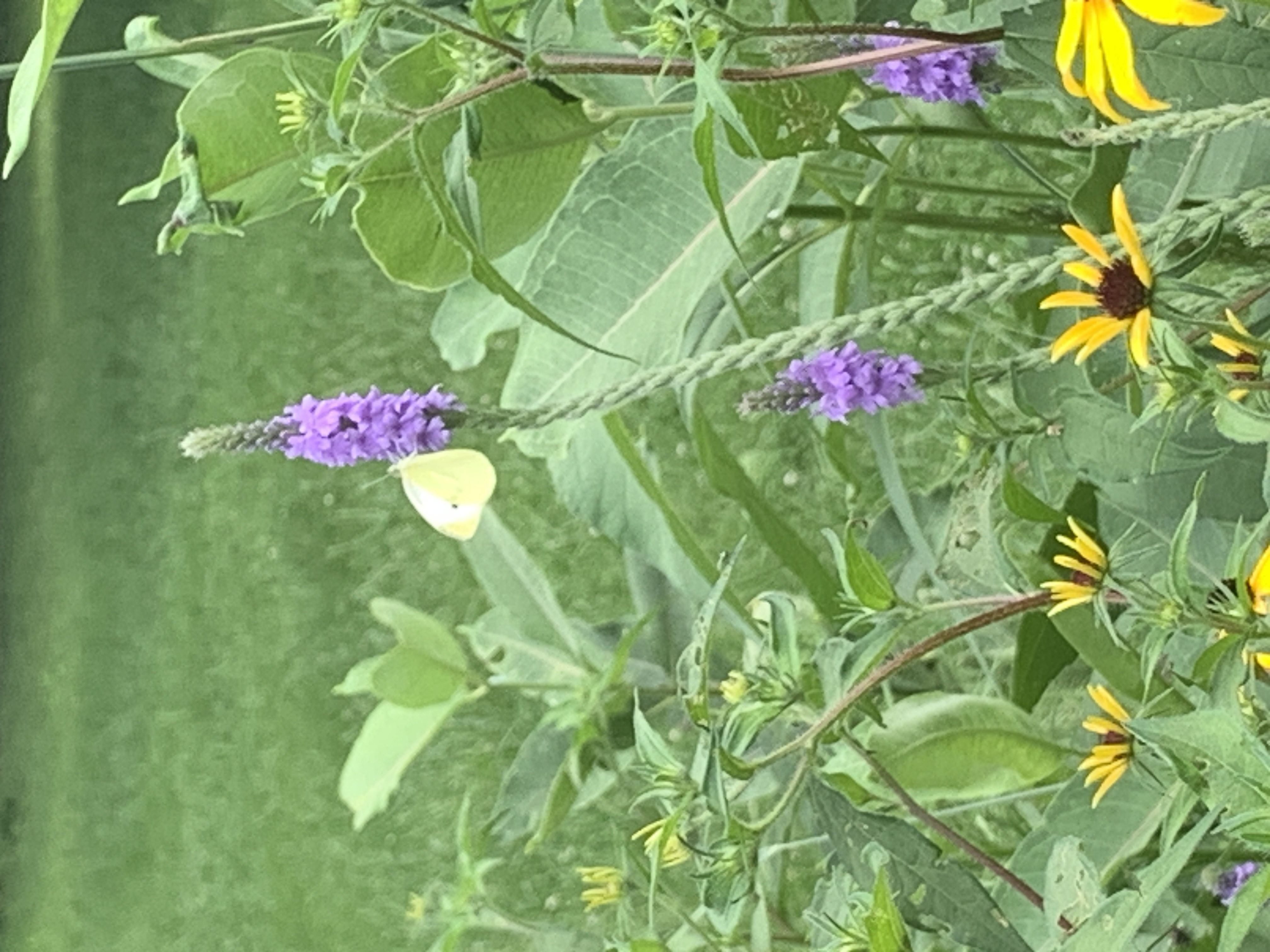
In our prairie garden, little white ballerinas dance their way from flower to flower. They’re only about an inch and a half from wing tip to wing tip, tiny compared to their monarch cousins. They dip and swerve in their aerial dance evading the birds and bigger insects that would have them for dinner. They are cabbage white butterflies, (Pieris rapae). Introduced to the Americas around 1860 from Europe, they are now ubiquitous on Owl Acres and around the world.
These little pollinators prefer flowers that are blue, purple or yellow. The flowers themselves help the butterfly find their nectar. The flowers send out odor chemicals that the butterflies know mean lunch. The odor trail leads the butterflies to the flowers. The design of the flower also helps draw them in. In some of these flowers, ultraviolet light is reflected at the ends of the petals and absorbed in the center of the flower. Because these little butterflies can see ultraviolet colors, this coloring creates a bull’s eye—a bright circle with a dark center–for the butterflies to target. When they zero in on the flower, they uncoil their long feeding tube, then land on the flower and go right for the nectar.
Nectar is all well and good if you’re a butterfly, but these little guys need more than that. Nectar is basically sugar-water. It doesn’t come with certain salts and other nutrients that these butterflies need for successful breeding. So the males go hunting for them in the mud in a behavior aptly called puddling. They gather at the edge of a puddle or other wet spot and suck up water, salts and other necessities. They will share these provisions with their mates via the mating process when the time comes.
That time comes soon, because the adult cabbage white butterfly only lives for about three weeks. The males go patrolling, and mate with females about a week after they emerge as adults. Then the female uses her sense of smell to find plants like cabbages in the mustard family. When she finds the right ones, she lays her eggs one at a time on the leaves that will become the caterpillar’s food.
Cabbage white adults have creamy-white wings with dark edges. The underside is yellowish with black speckles. Males have a black dot on each forewing, and females have two dots on theirs. Females may also have ultraviolet markings on their wings that males can see.
Beautiful though they may be, they are not a favorite of the gardener. It’s not the adults that cause trouble. It’s the caterpillars. These butterflies are called cabbage whites because their caterpillars, called imported cabbage worms, are particularly fond of plants in the mustard family. They chow down voraciously on cabbage, turnips, kale, horseradish, Brussels sprouts, radish and broccoli in the garden, and wild mustard plants in the ditches and fields. These plants contain mustard oils and make the caterpillars taste bad. The caterpillars are bright green with black dots and yellow markings. This coloring gives them good camouflage as they spend the days eating the leaves off their favorite plants.
Imported cabbage worms have several enemies including two types of wasps and two types of flies that lay their eggs inside the caterpillar. When the eggs hatch, the larvae of the wasps or flies devour the caterpillar from the inside out. This probably seems like justice to the beleaguered gardener. Eventually the wasp or fly larvae kill the caterpillar and hatch into adult wasps or flies. To take advantage of this warfare, humans have introduced at least four of these wasp and fly species in the name of biological controls.
If the caterpillar survives through its five instars, (growth phases), its next step is to make a chrysalis and pupate. It will go in as a fat green worm and come out as a delicate white butterfly. More on that in the next blog post. For now, look at this little butterfly enjoying a spike of blue vervain.
Photo by Author. Alt text: A Cabbage White Butterfly stands on the flower stalk of Blue Vervain in the prairie garden, its triangle-shaped wings held in rest posture like a sail above the animal’s body. The single spot on the forewing identifies this as a male.
3 comments
As someone who has experience with vegetable gardens, these creatures are the devil.
Wait for the rest of the story next week!
Since I am not currently gardening, I enjoy these little guys!