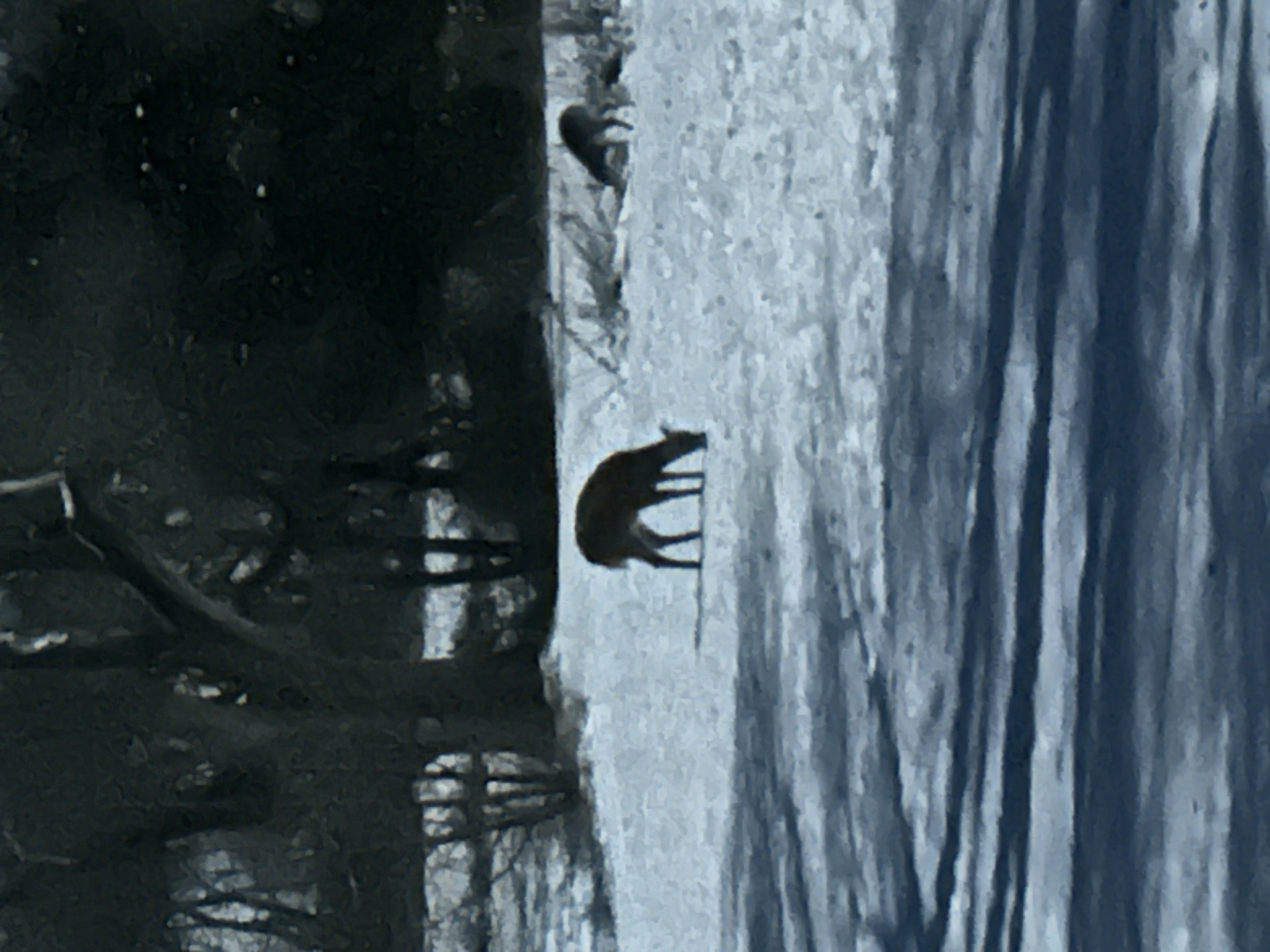
It was about 2:00 a.m. The sky was clear, and the moon shone brightly, reflected by the pure white snow that covered everything. Shadows of the trees lay across the yard, and footprints of passersby advertised their presence. Clancy saw something in the yard and started barking. Bryan went to investigate.
Two white-tailed deer stood, head down, grazing on the frozen grass. He assumed they were does. They didn’t have antlers. If the deer has antlers, it’s a buck. If not, it’s a doe. Only members of the deer family (Cervidae) which includes white-tailed deer, mule deer, caribou, elk and moose, grow antlers.
Antlers grow from two bony, skin-covered nubs between the buck’s ears. These nubs, called pedicels, are present in male fawns as little buttons. When a buck is about ten months old, he will begin to grow his first set of antlers. This growth is triggered by day length and typically begins in March. As the days get longer, the daylight triggers hormones in the buck’s brain to start the process of growing antlers. The first year, the antlers are usually just a spike without branching. As the buck gets older, his rack grows bigger with more and more branching.
Antlers are the fastest growing tissue in any mammal. They may grow as much as an inch a day on a healthy, well-fed bull moose. The result can be as much as 80 pounds worth of antlers. Our white-tailed deer aren’t that ambitious. A mature adult buck will grow from three to nine pounds of antler in a season. As the antlers grow, the muscles in the buck’s neck also increase in order to compensate for the extra weight. During the growing season, antlers are covered in velvet–skin rich in nerves and blood vessels. They are very soft and sensitive to touch during this time, and bucks try to avoid any impacts. By fall, though, as the day length shortens, they are done growing their antlers and begin to shed the velvet. They rub their antlers and their faces on tree branches, leaving pheromones that say “I am a buck, and I was here.” By late fall, the velvet is gone. The antlers harden and take on a polished patina. Antlers are actually a form of bone with an interior honeycomb structure. After the velvet is gone, there are no blood vessels or nerves in the antlers—just the polished bone. During the mating season, the bucks use their antlers to discourage or fight off rival bucks. This often takes the form of a shoving match. Sometimes, the antlers get locked together. When that happens, if they can’t disengage, both bucks are doomed. Normally, though, they can pull away and continue fighting. By January, the support for the antlers where they connect with the pedicels has weakened to the point that the antlers will fall off completely.
These “sheds” are prized as dog toys. Dave and Clancy have a nice one which they tend to leave in the middle of the floor for late night entertainment. Most of the shed antlers, though, are eaten by rodents. Antlers are about 80% protein and 20% calcium and phosphorus, nutrients needed by critters who are constantly growing their teeth.

Clancy carries a shed white tail antler, a favored toy. Author photo.
In March, when the days begin to get longer, a buck will start constructing an entirely new set of antlers. This will take about five months to complete, so by September he’ll be ready to shed his velvet and let his antlers harden. Later in the fall he’ll mark his territory and be ready to defend it.
Life can be dangerous for a deer, especially out on the open road. Sometimes the buck will sustain an injury that is not fatal. This injury can affect the growth of his antlers. If the injury affects his right back leg for example, the antler on the left side will become deformed. However, if the injury is to his front leg, the antler on the same side will likely be deformed. If the injury is to his head, the antlers on both sides may be deformed. Theories abound regarding the reason for this. One explanation is that antler development is a costly activity for a deer, and if he has to heal an injury, he will divert resources from the antler growth to spend on healing the injury. Generally, a buck White-tail will grow bigger and better antlers each year until he’s about six and a half. At this point he is at his maximum for antler growth. He may live to be ten, and in extreme cases up to 20 years in the wild, producing antlers each year.
The deer in that surreal, moonlit landscape are definitely does. They live in the woods and fields around Owl Acres. They come out at night to feed on the grasses and other plants in the yard and the prairie garden. There are bucks out there somewhere, getting ready to prove their worth to the ladies so they can mate and pass on their genes.
Feature Photo by Author. Alt text: Two white tail deer browse in the moonlit snow in the front yard. They are juveniles or females and aren’t wearing antlers.