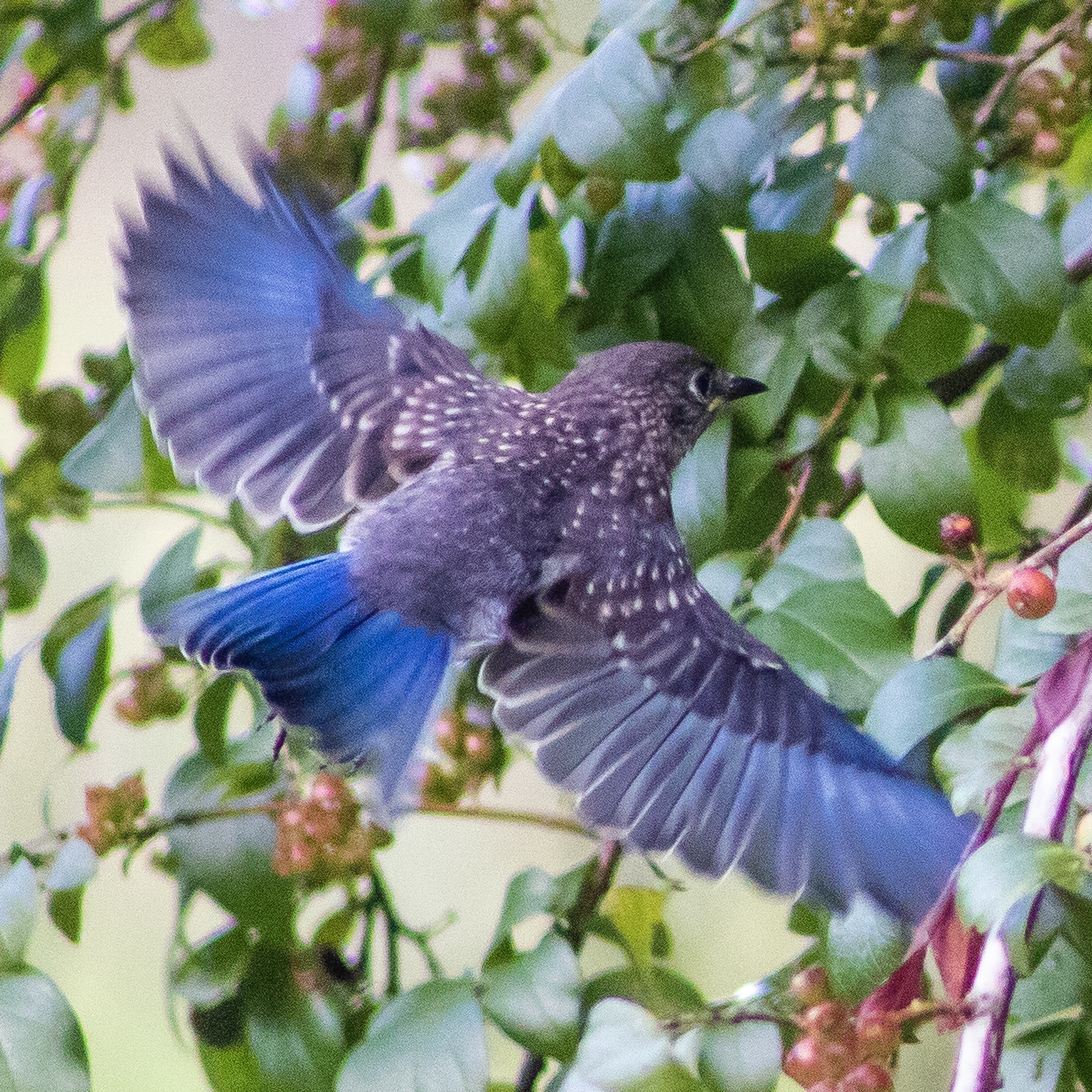
One day in late September, I heard a bird that was new to my soundscape. Its song reminded me of a scolding chatter followed by an upward-trending whistle. It’s not mating season, so this call undoubtedly meant something else. It was an Eastern bluebird on migration to somewhere warmer. It stayed for a day or so on Owl Acres, then disappeared from the soundscape.
The Eastern bluebird, (Sialia sialis) is a striking species in the thrush family. They are small and plump, with a straight bill and brilliant coloring. The males are bright blue on their backs, wings and head. The throat and breast are reddish-brown; the belly and underside of the tail feathers are white. The female has similar but, as usual, duller coloring. Both sexes have rounded wings and notched, square-tipped tails.
Eastern bluebirds are native to North America and can be found from Canada to Nicaragua. A population of Eastern bluebirds also lives on Bermuda. These birds are isolated from the mainland and have evolved separately with notably brighter coloring. How the birds got to Bermuda is uncertain. Very likely, though, they were introduced by early settlers in the 1600s. Early settlers apparently liked to have their familiar birds to keep them company. They also introduced the Northern cardinal to Bermuda.
Unlike some species, like robins, that all migrate more or less on a schedule, Eastern bluebirds have several approaches to migration depending on circumstances. There’s the long-distance migration from Canada to Mexico and Nicaragua. They gather in flocks and head south in October and November. Come February, they head back north, flying in flocks in the daytime. I’m guessing that our visitor was one of these long-distance migrants.
Eastern bluebirds that live in the south don’t need to migrate. They stay at home year-round. Yet another strategy they employ is to stay put on their home grounds unless the weather turns cold or food resources decline. Then, they’ll undertake a short-distance migration. They’ll fly as far as they need to to avoid the adverse conditions, and then return to their home grounds when adverse conditions ease.
Eastern bluebirds are cavity nesters. They will take over old woodpecker holes several feet above the ground. They also are happy to use manmade nesting boxes. During the first half of the twentieth century, the population was on the decline. This was largely due to habitat destruction as woodlands and forests were cleared to make room for agricultural fields, and cities grew. Competition for nest sites with the more aggressive, non-native house sparrows and European starlings also took its toll. Since the 1960s, bluebird enthusiasts have created bluebird trails by lining roads with nesting boxes that are suitable for bluebirds and purple martens but are too small for European starlings. As a result, the bluebird population has been on the increase in North America. Today an estimated population of 23 million birds brighten our landscape.
During the mating season, the male finds the potential nest site and starts carrying bits of nesting material to the site to impress the female. Once she’s agreed to mate and they’ve agreed on the nesting site, he leaves all the rest of the work of building a cup-shaped nest inside the cavity to the female. It takes her about ten days to get the job done. She builds her nest with twigs, weeds, and grasses, and lines it with softer grasses, feathers and animal hair. Once she’s done, she lays three or four eggs, and incubates them for a couple of weeks. After they hatch, helpless and ugly, she continues to sit on the nest to keep them warm for another week while the chicks grow. The male and sometimes older siblings help the female feed the nestlings, bringing them mostly insects. The family works together to feed the nestlings and, after the nestlings leave the nest, they continue to feed them for another few weeks. A pair may raise a couple of broods throughout the summer before they all join flocks flying south. They can fly up to 17 miles an hour, so this 1300-mile trip will take them a while.
Bluebirds eat mostly insects and, when insects are less plentiful, they eat fruits and berries. They hunt by perching several feet above the ground on a wire or tree branch. When an insect comes by, they dive for it, catch it, sometimes in mid-air, and retreat to the branch or wire with it.
Here on Owl Acres, we don’t have any permanent resident bluebirds. We do have the occasional migrant. We may consider putting up some of these nest boxes to see if we can lure bluebirds to Owl Acres next summer.
Photo from Wikimedia.org by KellyC.5366 Alt text: A small songbird is pictured from behind and above, in flight with wings fully outstretched. Vivid, iridescent blue light shines from every feather. As the bird is in flight, this is an instant shot that can only be captured with a camera, by a committed and patient photographer. Please enjoy this moment with our Eastern Bluebird.