As I am discovering more about the insects on Owl Acres, I’ve learned that insects follow one of two basic lifecycles—either incomplete metamorphosis or complete metamorphosis. The approach that’s easiest to understand is incomplete metamorphosis. This scheme has the egg hatching into a nymph—a miniature version of a cicada or grasshopper. The nymphs grow and shed their hard exoskeleton several times, getting bigger each time. Finally, during the last molt, they emerge as mature adults. Their wings, which have been there all along, have developed completely by this time and they are able to fly.
The other approach, called complete metamorphosis, is more of a mystery. In the 1830s a German scientist was actually jailed for declaring that he could turn a caterpillar into a butterfly. Our cabbage white butterflies undergo this complete metamorphosis.
How this kind of lifecycle developed is still largely a mystery to scientists. Something happened between 280 and 300 million years ago that introduced the first instances of complete metamorphosis. Theories point to specific genes and mutations but no hard evidence exists so far. One thing scientists agree on though is that complete metamorphosis is an incredibly successful way of going about life. In fact, between 40 and 65% of all animals on earth go through complete metamorphosis. That includes bees, ants, wasps, fleas, beetles, moths and butterflies, and even frogs and toads.
Although the question of how complete metamorphosis evolved is still open, there is consensus on why it evolved. The larvae and adults of a species that undergoes complete metamorphosis, like our cabbage white butterfly for instance, occupy two very different places in the ecosystem. The larvae stay put munching on cabbage leaves. The adults fly around drinking nectar and mating. These niches in the ecosystem don’t overlap. Therefore the larvae and adults are not in competition with each other for resources. That means that an ecosystem can support twice as many cabbage white butterflies, resulting in the survival of more of them and of the species itself.
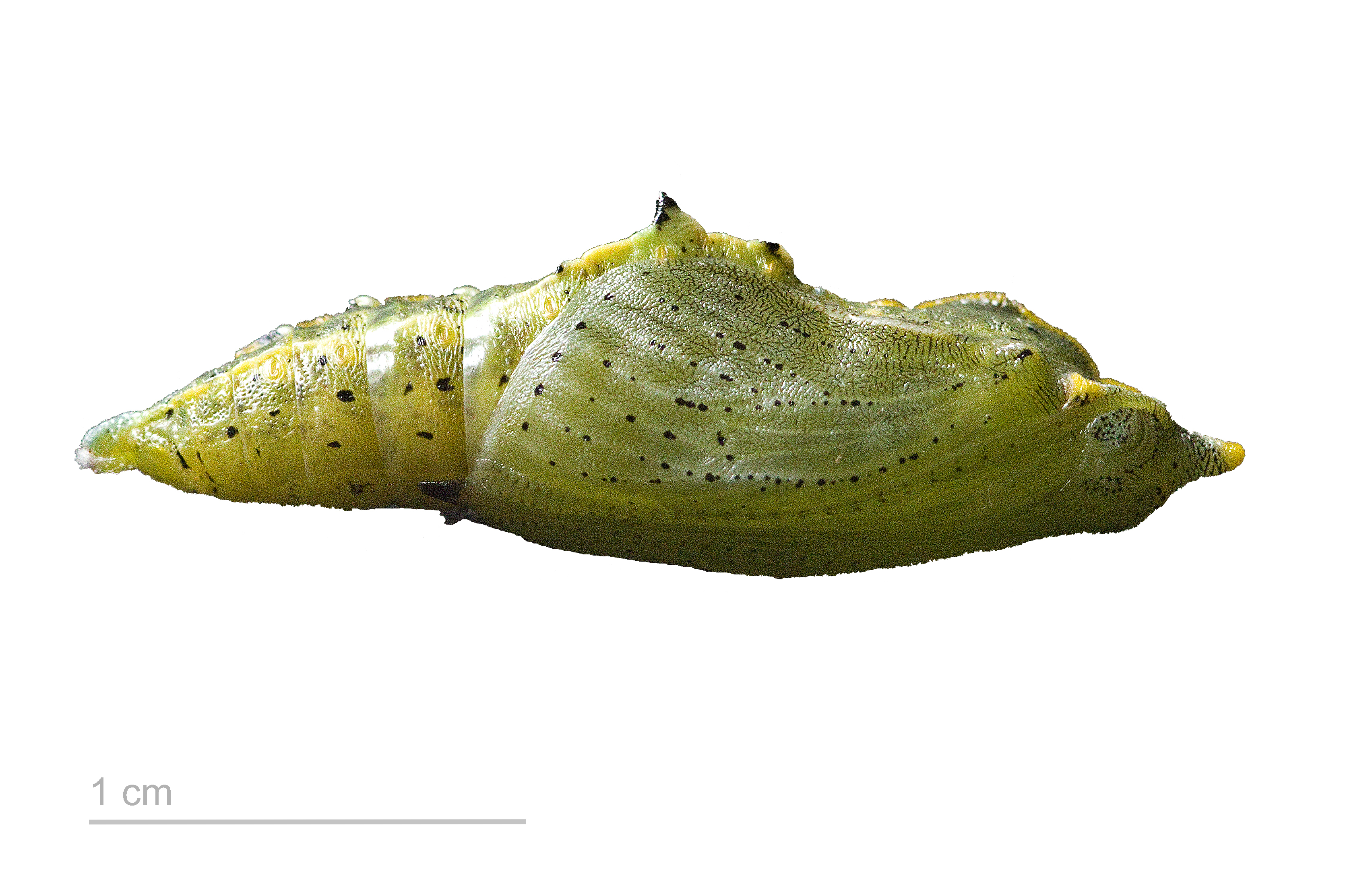
Our cabbage white butterfly starts out as an egg. It hatches into a caterpillar, and after it molts five times, it makes a chrysalis to protect itself during the next phase. , called a pupa. Inside the chrysalis, the pupa transforms itself into the butterfly.
So what’s actually going on inside that chrysalis? It’s biology, but it feels more like a miracle. Generally speaking, during a butterfly’s fifth instar as a caterpillar, it undergoes hormone changes. It stops eating everything in sight and seems a bit disoriented. It finds a leaf it likes and spins a little pad of silk that sticks to the underside of the leaf. Then it turns around and grabs the silk with little hooks on its hind legs and hangs there. In this upside-down position, it molts for the last time. It sheds the outer covering of its cabbage worm body after it separates from the newly formed chrysalis underneath. The chrysalis is an elongated hard greenish shell that’s pointed at each end.
Now, completely encased in that pointy green shell, it begins the process of pupating. For the first three or four days, it puts out enzymes that dissolve all of its muscles and organs. Everything turns into a soup like a culture medium you might use in a lab. This rich culture will provide the energy the cabbage butterfly will need to complete its transformation.
Floating around in this soup are little sacs called imaginal discs. They arise from cells that were created in the embryo but have stayed quiet until now. Now they explode into activity, multiplying cells madly. The next step is to pair them up into the shape of the adult butterfly. There is one imaginal disc for each wing, each leg, each eye, each antenna. These all pair off and line up in the right part of the butterfly-to-be. Next each little bag turns inside out and starts making parts for real. Wings, legs, eyes, antenna, and one-offs like the head, thorax and genitalia, all guided by the butterfly’s genetics. When it’s done, the whole creature, including its nervous system, heart, digestive system, and all its muscles—everything has been completely rebuilt. This process takes a lot of energy, so by the end, the whole chrysalis weighs about half what it did at the start.
It’s a lot more complicated than that, of course, but it’s not magic. Just developmental biology. On the other hand, biology seems pretty magical when you think about it.
Photo from Wikimedia.org by Roger Culos. Alt text: Chrysalis of Cabbage White Butterfly. Green and knobby with black dots, the pupa tapers to a point at each end. It emerges the last time the caterpillar splits its skin.
1 comment
Wow. That’s quite the process, Karen. It’s a marvel of nature. – Joe