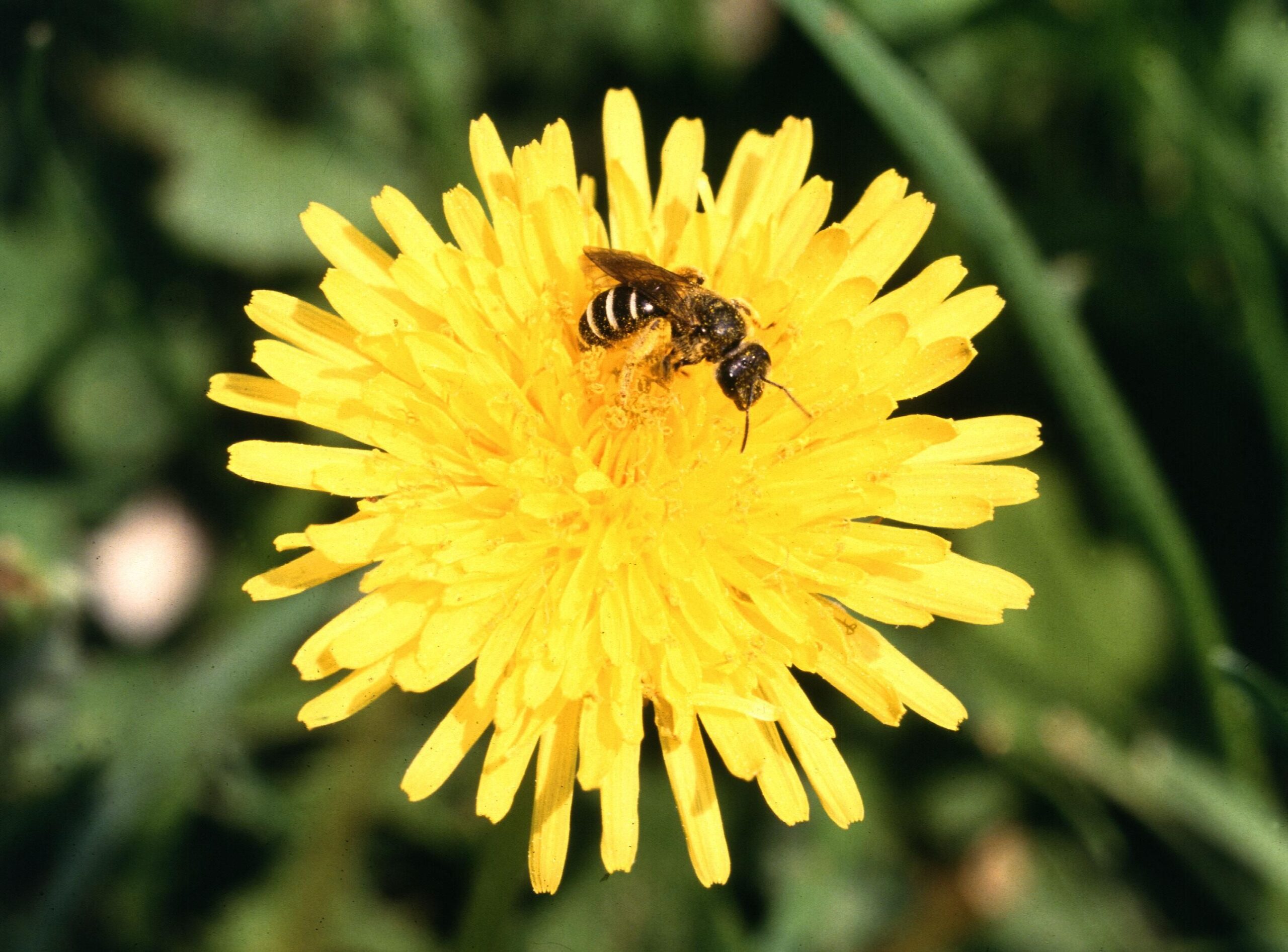
On a hot summer day, I feel something land on the inside of my elbow. My initial reaction is to slap it away. It objects to this treatment, though and promptly stings me. The sting is acutely painful although it fades fairly quickly. I can’t see it to identify it, but the familiar sting tells me that it is a sweat bee, looking for the salts it needs. I read that if I just leave it alone, the little fellow will lap up some of my sweat—and there’s plenty of it today. Then it will leave without stinging me. Letting it sit there on my arm takes more self-discipline than I have today, though, so I get stung instead.
Sweat bees belong to a large family of bees called halictids. The origin of the term halictid is uncertain. It may be derived from the Greek word halizein meaning “to gather” or halēs meaning “assembled.” Or perhaps it comes from the word halite, which is the mineral made into table salt. At any rate, the term sweat bee is unambiguous. They crave human sweat for the salts and minerals it contains.
Over 4,500 species of halictid bees have been classified worldwide, with some 500 species presumed native to North America. Halictids are short-tongued bees. This causes them to frequent shallow blossoms like daisies and sunflowers instead of deeply tubular flowers.
Across the 4,500 species of halictids size, color and social habits cover a very wide range. Some are metallic green—others are brown or black with bands of green on their abdomens. Some are completely solitary, others are nearly as social as honeybees. Some species have evolved along with a specific host flower so that they are very efficient in collecting pollen from that flower. Others are generalists taking what they find out there. They are all important pollinators, spreading the joy in alfalfa fields, apple and cherry orchards, sunflowers and watermelons, along with their native hosts.
Most sweat bees excavate underground nests. The solitary female will mate and then begin building a nest chamber where she stores enough pollen for the next generation to eat and survive through the winter. To collect the pollen, she visits flowers and captures pollen grains on the hairs of her back legs. These hairs form a pollen basket that she uses to carry the pollen back to her nest. When the chamber is sufficiently full, she will lay an egg in it and then seal it up making it waterproof. This female probably won’t last the winter, but she has provisioned her young with food so they will survive.
Unless, that is, a cuckoo bee comes along. This kleptoparasite is a member of the bee world that takes over a sweat bee’s nest, either kills or ejects the original eggs or larva, and replaces them with her own eggs. Her offspring, then, will eat the stored pollen and kill the host’s larvae.
Kleptoparasitic behavior is not restricted to one family or genus or species of bees. In fact, it is fairly common across species. And it’s not only bees. Remember our cowbirds and our yellow-billed cuckoo? They do the same thing, laying their eggs in other birds’ nests. It’s a jungle out there!
Photo from Wikimedia.org by Scott Bauer, U.S. Department of Agriculture. Alt text: Take your pick. A sweat bee on a dandelion. Genus unknown, Species unknown. But go out in your yard right now, and there they’ll all bee.