A small creek known as Cherry Creek runs at the bottom of the hill near Owl Acres. We were surprised recently to see beaver activity at the creek. A beaver had built a dam across the creek, and had gnawed through a large tree near the bank. The creek is fed by drainage tile and is usually only a few inches deep—not a likely location for a beaver to set up housekeeping. And yet there it was.

A dam made of woven sticks spans across a small stream near Owl Acres. Water spills over the dam at the nearby bank. The beaver who built it appears to have moved on. Photo by Author
The beaver planned to fell a tree that it could use in building its dam. It gnawed around and around and around until what was left was just a peg holding the tree together. At some point the tree began to fall and, no doubt, the beaver got out of the way. The tree didn’t fall, though. It got hung up on a neighboring tree and remained partly upright. Undeterred, our beaver found other materials to build its dam, backing up the water in the creek to a suitable depth. We didn’t see the beaver’s lodge. Perhaps it was dug into the soft dirt of the bank. We wondered if this was a young beaver striking out on its own and whether we would have a family of beavers to entertain us at the creek.

A tree has been gnawed around and felled next to Cherry Creek. Much too large for the animal to move, the tree trunk was about 16 inches in diameter and about 50 ft tall before the beaver dropped it. Bark has been stripped for about 2 feet up from the cut. Photo by Author
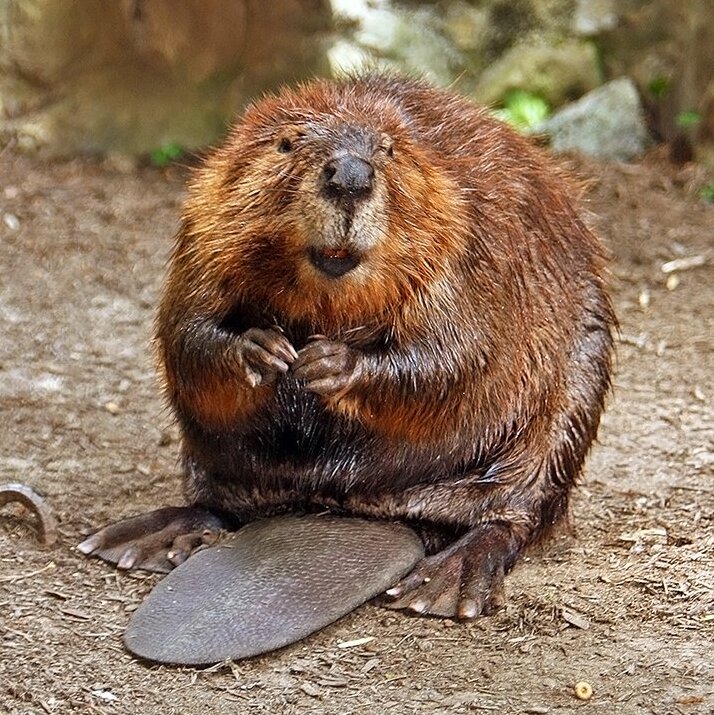
Beavers (Castor canadensis) are the largest rodents in North America. Being rodents, they have large orange teeth that they use for gnawing. They have to gnaw constantly to keep those teeth in shape. If they get too long, the beaver can’t close its mouth to eat, and it can actually starve to death. The tree leaning against its neighbors by the creek may not have worked out for the dam, but certainly provided plenty of gnawing and also bark and soft wood that beavers eat.
It has been widely held that a beaver’s teeth (and other rodents’ teeth as well) are orange because of a high content of iron in the enamel. The iron is definitely there, but new research suggests that it’s not the cause of the coloring. Researchers believe that the orange comes from the teeth’s outer layer which is made up of a matrix of organic material and inorganic minerals.
The beaver gets its scientific name for the castor glands near the base of its tail. Castor is a thick, smelly substance that the beavers use to scent-mark.
A beaver’s coat consists of chestnut-colored coarse guard hairs about 2 inches long, with an amazingly thick undercoat comprising between 12,000 and 23,000 soft, ¾-inch-long hairs per square centimeter. Each hair has a tiny barb that clings to its neighbors, creating a waterproof layer of fur. When they go into the water, the undercoat traps air so they stay warm and dry. Other ways that beavers are adapted for their life under water include nictitating membranes to close their eyes and dense fur in their ears to keep the water out. They use their whiskers to feel currents and underwater environments, and their tails make excellent rudders and paddles. Their hind feet are webbed for swimming, and their front feet are able to hold and carry things. They don’t see very well, so rely on hearing, touch and smell. It amazes me to consider how perfectly adapted they are for an environment that we humans would have no chance of surviving in.
Instead of admiring them, though, humans have hunted them to near extinction for the sake of their fur. Because of those tiny barbs on the undercoat hairs, beaver fur makes good felt for hats. When King Charles I of England was crowned, he is said to have bought 20 beaver tophats, launching the fashion that, by the end of the 17th century, had decimated the beaver population in Europe. North American beavers were then hunted to near extinction in the New World until Queen Victoria and Prince Albert promoted silk to replace beaver in the 19th century.

Cylindrical hat with curving brim made from beaver felt. This is a reproduction beaver hat c.1850 by hatter and cap maker John McMicking of Dundas, Ontario, permanently on exhibit in the Hudson’s Bay Company Museum Collection Gallery, Manitoba Museum, Winnipeg Manitoba. Photo from Wikimedia.org by Syntax max 2.0
Cherry Creek is pretty shallow except where the beaver built its dam of sticks and mud. The dam is about a foot and a half high and has been breached, so there’s no pond for the beaver, and, it appears, no beaver for a pond. They’ve been here, though.
Feature photo from Wikimedia.org by Steve from Washington, DC, USA Alt text: Fat brown rodent with duck-like webbed hind feet and a broad flat tail looks at the camera. American Beaver
1 comment
Such a neat story. How nice to live within and around all of God’s amazing creation. ❤️