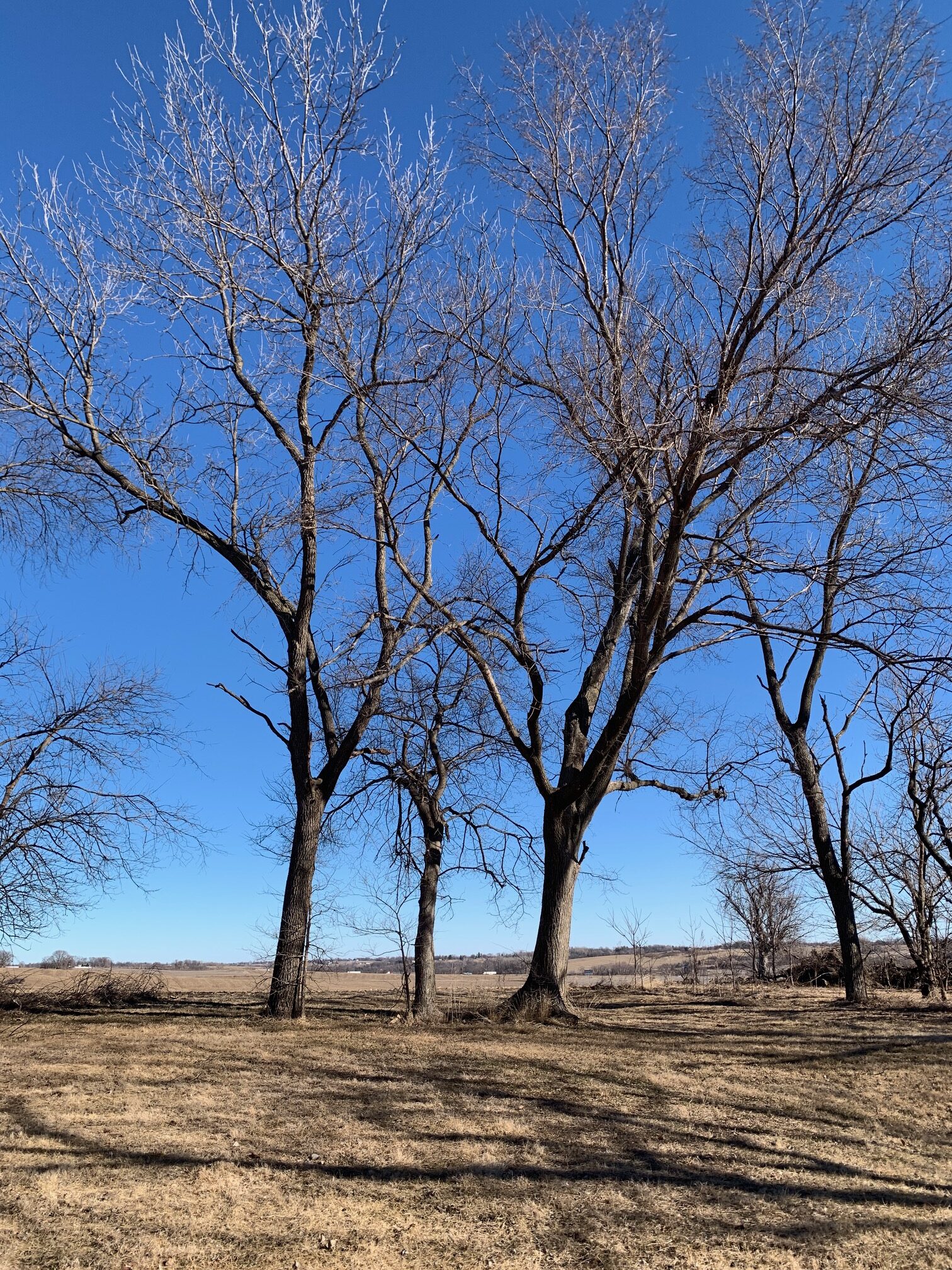
Several American elms stand guard around the perimeter of Owl Acres. They’re part of the mixed-species windbreak that slows the northwest wind on cold winter days.
They’re not the huge old American elms that were once such a part of Americana. Those beautiful old trees were planted along suburban streets, arching over to hold hands with their sisters, creating a cathedral ceiling of shade and tranquility.
The trees on Owl Acres are smaller, and stand shoulder to shoulder with their cousins the Siberian elms. They have escaped the ravages of Dutch elm disease. Perhaps it is the isolation of their location on the prairie, or perhaps they are too young to have been infected in the 1970s when the plague of Dutch elm disease swept the land. Or maybe they’re one of the cultivars that have been bred to be resistant to the elm killer. At any rate, they are growing happily, oblivious of the plague that decimated their forebearers.
In about 1910, Dutch biologists began to notice that their Dutch elm trees were dying. By 1919 they discovered the culprit—a fungus (Ophiostoma ulmi) from East Asia. In 1930, a shipment of elm logs from Europe arrived in the United States, destined for a veneer factory in Ohio. Unbeknownst to the shippers, these logs contained the fungus, and so it began to spread. Meanwhile about the same time, another pest was accidently imported from Europe. Known as the European elm bark beetle (Scolytus multistriatus), it teamed up with the native elm bark beetle (Hylurgopinus rufipes )to help the fungus along. The beetles carry the fungus as they bore into the bark of the elm, opening a convenient pathway for the fungus to invade. The tree tries to fight back against the fungus by shutting off its water transport system to isolate the fungus. This starves the leaves of water, and the tree dies within a couple of years.
Dutch elm disease is not the only enemy of the American elm. Various fungi, viruses, and insects take their turns. But it’s Dutch elm disease that has decimated their population in the past 100 years.
Elm trees are thought to have originated in central Asia as much as 20 million years ago. They co-evolved with the elm fungus that causes Dutch elm disease, building resistance to it. Since that time, several species of elm trees have spread throughout the northern hemisphere. The American elm (Ulmus americana) is native to North America and goes by several names, including white elm, water elm, soft elm or Florida elm. It is at home across Canada and the U.S. from the East Coast to the Rockies, and from northern Canada to Texas. Other species of elm native to North America include Slippery elm (U. rubra), Cedar elm (U. crassifolia), Winged elm (U. alata), Rock elm (U. . thomasii), and September elm (U. serotina).
The American elm has been prized for its vase-like shape. The trunk of a mature tree rises 50 feet or more before spreading its branches in a canopy of foliage. A mature tree in good soil can reach 125 feet in height and up to five feet in diameter. Its leaves turn a bright yellow in the fall and tend to decay more rapidly than their neighbors. Early in the spring, elms flower with tiny purple blossoms which contain both male and female parts. They don’t self-pollinate, though. In April or May their winged seeds called samaras drop from the branches and fly on the wind.
The American elm can live for 200 to 300 years, and will begin producing seeds in earnest by the time it’s 40 years old. Its seeds are light and designed to be carried on the breeze, so they spread easily.
The wood of the elm is tough, with interlocking grain that makes it hard to split. It works well though for steam-bending to make hoops, barrel staves, and furniture.
We have some elm planks in storage in the barn. They’ve been there for decades, left over from milling activities in times gone by. We used one small piece to mount the tiles I got in France that display our house number. It hangs on the porch subtly proclaiming two of my passions—travel and home.

Colorful tiles set into a weathered, native elm board form a display of a house number. The board hangs from a chain and wrought-iron hook on a white post in front of barn-red siding. Author photo.
Feature Photo by Author. Alt text: A small group of bare trees stands in the north fence row on a late winter day. The sky is brilliant blue; the rest of the world is drab. The tree on the right is an American Elm, one of less than ten remaining on Owl Acres. On the left is a Black Walnut, in the middle is a Black Cherry and the little weedy trees among the big ones are Hackberries.