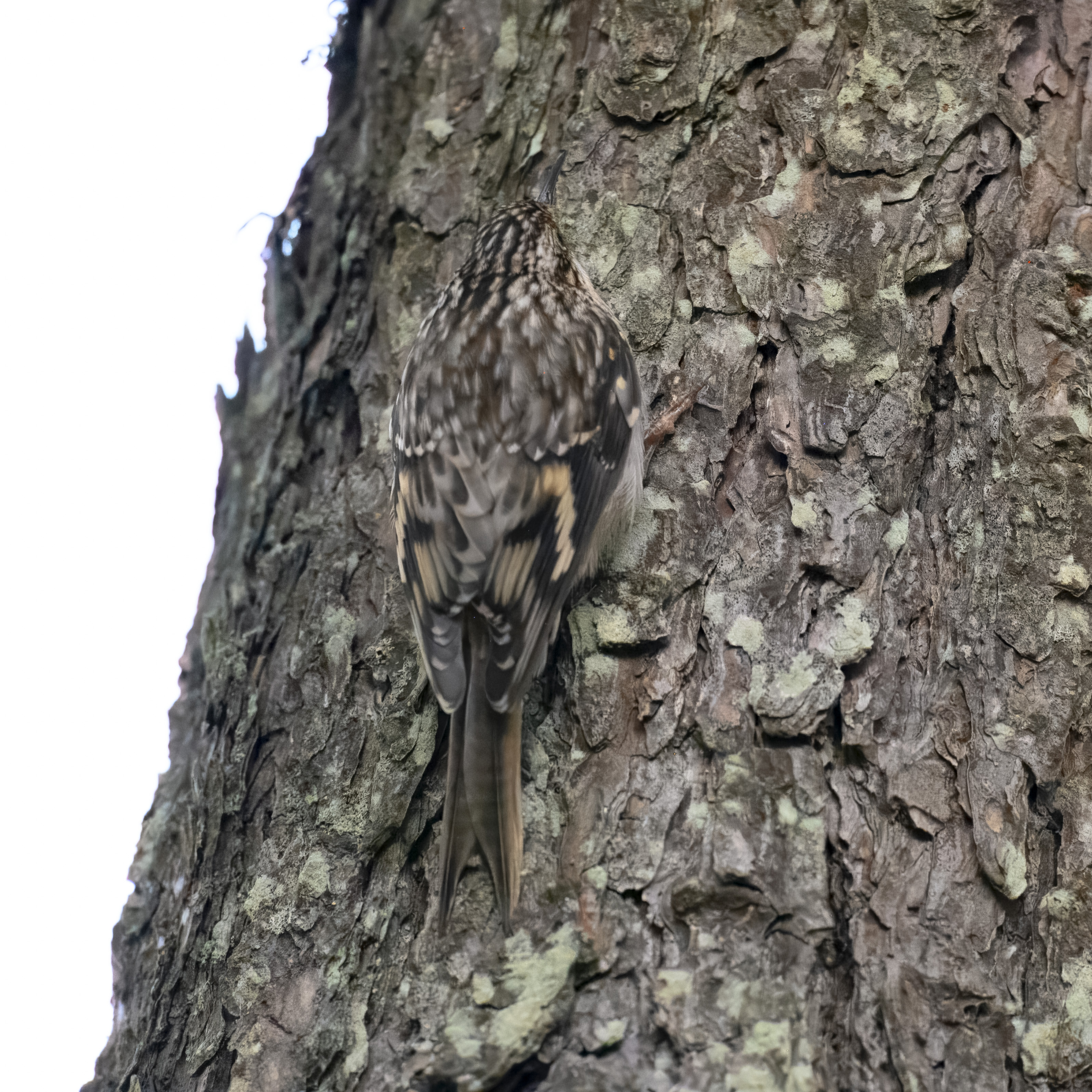
The brown creeper (Certhia americana) is one of the birds that frequent Owl Acres occasionally. Last spring I captured the song of one on my Merlin app. Although I haven’t been monitoring the birds this winter, it is likely that out in the woods, a brown creeper will set up housekeeping.
Camouflage is one of the brown creeper’s main strategies for survival. Its brown coloring with white streaks makes it blend in perfectly with the bark on a tree. And that’s where you’ll find it if you’re lucky. The brown creeper spends its time creeping up a large tree trunk in a spiral pattern. As it goes, it checks out all the cracks and crevices that the woodpeckers have overlooked. Brown creepers prefer to be in wooded areas so that they can creep up one tree and then drop down to start working their way up a tree nearby. They have slender, down-turned bills which give them access to the smallest hidey-holes in the tree bark where insect eggs, spiders, leaf hoppers, ants, scale insects, aphids, caterpillars, pseudoscorpions, stink bugs, weevils, fruit flies, and other tiny insects hide. A wedge-shaped tail acts like a kickstand, helping them balance on the tree while they forage. Although their primary diet is insects, they will eat seeds, suet or peanut butter mixtures in winter. We haven’t seen them at the bird feeder though.
The brown tree creeper is about the size of a sparrow with rounded wings and a wedge-shaped tail. Its back is brown with white streaks, and is somewhat reddish at the base of the tail. Its underside is pure white, and it wears a buff-colored stripe above each eye.

Here’s what a brown creeper looks like when you can actually see it. A tiny bird stands head-up in profile on the side of a tree. Brown and white mottled above and white below with slender, curving bill and tiny, round eye. Inline photo from Wikimedia.org by: Chuck Homler
Brown creepers, also known as American tree creepers, do their foraging on live tree trunks and branches. They particularly like trees with thick bark where insects can hide. For housekeeping, they prefer dead trees with loose bark. They build their hammock-like nests under slabs of loose bark, protecting their eggs from danger. The pair choose the nest site together, and then the female builds the nest in April or May while the male guards it. She lays up to seven eggs and keeps them warm while her mate brings her food. The eggs all hatch at the same time, and the young birds leave the nest after a couple of weeks. Both parents work to keep the nest clean by removing the egg shells and fecal sacs.
Brown creepers nest in the northern forests, and migrate southward to less severe climates like Iowa in winter. Their song is a descending, tinkling warble in the high frequencies.
The chances of seeing a brown creeper aren’t great because of their superb camouflage. When they’re threatened or disturbed, they will flatten themselves against the trunk of the tree and basically hide in plain sight. We’ll listen for them as spring comes to Owl Acres.
Feature photo from Wikimedia.org by: lwolfartist. Alt text: A brown creeper displays its remarkable camouflage as it clings to the flaky bark of a tree. The little bird is almost invisible even in this close-up photo.