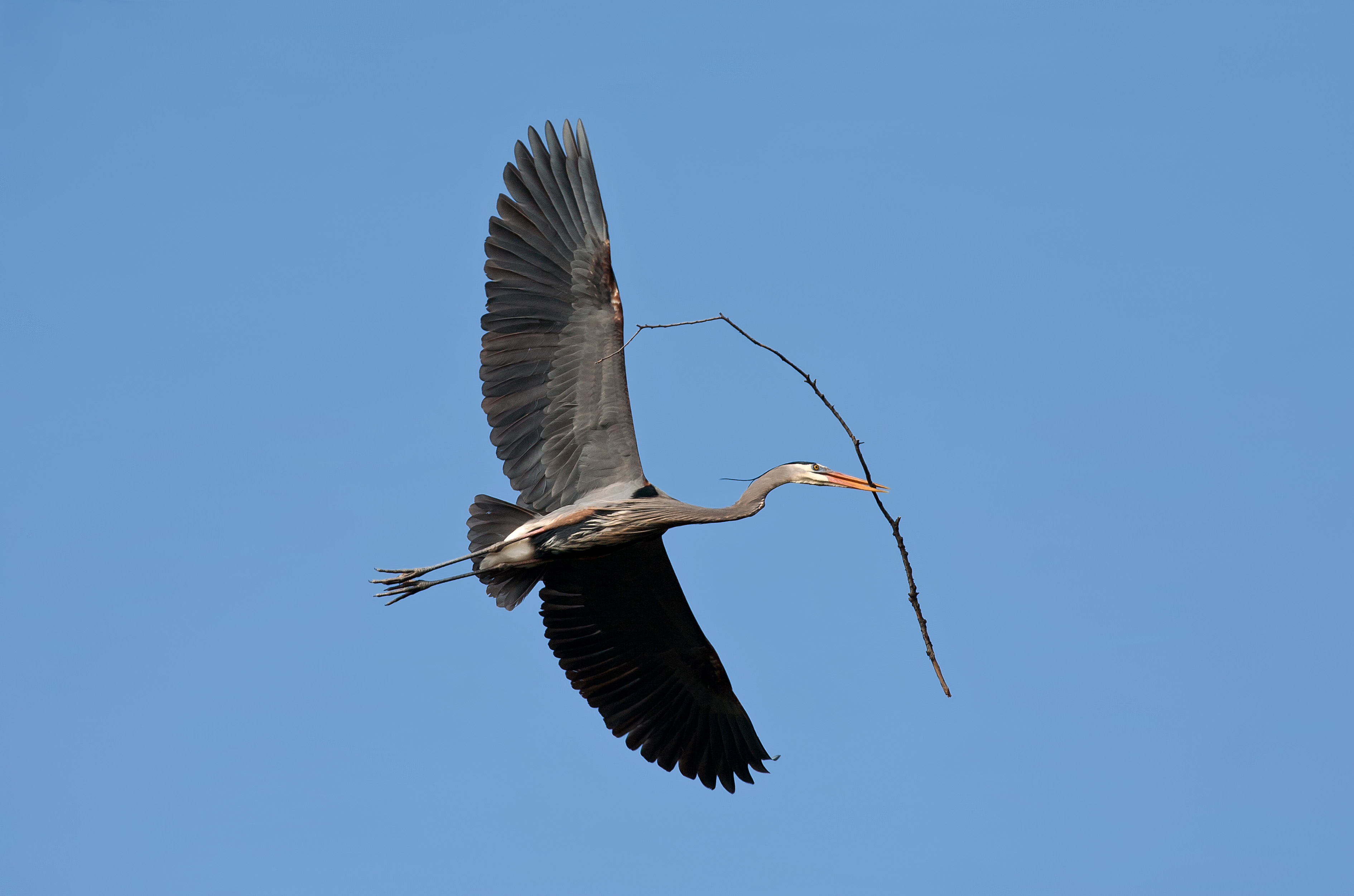
Early of a summer morning, I hear the rather unlovely squawk of a bird flying overhead. It beats its wings slowly as it cruises over the fields. Its legs trail behind as though forgotten, and its neck is scrunched into an S shape against its chest. It sounds like a great blue heron, but I am skeptical. Why would a heron be flying over Owl Acres? We don’t have any water features right here. However, as the crow, or heron, flies the South Skunk River runs about two miles to the southwest of Owl Acres, and the identification was unqualified. So, I’ll count the great blue heron (Ardea Herodias) as a visitor to Owl Acres. They probably nest down by the river. They like to nest in colonies where they are safer from their mortal enemies, the eagles.
Great blue herons have a wingspan of about six feet and from beak to tail measure around four feet. They weigh from five to six pounds. They have very long legs, so when they stand in a river or field, they stand about four feet tall. They have a very long neck as well, and a six-inch-long, sharp, dagger-like yellow beak. Their back and wing feathers are a blue-gray in color. Their heads are white with a black eyeline, and their breasts, wings and heads exhibit shaggy plumes of feathers.
Great blue herons are revered for their patience. A heron will stand perfectly still on a log in a river for hours, head extended, waiting for prey. Riverboat pilots of yesteryear called herons angels, because by watching the herons, pilots could know where submerged logs were and avoid them.
They’re not really just spotting logs, though. They’re fishing. When the right prey comes along, the heron will shoot out its dagger-like beak at 90 miles an hour and spear the prey, then swallow it whole. Their necks are very flexible and are also designed to stretch to accommodate swallowing an entire fish. The placement of the windpipe behind solid vertebrae keeps them from choking as the food goes down. This usually works for them, but occasionally the heron will snag something too big or too spiney and not live to tell the tale.
The combination of the heron’s excessively long legs and long neck allows it to reach quickly down into the water to catch fish while standing still on the riverbed. Herons don’t swim—they walk around, wading up to their bellies in the water.
The long neck also comes into play during courtship. The male and female herons wrap their necks around each other as part of the mating ritual. When they’ve agreed to mate, they bang their beaks together and fluff up their crest feathers. They build a rather sketchy nest of sticks, and she lays three or four light blue eggs the size of chicken eggs. Two months later the chicks will hatch, And it takes another two months or so before they can fly and begin to fend for themselves.
Great blue herons are native to the Americas. In March or April, they migrate to breeding grounds as far north as Canada, flying singly or in groups of ten or so. After they’ve raised this year’s brood, they fly back down to Central or South America for the winter, leaving in August or September. They may make this trip 15 times on average during their lifetime. their lifespan averages 15 years which is much longer than smaller songbirds.
Herons are happy to fish in both fresh water and salt water streams and lakes. Their preferred food is fish, but they will hunt in open fields and grasslands, catching small mammals, turtles, frogs and salamanders when fish aren’t available. They have been known to steal the fish out of decorative coy ponds, much to the irritation of the pond owners.
People used to believe that herons made magic dust. The theory was that the herons feathers created this magic dust, and when they sprinkled the dust onto the water, it made a phosphorescent glow. This would attract the fish to the surface for easy hunting.
It turns out that herons do have feathers on their breast, rump and flanks that disintegrate into powder. They don’t light up the river with it though. Instead, they gather the powder in their beaks, then pull their wing and body feathers through one at a time. And like magic, the powder helps clean off all the grease and slime that comes with eating and sharing their food with hungry chicks.
In the lore of ancient Egypt, Ra, the sun god, is depicted as a huge heron emerging out of the sea, bringing the first light into the world. Scholars believe this was the predecessor of the phoenix of Greek mythology. The heron is depicted on Egyptian artifacts as early as 2,000 B.C.E.
In many cultures, herons are considered the embodiment of wisdom and of patience. I hope we’ll discover more of them.
Photo from Wikimedia.org by PhotoBobil Alt text: Great Blue Heron in flight, viewed from below against a cloudless blue sky. Blue-grey soaring bird with wingspan much longer than its body length. Long slender legs trail behind and neck curved into an “S” shape bears its head with a long, sharp bill. The Heron carries a long twig for nesting material. (Note how many times “long” is used in this description. It’s the right word for this bird.)